NAME OF LAYOUT: Georgia Road Alabama Interstate Division in HO Scale
SCALE: 1:87 (HO Scale with NMRA double stack capable clearances)
TRACK STRUCTURE AND MINIMUM CURVATURE: North American Standard Gauge track and structure guidelines; 40” minimum radius, 30” minimum on industrial and yard
2”centers between parallel tracks minimum in most cases. Main helix linking all levels at 46” Code 100 staging and non visible; Code 83 main and Code 70 for yard and some spurs and sidings. Track and curves can accommodate 86-foot equipment with double stack container clearances with no issue. Trackage is combination of hand laying and flex track with larger number switches on main down to #8 in sidings and some branch trackage. There is a helper grade on modeled section.
APPROXIMATE SIZE: Approximate 45X55 purpose-built building built around pending final layout design
PROTOTYPE INSPIRATION: Modern Southeastern USA Class 1 and regional railroads; Includes 1990s-2020 ICG/IC KCS, CSX and NS in terms of inspired operations, motive power and appearance. Regional inspirations include GWI Southern Division shortlines, MRL, WC, WLE, CC, CMNW, DME and GWWR. Coal operations are loosely based on SECX, USS Cumberland Mine and OW operations of the L&N.
LOCALE: Middle to Upper Alabama, USA between Birmingham, AL and Tuscaloosa, AL in Blue Creek Coal Region with setting of Spring/ Summer 2000s era.
LAYOUT TYPE: Point-to-Point with added continuous loop operation; “around the walls” helix-linked dual deck/mushroom hybrid layout with staging in valence above upper level. Layout does have reversing connections at main helix to allow for continuous operation for display purposes. Center of layout consists of peninsula based configuration with modified mushroom design. Benchwork is cabinet base main level with modular L-girder style 8ft maximum sections with ability to be dismantled without destroying layout scenes. Upper Level is shelf style supported by L shaped Box beam supports that allow for an uncluttered upper back drop. Upper Valence staging is similar. A Library ladder accesses staging.
ERA AND PROTOTYPE: Georgia Road is a modern era prototype freelance concept in HO scale. The area modeled is loosely based on the prototype CSX Brookwood Coal Subdivision (former L&N) operated out of the CSX Birmingham Terminal. Track extends west from Brookwood on ex ICG-GM&O track into outskirts of Tuscaloosa, AL Operations are influenced by similar CSX, NS and KCS prototypes in the region.
OPERATIONS OVERVIEW: The Alabama Interstate Division consists of a combination of terminal/urban/cityscape and countryside/rural mainline railroading typical of NS and CSX class one prototypes in the modeled area. It is a a freelance version of the prototype route of the current CSX Brookwood Subdivision, a former L&N Mineral Belt Division line between Birmingham, AL and Tuscaloosa, AL. The modeled area includes a downtown industrial switching area and main yard at Ensley in western Greater Birmingham running into rural Appalachian foothill country with both double- and single-track main line running. The operation is a Class One heavy mainline known as the Brookwood Subdivision of the Georgia Road Alabama Interstate Railroad Division subsidiary. Principal industry is intermodal, manifest, timber, quarry, grain, coal and automotive OEM traffic. This main line connection also passes through the active Warrior Coalfield, specifically the Blue Creek Coal Seam. There is a helper grade over Flat Top Mountain between Herrin, AL and Bessemer wye. (please see Brookwood Subdivision Below). The line also hosts run through Powder River Coal trains between Wyoming and Alabama and Georgia. The line is also a link between the former IC midwestern part of system and the Deep South including Florida. Cross Border MexXpress Service between Guadalajara, MX and Birmingham, AL are also prevalent.
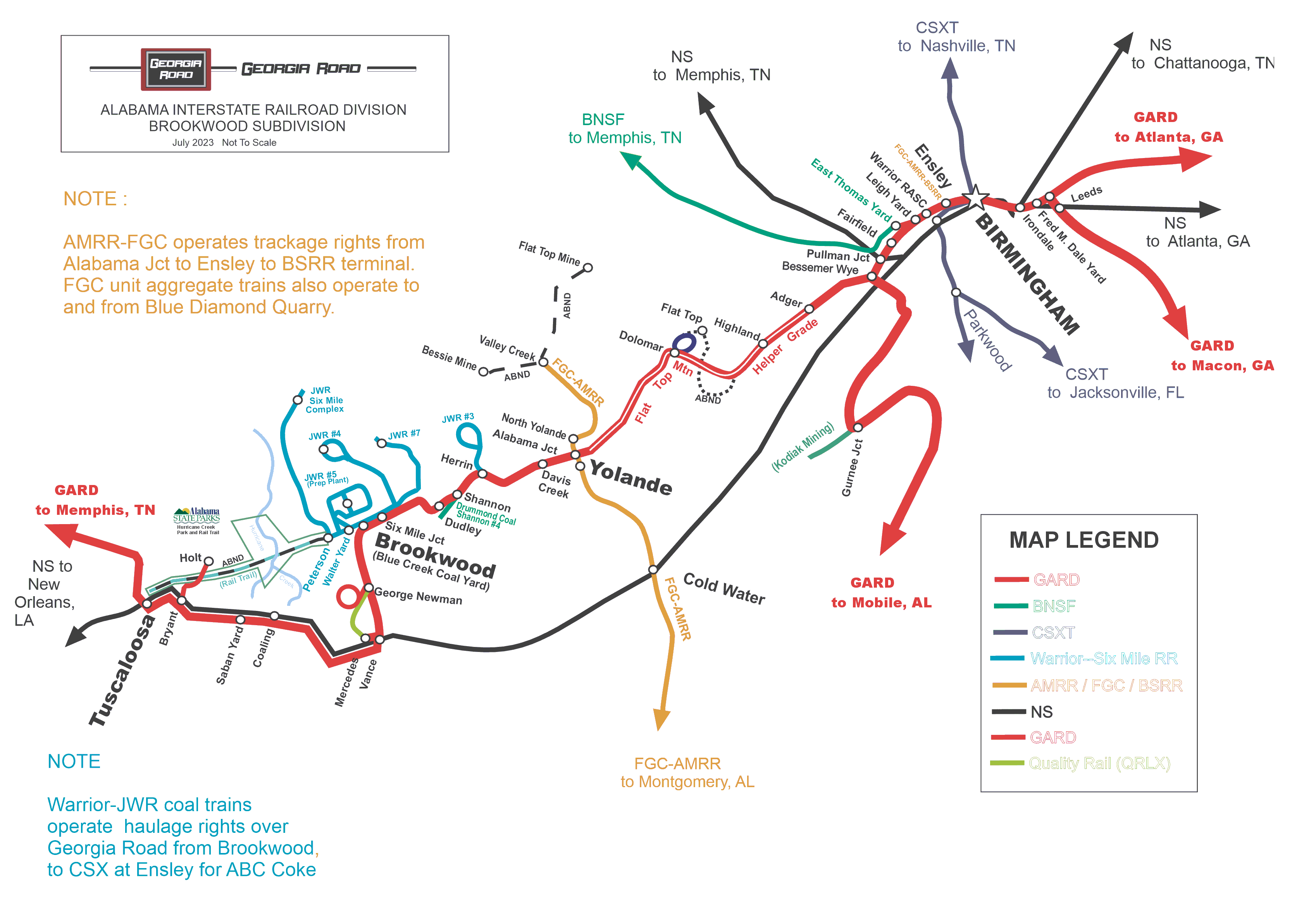
Georgia Road represents a freelanced modern Class One similar in corporate structure to the Family Lines System of the 1980s with subsidiary railroads sharing a “family” paint scheme. Actual modeled trackage begins in Greater Birmingham, AL at Ensley, AL at the Georgia Road Leigh Yard. This brand new yard was constructed as a local/marshalling point built from the remains of the old Southern Railway Finley Yard location, all but abandoned in the 1990s. Leigh Yard is not the primary or largest yard of Georgia Road in Birmingham, AL. It actually acts as a feeder and interchange point for the larger The Fred M Dale Classification Yard sitting on the east side of Birmingham in Irondale. Dale Yard comprises the former NS Norris Yard which was purchased by Georgia Road and renamed in the early 2000s after NS deemed the yard surplus. The renamed Dale Yard became the primary classification point, main locomotive service location and train dispatch point for the Alabama Interstate Division. This massive hump yard and adjoining intermodal ramp are not modeled but are represented by eastern side staging.
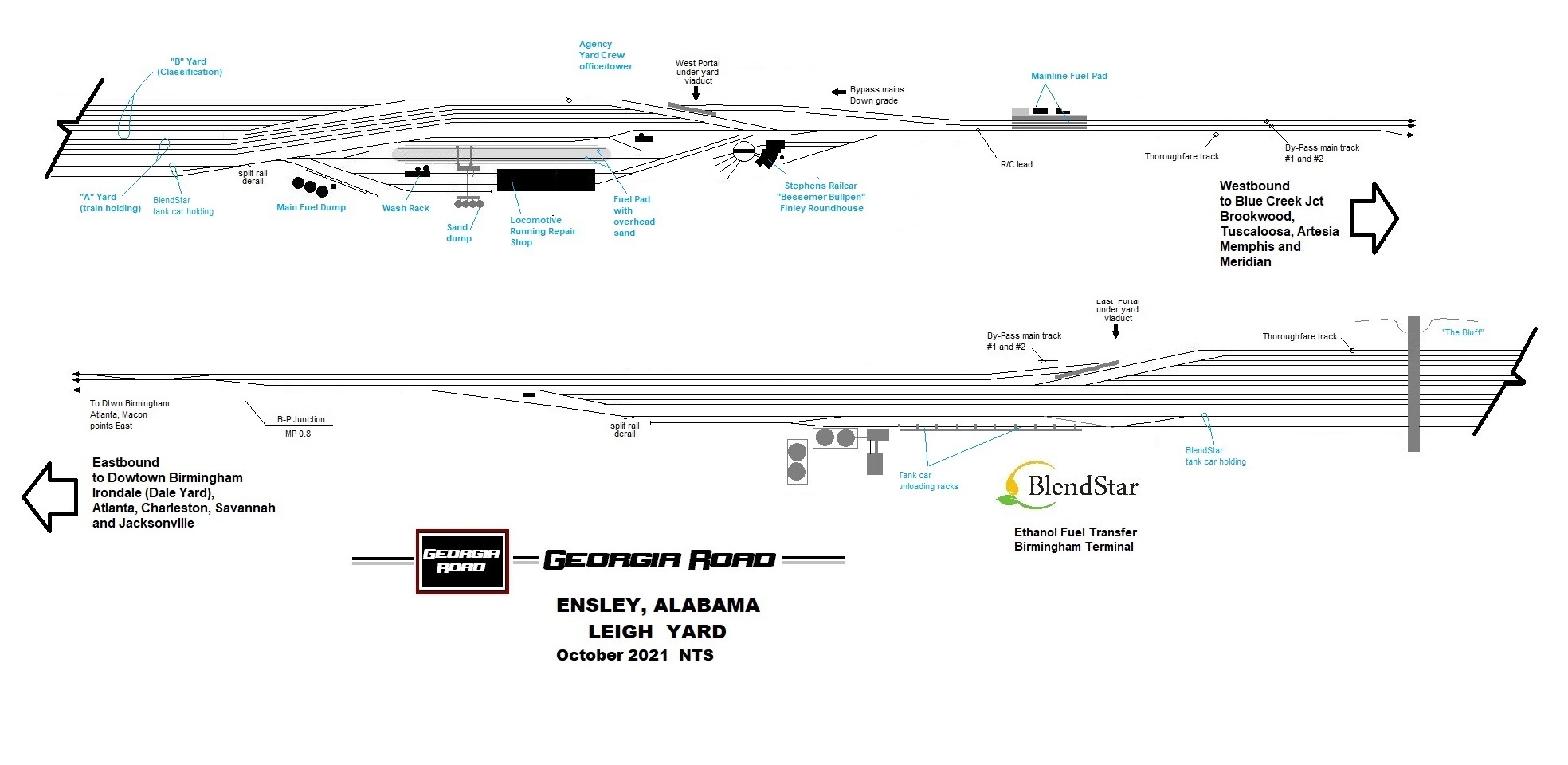
Leigh Yard is a recent (mid 2000s) purpose built to handle local traffic on the west side of Birmingham and the Brookwood Division. It is a running service and repair point for power on trains normally bypassing classification at Dale Yard. It also supports foreign-based automotive assembly operations of Mercedes, Toyota, Mazda, KIA and Hyundai and related suppliers in the region at the nearby Warrior RASC Intermodal Terminal. The remote control switching flat yard also acts as a transfer point between other Class One and regional Railroads in greater Birmingham including CSX Transportation, Norfolk Southern, BNSF, Florida & Gulf Coast and several Birmingham switching and shortline railroad operations. Leigh Yard also handles local switching for customers around west Birmingham, including the remains of US Steel Fairfield seamless pipe operations, US Pipe, and ACCIPCO. The yard is the base for the Brookwood Turn road switcher working the mainline non-coal local customers located on the Brookwood Subdivision between Birmingham and Vance, AL (near Tuscaloosa, AL) which comprises the modeled portion of the railroad. This operation is backdropped by over-head intermodal, manifest, grain and unit trains linking the western and eastern sides of the Georgia Road system. Leigh Yard interchanges with the regional Alabama Midland Railroad (AMRR), a Florida & Gulf Coast Railroad (FGC) subsidiary linking Alabama, Georgia and Florida to Class One interchange partners at its own Birmingham Terminal Yard, formerly the Birmingham Southern Railroad Ensley Yard. Blocks of railcars from the FGC operations are blocked for trains that regularly pass through and “block swap” at Leigh Yard without terminating. All general freight traffic is forwarded to Dale Yard across town for classification using regular transfer moves.
As mentioned above, Leigh Yard is a provision and service point for locomotives on some QuickSilver Intermodal, unit grain and coal trains that run through Birmingham. One large segment is the regular Georgia Road Powder River Coal run through trains moving between Wyoming and the Georgia Power Plant Scherer power generation plant near Macon, GA Leigh yard is equipped with a complete modern running repair shop, service tracks and mainline fuel pad for unit and expedited trains. Leigh operates assigned yard jobs, dispatches road locals and sends transfers to connections on a daily basis. Stephens Railcar maintains the restored Finley Roundhouse remnant inside the yard as its Emissions Testing and Research Center, known to locals as “the Bessemer Bullpen”. This location is a locomotive set up, test train assembly and base for the ongoing TGX Program of Stephens Railcar which rebuilds locomotives able to meet current federal emissions regulations. An engineering marvel of Leigh Yard is a bypass double track main that actually runs a tunnel causeway under the midsection of the yard, allowing trains needing fuel and crew changes to remain separated from yard operations. Ethanol producer Green Plains also has a transload facility located at the yard through its BlendStar subsidiary, complete with its own six axle switcher.
The adjoining Warrior RASC Intermodal terminal beside Leigh Yard is used as a mixing and sort point for autorack traffic for area OEM automotive plants, feeding the adjacent Warrior Regional Automotive Service Center (WARRIOR RASC). The RASC is a combination intermodal ramp and autorack loading/sorting specific to the foreign automotive production plants located the Deep South. This terminal is one of two anchor operations of the Ensley Industrial Park which was built on the reclaimed land under the now long closed and removed TCI Ensley Works. The other anchor is the Stephens Railcar John Tyler Locomotive Shops (JTLS)complex. This modern locomotive and rebuilding plant is home to the Stephens Railcar “TGX Program” line of rebuilds. All of these are accessed at the west end of Leigh Yard via Pullman Junction. Pullman Junction was named for the now empty former Trinity owned Pullman Railcar Plant, closed now used as transfer warehouse space. Birmingham Southern trackage pulls off the Georgia Road main running track and headed to the plant located in Bessemer, with a second switch added to access the Ensley Industrial park. As the mainline toward the Brookwood Subdivision runs southwest out of Pullman Junction, it passes the US Steel recently opened a scrap electric furnace. This is a part of the remaining Fairfield Seamless Pipe Works. The mini-mill was built to replace the closed Fairfield BOF Steel Production Works which supplied steel slabs for pipe conversion until it was idled in 2015 and razed in 2017.
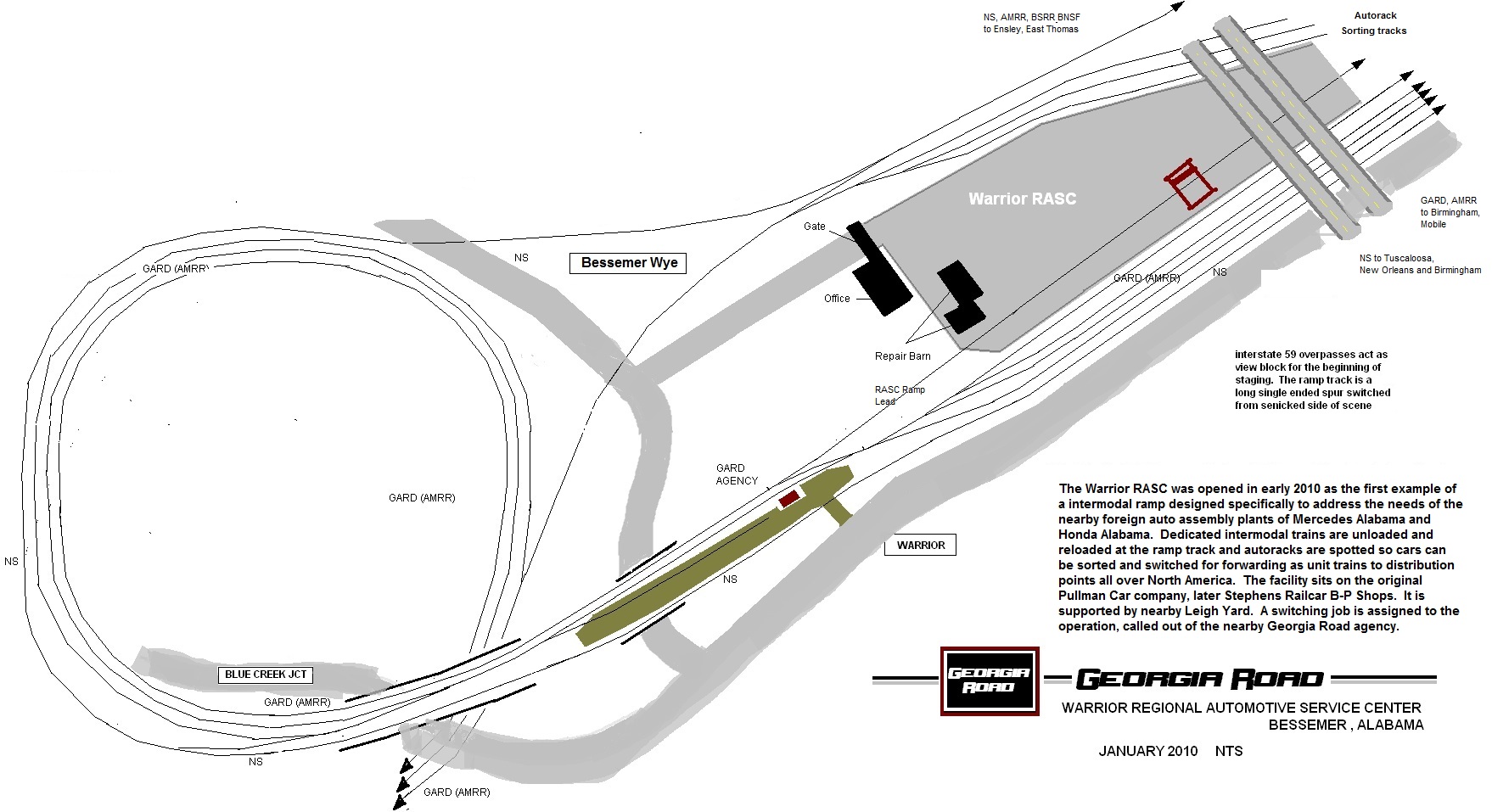
Now completely out of Leigh Yard and headed west, the Georgia Road Brookwood Sub main passes in the shadows of the closed and repurposed former Pullman Standard Railcar Facility at Bessemer Wye. This wye allows Georgia Road, CSX and NS trains to interchange with the large ACCIPCO and US Pipe Foundry operations in Bessemer (staging loop), Leigh Yard in Ensley and the Georgia Road line that eventually turns south to Selma and Mobile (staging loop). The wye gives way to Blue Creek Junction, where Brookwood Subdivision trains bear west off the Mobile main to gain the mainline of the Brookwood Subdivision. This is the end of yard limits and the mainline begins a curvy downhill grade as it leaves the cityscape of the outskirts of Birmingham, AL.
The busy terminal track quickly turns to Appalachian rural countryside once past the Bessemer Wye. The Brookwood mainline is double tracked west out of greater Birmingham, proceeding west toward Adger, AL and tops grade at Highland, AL. From highland it is more reverse curves downgrade, with a compensated eastbound grade of 2.3 percent. This is the east end of the Flat Top Mountain helper district based south of Yolande at Herrin, AL that pushes heavy trains up the grade from Yolande, AL to Adger, AL and provides braking for those headed west between Adger and Yolande on west bound runs. A new alignment and tunnel Between Adger and Dolomar eased the strain of the grade on longer trains by reducing some of the worse curvature around Flat Top Mountain. The addition of an extended second main over the whole helper district including a middle passing siding at Yolande increased capacity and reduced transit times over the mountain. Northbound helper push as far as Highland, where they cut away and wait for a westbound to brake down grade back to the helper station at Herrin, AL
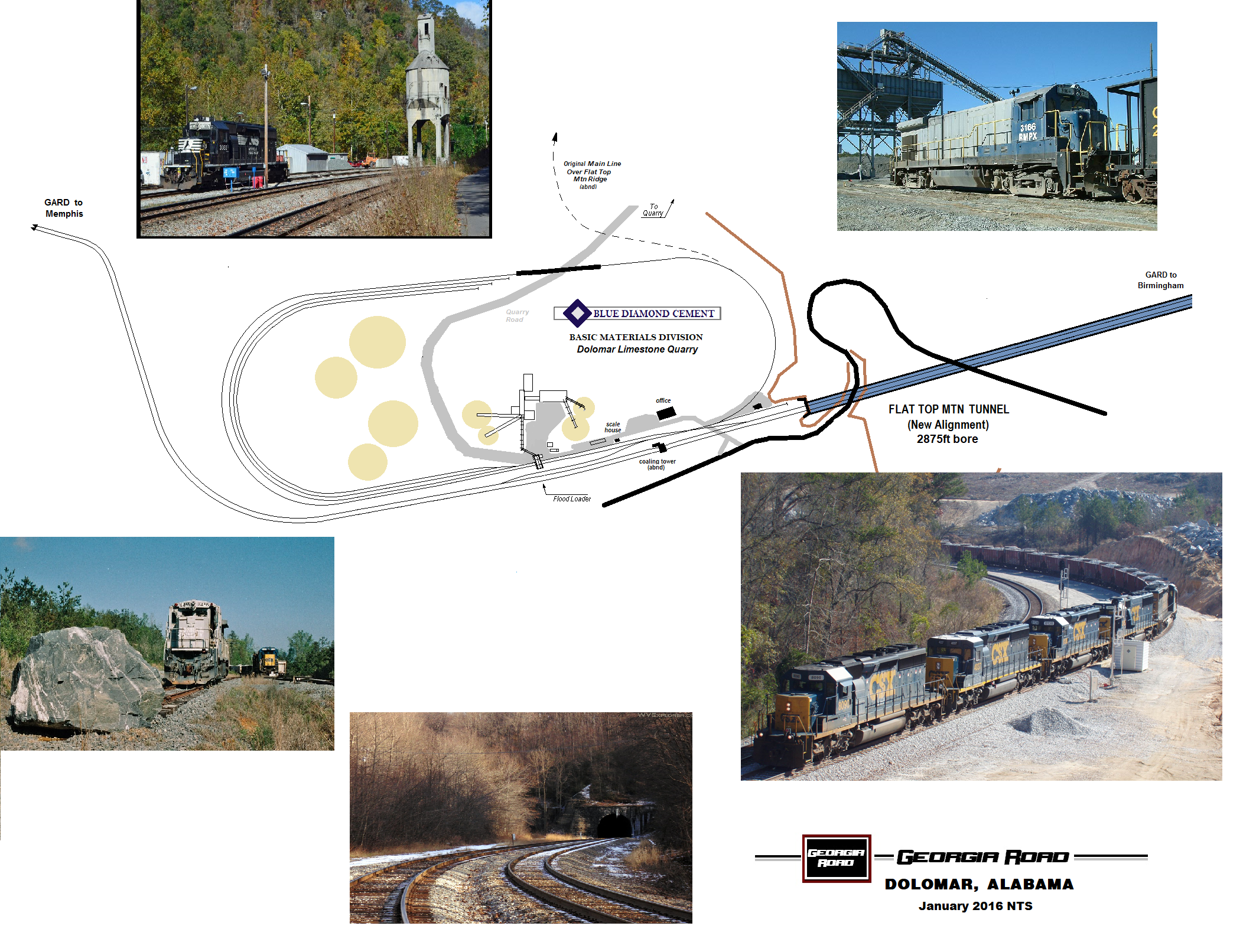
Blue Diamond Aggregates operates a quarry west of the summit of the ruling Flat Top Mountain grade at Dolomar, AL. The Dolomar quarry sits juxtaposed between the long mined out Flat Top Mine and the new Georgia Road main track and tunnel alignment to the south of it. The mine produces limestone for cement mills east of Birmingham at Leeds, AL and loads FGC-AMRR branded “RockTrain” movements bound for Florida. Blue Diamond used some of the original alignment to construct a loop loading track and holding yard. A former L&N concrete coal tower stands guard between the quarry lead and mainline. “RockTrain” and Blue Diamond’s own locomotives tend to congregate under it between assignments, being a favorite location for local railfans to photograph FGC mainline locomotive consists.
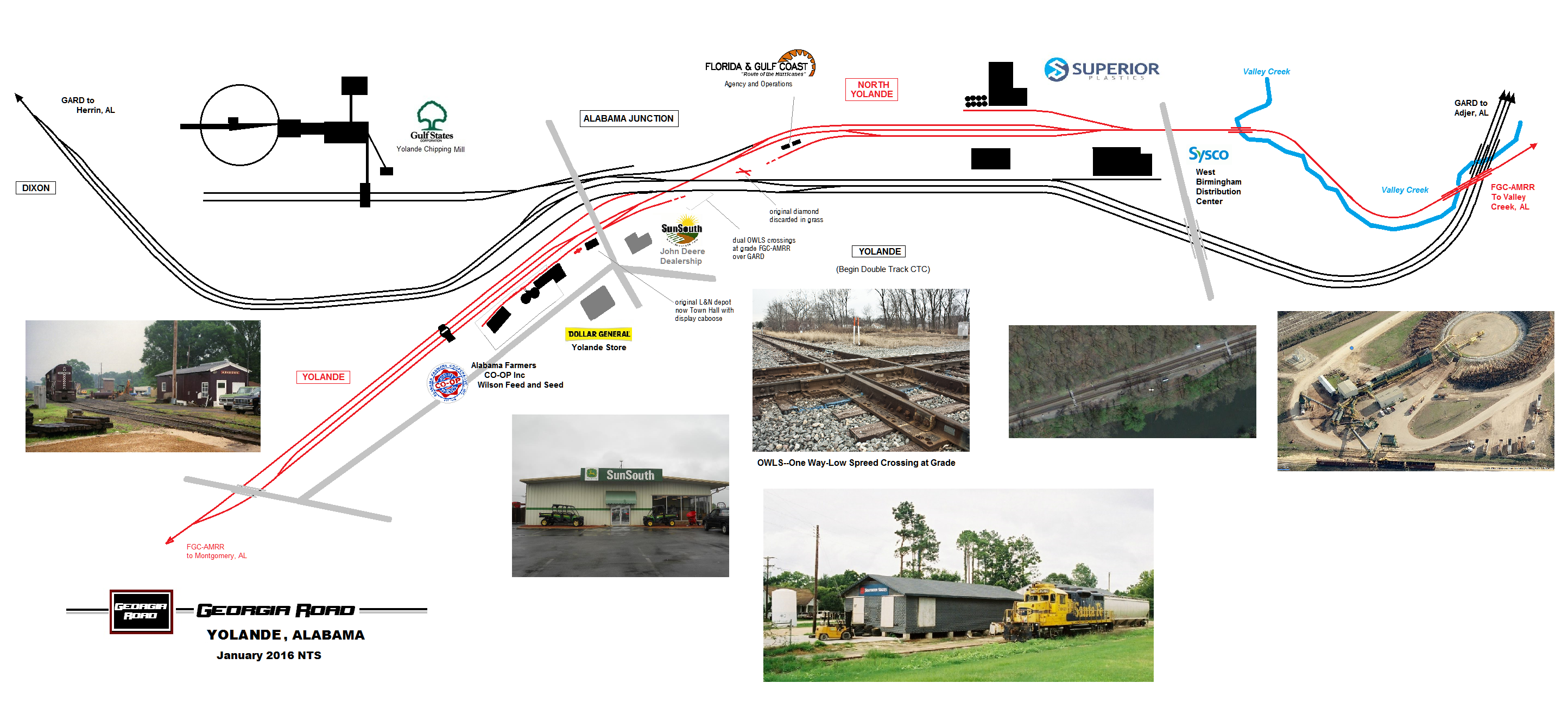
The town of Yolande, AL is the next westbound town after Dolomar and sits at the bottom of the ruling eastbound grade. The small mining hamlet has seen a renaissance of sorts as a bedroom community for Birmingham and industrial location for automotive suppliers in recent years. Southern Chips operates a large chipping plant at Yolande, primarily switched by the Georgia Road. These loaded woodchip car along with those from the DPI Curtis Mill are interchanged between the FGC-AMRR and Georgia Road with FGC carrying its loads south to Montgomery, AL and Georgia Road taking its cut to for eventual movement east to Birmingham, AL and then south to paper mills around Mobile, AL. With the Mercedes Assembly plant and Interstate 59 only a couple of dozen miles to the southwest, cheap land and easy rail access turned the crossroad town into a automotive and warehousing center. A passing siding occupies space between the double track here starting just west of Dolomar at control point Johns and ends at Yolande. This siding allows FGC-AMRR trains to enter the Georgia Road without tying up mainline operations. FGC RockTrain unit aggregate trains hold in the siding coming out of Dolomar for FGC crews who take it south back to FGC-AMRR trackage in the “downtown” area of Yolande. The FGC-AMRR connects from Montgomery, AL up the old GM&O main from Moline, AL where it turns north and crosses the Georgia Road mainline at grade at Yolande. FGC-AMRR sends interchange trains and a pair of intermodals to Birmingham at Yolande using a new connection built south of the OWLS diamond crossing called Alabama Junction by the FGC-AMRR. Inbound FGC-AMRR trains gain trackage rights at Yolande on the Georgia Road eastward to their Birmingham Southern Railroad (BSRR) Ensley Yard, typically called Birmingham Terminal as noted earlier in the overview.
FGC-AMRR maintains a switcher at North Yolande to work industry on the former GM&O Valley Creek Branch north of the Alabama Junction diamond. This branch was historically a GM&O coal branch linking the long-closed Drummond Coal Company Mines of Flat Top and Bessie to the outside world. Only the trunk of the branch still exists, running from the OWLS diamond crossing in Yolande about 20 miles to Valley Creek Junction.
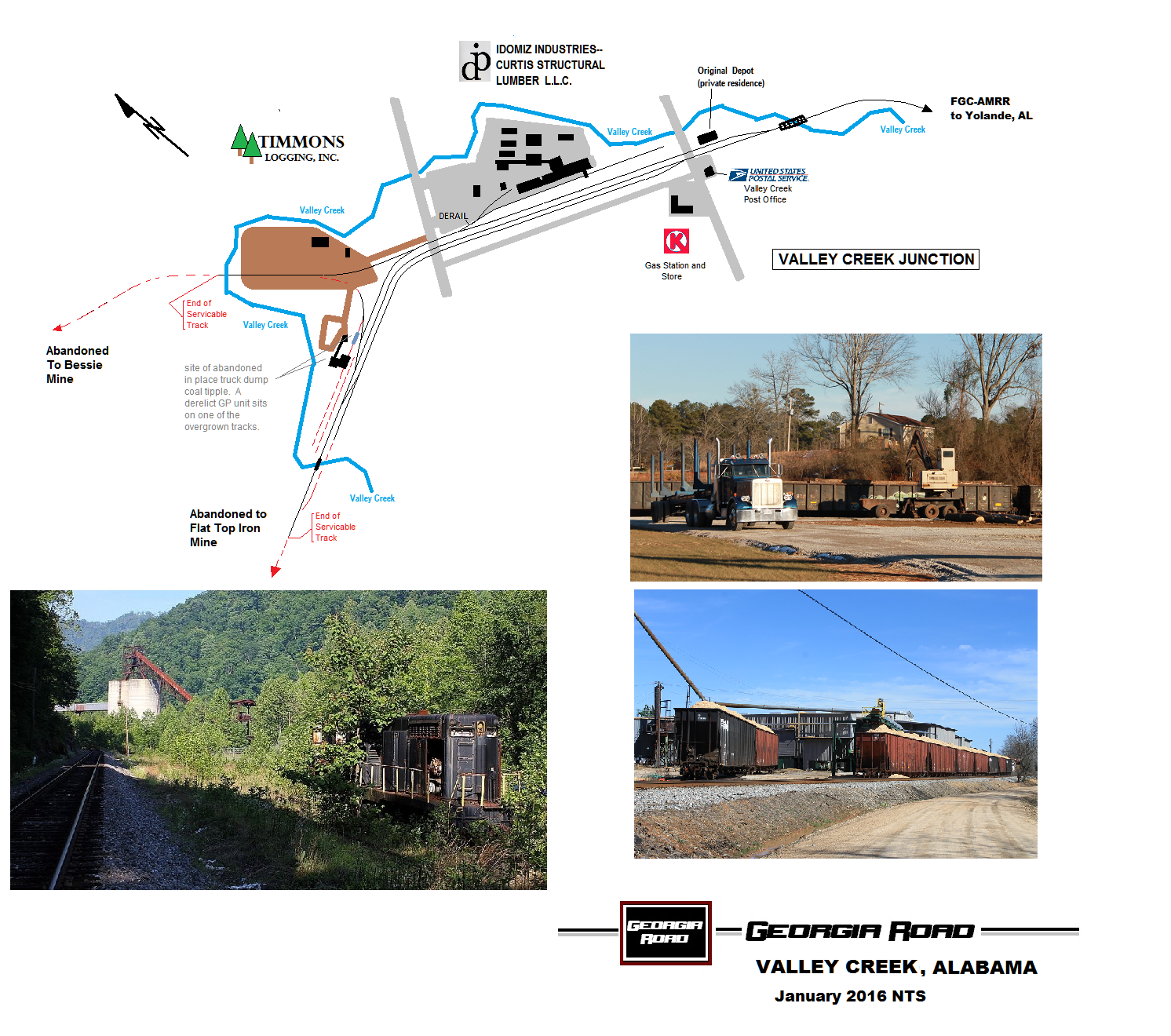
Track and bridges on the FGC-AMRR Valley Creek branch still require light stepping locomotives due to several wood trestles past the crossing at grade in Yolande. The branch has a couple of Mercedes automotive suppliers along with longstanding timber related industry around Yolande and Valley Creek Junction. Southern Chips operates a large chipping plant at Yolande, primarily switched by the Georgia Road. The Brookwood main continues westward from the diamond and FGC-AMRR interchange where the line runs as single track. The old Yolande siding was relegated to storage for area industry and the FGC-GARD cars swapped off the Valley Creek Branch.
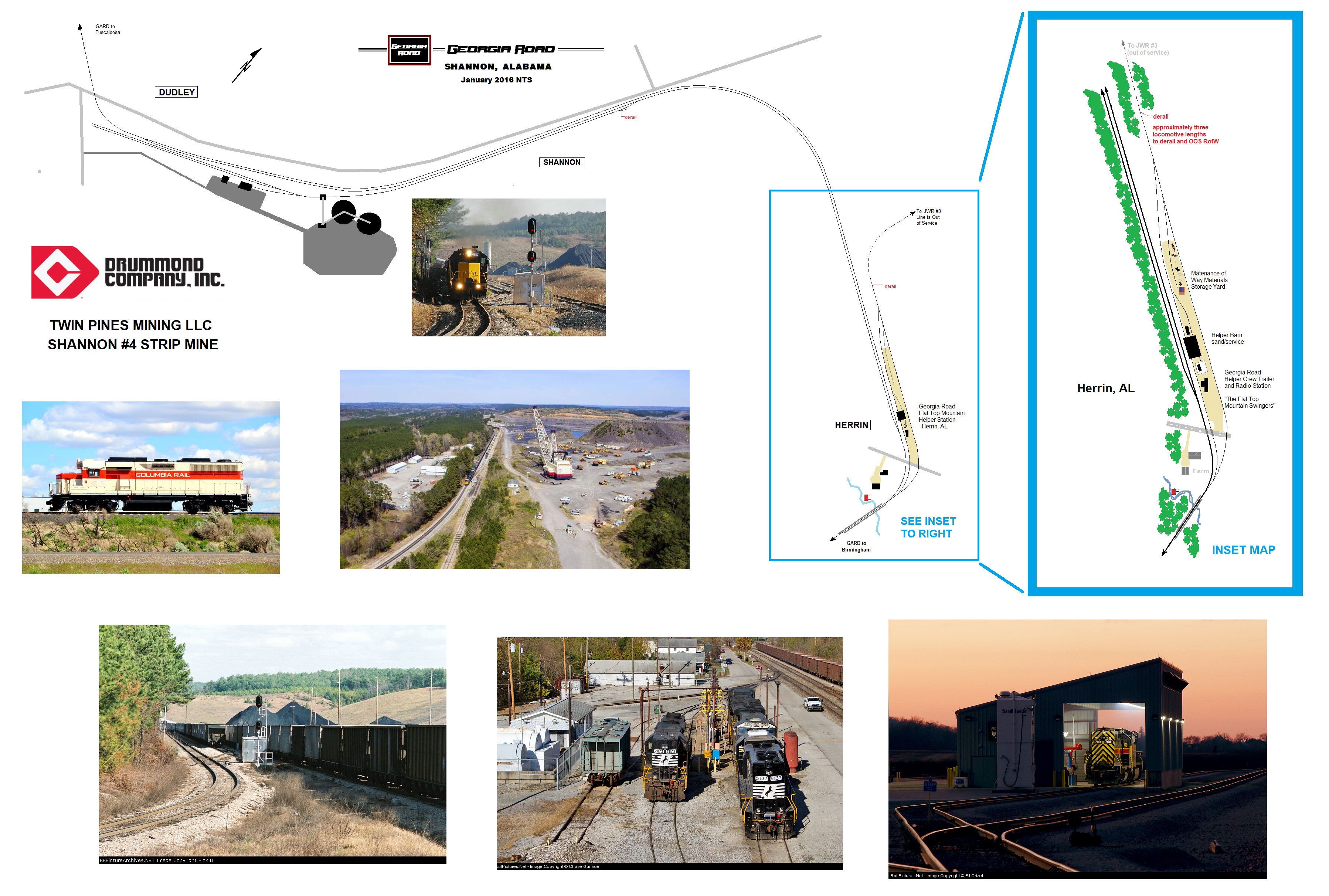
Herrin is the next westbound station. The long deleted whistle stop station name of Herrin was resurrected for not only the helper base located there, but as the east end of the new elongated passing siding originally ending several miles west at Shannon. Herrin sits a dozen miles west of Yolande and is the helper base of the Flat Top Mountain Helpers. This helper pocket uses the remains of the old mine Blue Creek #3 branch junction yard as a place to stage crews, service locomotives and store MofW materials. Helpers actually use the old branch as a switchback to rotate helper power and on rare occasion store idled coal train hoppers cycling to the mine load outs nearby. As many as two sets of helpers work around the clock pushing heavy trains up the eastbound grade toward Birmingham, and supply braking to west bound trains curving down from Birmingham to Dudley where the helper grade ends. The dispatcher and train operations managers typically run trains in blocks so that the helpers push an eastbound up the Flat Top Mountain and after a short wait return on a westbound providing the extra braking. Due to amount of fuel and sand consumed, Georgia Road added a modern fuel and servicing barn in the mid 2000s. This feature keeps crews out of the rain while servicing helper power and to reduce trips into Birmingham for inspections and servicing. The four mile extended the siding runs westward from Herrin to The Drummond Coal Company Twin Pines Mining operation at Shannon. Moving on westward by the junction with the Drummond Coal Company switch at Shannon brings the sidings western end at Dudley. Here the Shannon Mine #4 loadout parallels the main and siding and is overshadowed by the huge Drummond-owned Bucyrus-Erie drag line called “Mr. Tom.”
The Shannon #4 Mine tipple is fed via ground piles brought by off-road mine trucks from the mine face, a couple of miles away. This is the last of the Drummond owned coal seams still working in Alabama or the US for that matter. Georgia Road regularly handles unit trains of metallurgical coal to the McDuffie Coal Dock in Mobile, AL. from this loader or supplies coal to Drummond subsidiary ABC Coke in Tarrant City (Birmingham, AL). A former Alaska RR GP49 in Drummond Coal Company colors works empty cuts of coal cars under the loadout.
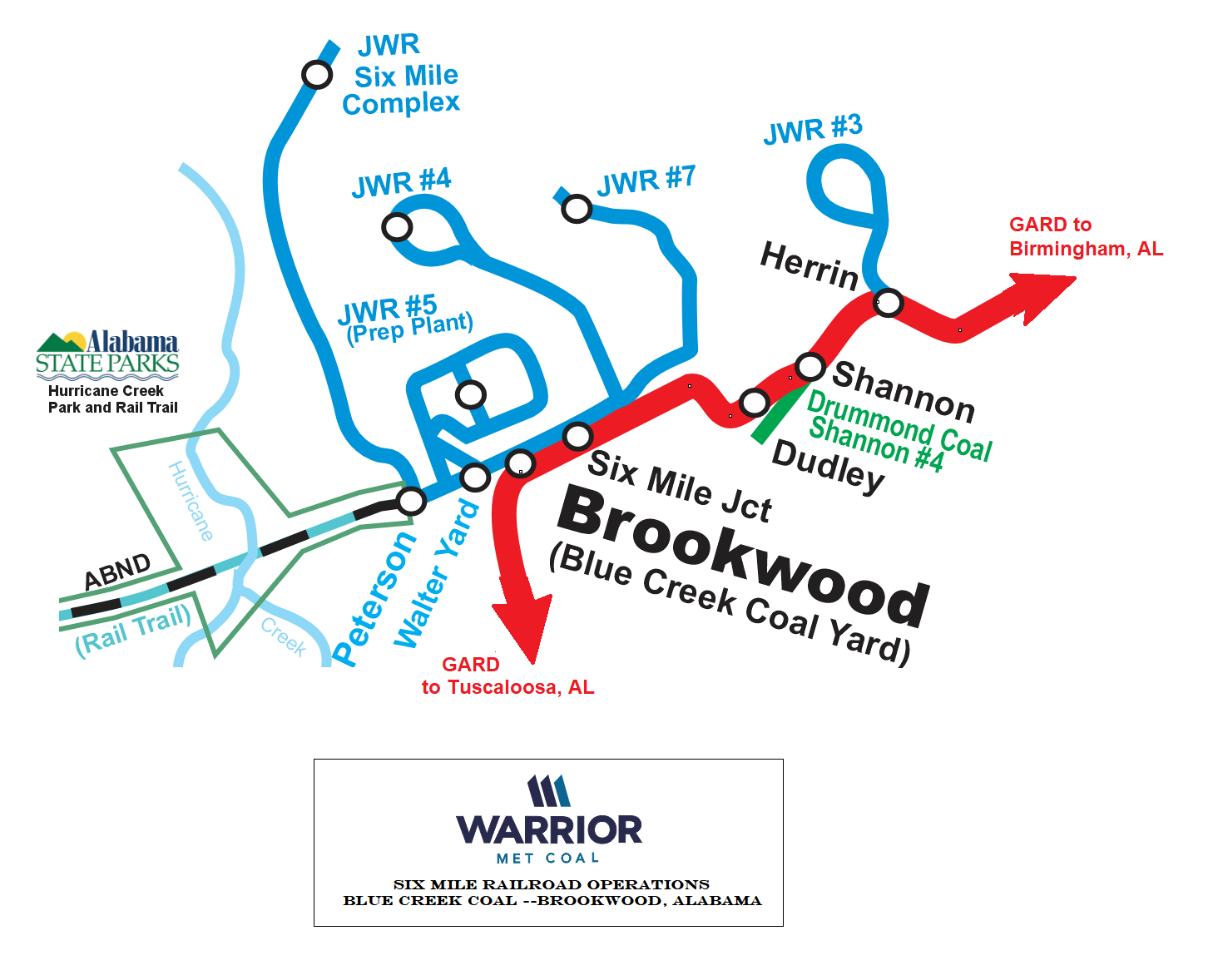
The second and largest coal mining operation is located around three active deep shaft mines owned by Jim Walters Resources (JWR) at the next westward station of Six Mile Junction. Here Georgia Road has its own unit coal marshalling yard, where Georgia Road empty unit coal trains are staged, serviced and adjusted in size to meet Warrior Met Coal customer requirements. The Six Mile Railroad, a fully owned part of the former Jim Walther Resources Blue Creek mining operation (now owned by Warrior Met Coal) uses its own connection line to shuttle raw coal mined from Blue Creek JWR #7 and #4 branches to the main preparation plant in Brookwood proper at the Blue Creek JWR #5 mine site. From the east end of the Georgia Road coal operations yard, Six Mile Railroad parallels it into Brookwood where the line connects into Walter Yard. Six Mile Railroad uses Walter Yard as its main sorting faculty and headquarters, complete with car repair and locomotive servicing. Georgia Road’s own yard seamlessly merges into the Six Mile Railroad Walther Yard, allowing Georgia Road coal trains to load finished coal without fouling the Georgia Road main or Six Mile running track paralleling it. Current owner Warrior Met Coal is based in Brookwood, and it utilizes its own railroad, the Six Mile Railroad, to move coal from the three active mines to the preparation plant at the dormant Blue Creek #5 near “downtown” Brookwood. The Six Mile railroad sports a mix of EMD SD units and slugs, acting as a rolling conveyor supporting the active JWR mines. Shuttle trains work around the clock moving raw coal to be washed, sized and prepped for Georgia Road unit trains to load the finished coal for the trip to Mobile for export. Empty trains move out of the Georgia Road holding yard onto the Six Mile running track, pass by Walter Yard and use a wye to access the dual purpose loading and unloading loop at the #5 mine expanded main preparation plant. Prepped metallurgical coal trains reverse direction on the loop as they load and head back through Walter Yard. and into the Georgia Road holding yard. A road crew then takes the trains on the main at Six Mile Jct and eastward to Blue Creek Junction in Bessemer where they turn south on the Selma line to run to the McDuffie Island Coal Pier in Mobile, AL. Georgia Road also delivers JWR loaded trains to SEGCO in South Alabama to feed coal fired steam plants producing electricity for Alabama.
With Georgia Road straining to keep crews available on the busy Brookwood Subdivision during the COVID-19 pandemic, JWR began operating regular runs from Brookwood to Birmingham utilizing mine-owned equipment, locomotives and crews to supply coking coal to both ABC Coke or SLOSS Industries inside Birmingham. The train then returns empties back to Brookwood for reload for the next days’ train. As the Georgia Road recovered from the pandemic and traffic increased, the JWR operation continued, allowing Georgia Road to concentrate on its own growing traffic plying the line. These trains are notable in they use a manned caboose on 50-65 car trains. By limiting the size of the trains and adding the caboose, the need the need for helper assistance to provide braking over the Flat Top Mountain Grade could be eliminated. These trains reduced in frequency to 3-4 trains per week after Sloss ended operations in 2024. The ABC coke business continued to grow in the early 2020s, and trains continued after Warrior Met Coal assumed Jim Walther Resources operations.
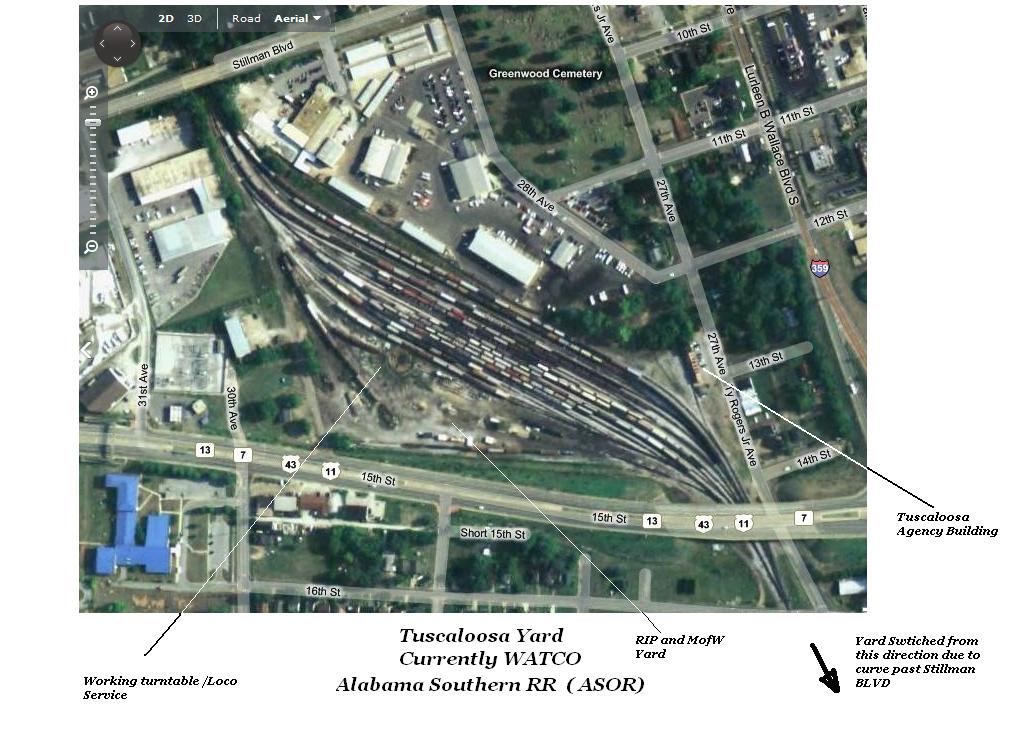
Brookwood on the Georgia Road marks the end of the original L&N alignment. The Georgia Road mainline originally ran on former GM&O trackage from Brookwood to Tuscaloosa and on to Meridian and Artesia. This route was part of the former GM&O lines that linked Georgia Road to its ICG/IC lines purchased from Kansas City Southern in the late 1990s. Prior to 2011, Georgia Road trains traveled through Peterson, crossed Hurricane Creek and west to Holt Junction and on to Tuscaloosa, AL. A series of severe tornadoes collapsed part of the high bridge over Hurricane Creek just south of Peterson, AL in 2011. At the time, Jim Walters was attempting to secure permits to open a new strip mine a few miles north of Peterson, which would eventually become the new Six Mile mine load out. Georgia Road and JWR worked out an agreement for JWR to acquire the Peterson line to just east of Hurricane Creek and the collapsed bridge. JWR wanted to use a portion of the line and build north to the new Six Mile location, and gifted the remaining right of way to the State of Alabama as a rail trail. The trail begins at Peterson at the end of active Six Mile Railroad track at the old wye, links the expanded Hurricane Creek State Park and ends inside downtown Tuscaloosa at the University of Alabama campus. The partially toppled bridge was converted to a viewing platform over Hurricane Creek as the trail wound in and out of the park. Georgia Road used the funds from the sale of most of its original alignment to new connection with the Norfolk Southern RR twenty miles south to Vance, AL. This new mainline allowed access to the Mercedes Benz-Vance assembly plant. Georgia Road had standing temporary detour trackage rights over the NS Birmingham-Meridian main to its lines in Tuscaloosa to maintain train operations while the damage to the Hurricane Creek bridge and approaches was being assessed for FEMA disaster funds . Georgia Road, Warrior Met Coal, the Sierra Club, State of Alabama and City of Tuscaloosa worked as a consortium to support the changes with each group gaining benefits. Georgia Road got its new and less expensive alignment with added bonus of access to Mercedes; Warrior Met Coal got its connection to its new mine and permits to operate; the Sierra Club got a rail trail and expanded watershed property added to the Hurricane Creek State Park and The City of Tuscaloosa got a walking thread through the city and the real estate at the old GM&O yard it could develop for lucrative student housing. Georgia Road moved its yard operations to its new Sabin Yard facility outside of downtown on the east side. it used a new connection and bridge over the river into Northport to exit downtown Tuscaloosa in its entirety. This eliminating all switching and bottlenecks created by the original yard and mainline. The timber and pile approaches and the old GM&O bridge were removed once the new river bridge was in place.
Warrior Met Coal expanded the Six Mile Operation after 2018 when it took over. The old #5 preparation plant was upgraded and a brand new preparation plant was built beside it to double capacity. The old tipple loop was doubled with an inside dumping loop for raw coal shuttle trains from the mines, and a new outer loop with modern dust abating storage and surge silos capable of loading a 150 car unit train in half the time of the old operation. Georgia Road built the coal operations holding yard to increase finish unit train capacity and reduce cycle time and included unit train power servicing and a new crew call, yard office dedicated to unit coal train operations. A short section of the old alignment was retained by Georgia Road to access several industrial concerns locating around Brookwood, including a coal car repair facility run by contractor Hank’s Truck and Electric (HTEX), an LNG distributor, Sabel Steel Scrap and Fabrication US Lumber distributor and GM parts warehouse
JWR’s new owner Warrior Met Coal deeded several large tracts of land to increase permanent land trusts around the expanded Hurricane Creek State Park as a watershed nature preserve. Warrior Met Coal in combination with Georgia Road funded the construction of the RailsEND Trail head and Mining Museum at Petersen. The old Petersen whistle stop station was rebuilt along with a modern museum featuring both railroad and Alabama mining artifacts.
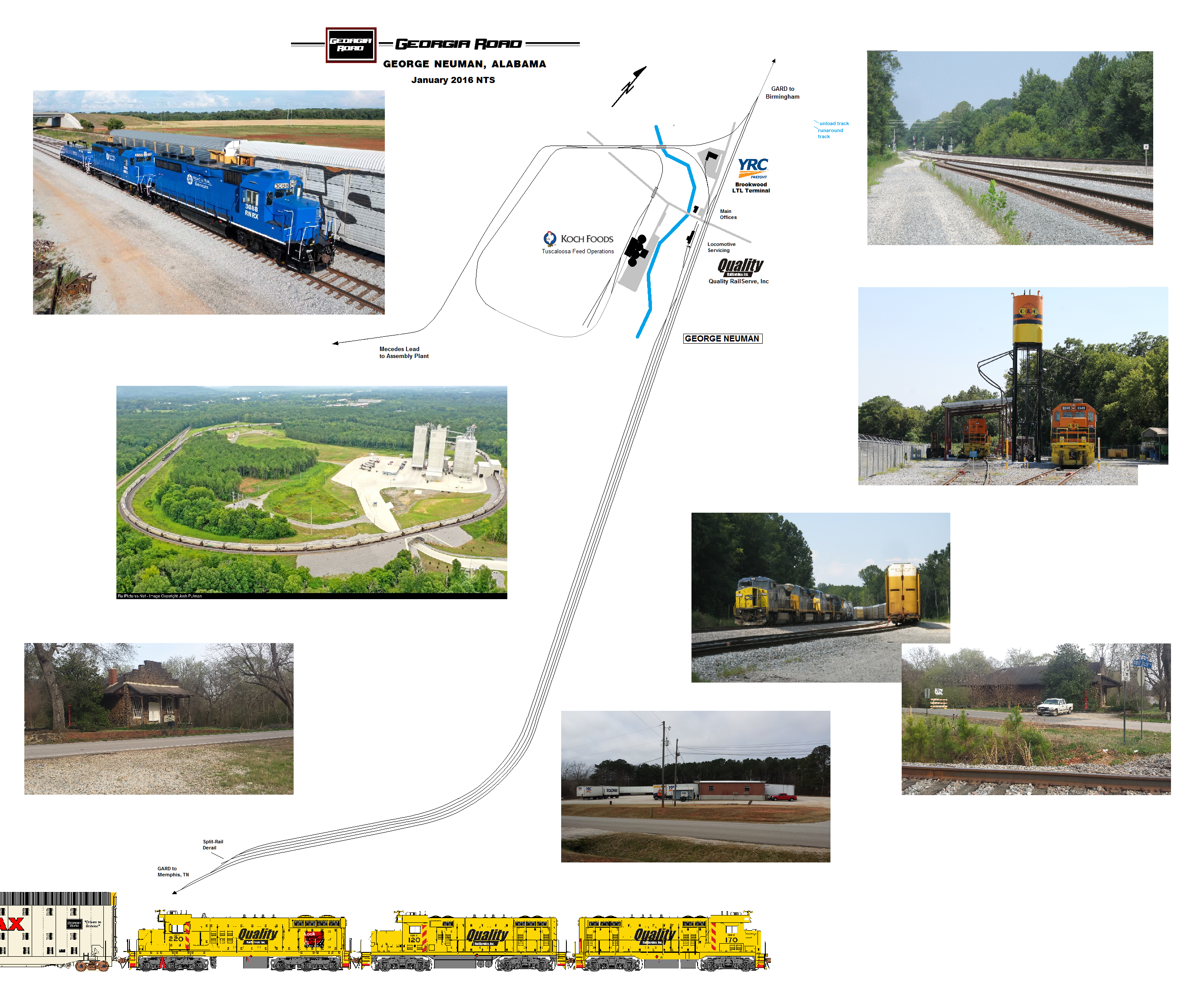
The replacement alignment for Georgia Road out of Brookwood ran due south to Vance. It passed by the east side of the Mercedes Assembly Plant at a new controlled siding at George Neuman, roughly half way to the NS connection at Vance, AL. George Neuman was developed as an interchange with the extended plant lead and soon Georgia Road installed a two track interchange yard to facilitate moving autoracks to and from the Mercedes Plant. A small leasing company called Quality RailService landed the contract to switch the plant and located its offices and maintenance area at George Neuman. It was tasked with the final mile switching of the plant and building autorack trains for delivery to the Georgia Road mainline at George Neuman or the NS at Vance. In 2021, Koch Brothers decided to open and brand new Feed Mill and Distribution Hub in support of growing poultry farming in the region. At its completion, unit corn trains from Midwestern connections began making regular cycles at the mill, delivering corn feedstock for milling into poultry feed.
The station of Vance, AL marked the physical crossing at grade with Norfolk Southern Railroad. Here the Georgia Road crossed the NS West End District running between Birmingham, AL and Meridian, MS. From here Georgia Road paralleled the NS for eighteen miles on its brand new alignment to its new Sabin Yard. on the east side of Tuscaloosa. A complete downtown corridor project in Tuscaloosa eliminated the original Tuscaloosa Yard and mainline. A new modern bridge was built over the Black Warrior River west of downtown Tuscaloosa on the outskirts of Northpoint. Once in Northpoint, the mainline continued Artesia and on to Memphis, TN where trains accessed connections over the IC lines acquired by Georgia Road in 1998.
The modeled portion ends at or just before the new Sabin Yard east of Tuscaloosa proper.
TRAFFIC: Georgia Road contributes two dozen mainline trains of intermodal, merchandise and unit movements along with a pair of yard and switching jobs around Leigh Yard and south to Brookwood. FGC-AMRR contributes a pair of general freight forwarders, A pair of Hurricane Intermodal Trains and the Valley Creek Junction local. The Jim Walter Six Mile Railroad works its intra mine operation and fields its own daily coal move to aligned coke producers in Birmingham. Georgia Road Mobile Coal export trains also originate and terminate on the Six Mile. FGC “RockTrain” aggregate units trains regularly move foundry sand from Florida to Birmingham, Empty trains run back to Dolamar to be filled with rock for Florida distributors. Autorack trains move regularly out of the Mercedes plant at George Newman where contract switchers build trains for NS and Georgia Road. Birmingham Southern RR, Alabama and Tennessee River RR, CSX , NS and BNSF make cameo appearances (to and from staging) to interchange trains at Leigh Yard. A midnight transfer moves traffic to and from the Fred M Dale classification yard (staging) on a daily basis also.
The layout plan focuses on 75 miles in the heart of the Georgia Road system between points west (staging), Birmingham (Leigh Yard) and Vance, AL (Tuscaloosa and points west staging). Using modern prototype examples in the Deep South region, most major industries are implied with leads and partial modeling such as the Mercedes lead. Others are shelf type stub peninsulas (FGC-AMRR Valley Creek Jct) A rough drawing of level one is below.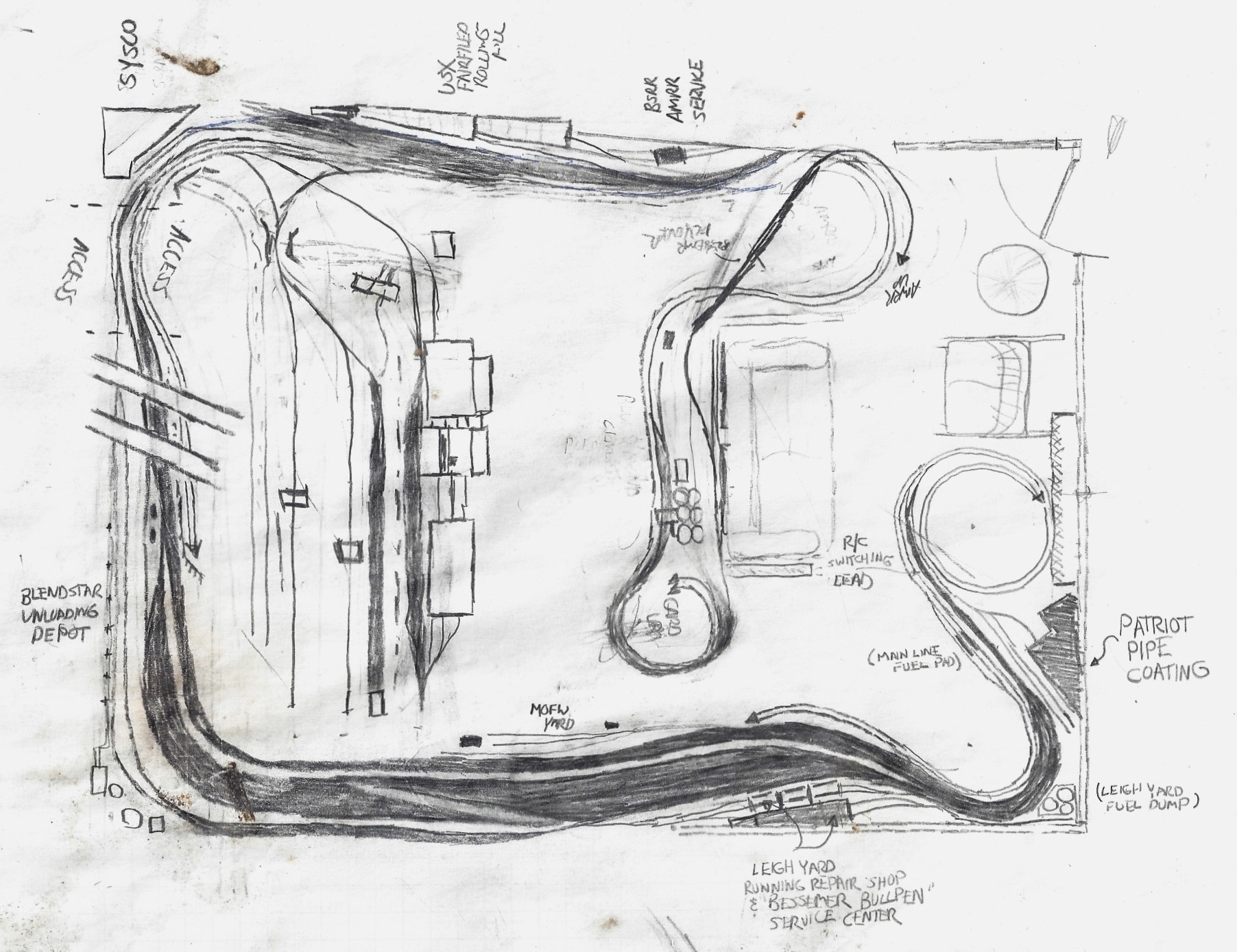
 Georgia Road Transportation