OVERVIEW
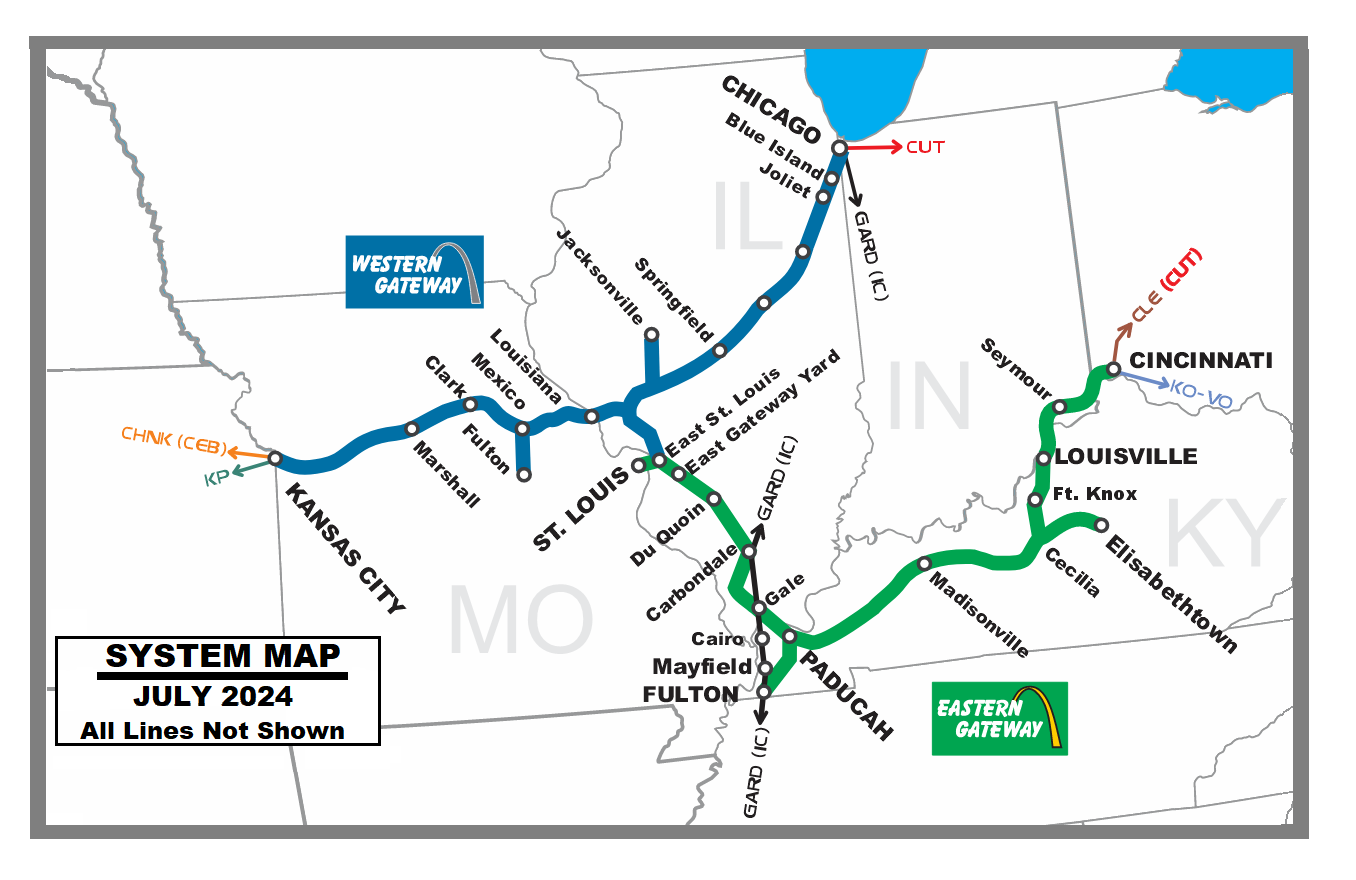
The GATEWAY SYSTEM consists of two regional railroads, the Eastern Gateway Railway (EAST) and the Western Gateway Railway (WEST) that comprise the holdings of Gateway Arch Properties know as GAP Rail. GAP Rail is a wholly owned subsidiary of Georgia Road Transportation (majority stockholder) and GAP Rail Incorporated (minority stockholder). The GATEWAY SYSTEM created when Georgia Road Transportation and the officers of former Paducah & Louisville Railroad (PAL) bought out the prior PAL corporate owner Four Rivers Transportation Incorporated in 2005. In addition to the original PAL properties, the new holding company purchased assets of the Gateway Western Railroad (GWWR) and certain secondary ex IC lines of the Georgia Road to form the complete system. The GAP Rail holding company officially changed its name to Gateway System Transportation Incorporated in 2010 during a reorganization aimed at streamlining its operational relationship with Georgia Road. Around the same time, GATEWAY SYSTEM acquired the Georgia Road minority interest in the Cincinnati & Lake Erie Railroad (CLE). As of 2020, GATEWAY SYSTEM and Cumberland, Utica and Toledo Railroad (CUT) operate the CLE jointly with CLE holding the majority of stock and directing operations.
Following the 2010 reorganization and recapitalization, GATEWAY SYSTEM became an integrated link in the Georgia Road system to link it to western interchange partners including the Kansas Pacific Railroad (KP) and the Chinook System Lines to the West Coast ports. During this time, Georgia Road purchased the Dakota, Minnesota and Eastern(DME) and its subsidiary Iowa, Chicago and Eastern (ICE). The DME/ICE purchase was designed to develop a third route into the Wyoming Powder River Coal Basin allowing Georgia Road to run Southern Company (SEEGCO) coal trains the full route from the mines in Wyoming to coal fired generating plants in the Deep South located on the Georgia Road. With this shift and increase in coal traffic through Chicago, Georgia Road sought to shift much of its overhead interchange away from the already congested Chicago terminals to its St. Louis terminal. The former GWWR tracks, now renamed the Western Gateway Railroad (WEST), opened a new link through Kansas City for West Coast stack trains and manifest traffic. A near abandoned yard in East St. Louis, Illinois was resurrected as a Gateway Yard, a modern classification terminal charged with resorting Georgia Road traffic for forwarding through Kansas City to western connections. In addition, former PAL lines were upgraded to handle new coal contracts sourced off the former PAL lines, now called the Gateway Eastern Railroad (EAST). In addition, the Virginia & Ohio opened a new interchange off the abandoned ex N&W “Pea Vine Line” from Cincinnati to Jimtown, WV through its V&O subsidiary Kentucky and Ohio (K&O) to forward coal trains to Georgia Road and also to Midwestern coal generators on the Eastern Gateway RR (EAST). The Cincinnati interchange with CLE was also upgraded as a Regional Automotive hub and the CLE connection was streamlined to move Georgia Road traffic to Northeast destinations through interchange partner Cumberland, Utica and Toledo (CUT).
Commodities hauled range from manufactured goods such as new import automobiles, Amtrak directed passenger service, agriculture and basic building materials, timber and paper traffic, coal and manufactured goods. The principal system shops are at newly upgraded EAST Gateway Yard in East St. Louis. Terminals are also located in Cincinnati and Paducah with primary interchanges at Cincinnati (the CLE). Kansas Pacific (both KP and CHNK) East St. Louis (the GARD/IC lines) and Fulton (GARD/IC lines. The railroad operates automotive distribution and regional intermodal hub along with large transload operations in major cities across the GATEWAY SYSTEM.
 Georgia Road Transportation