OVERVIEW
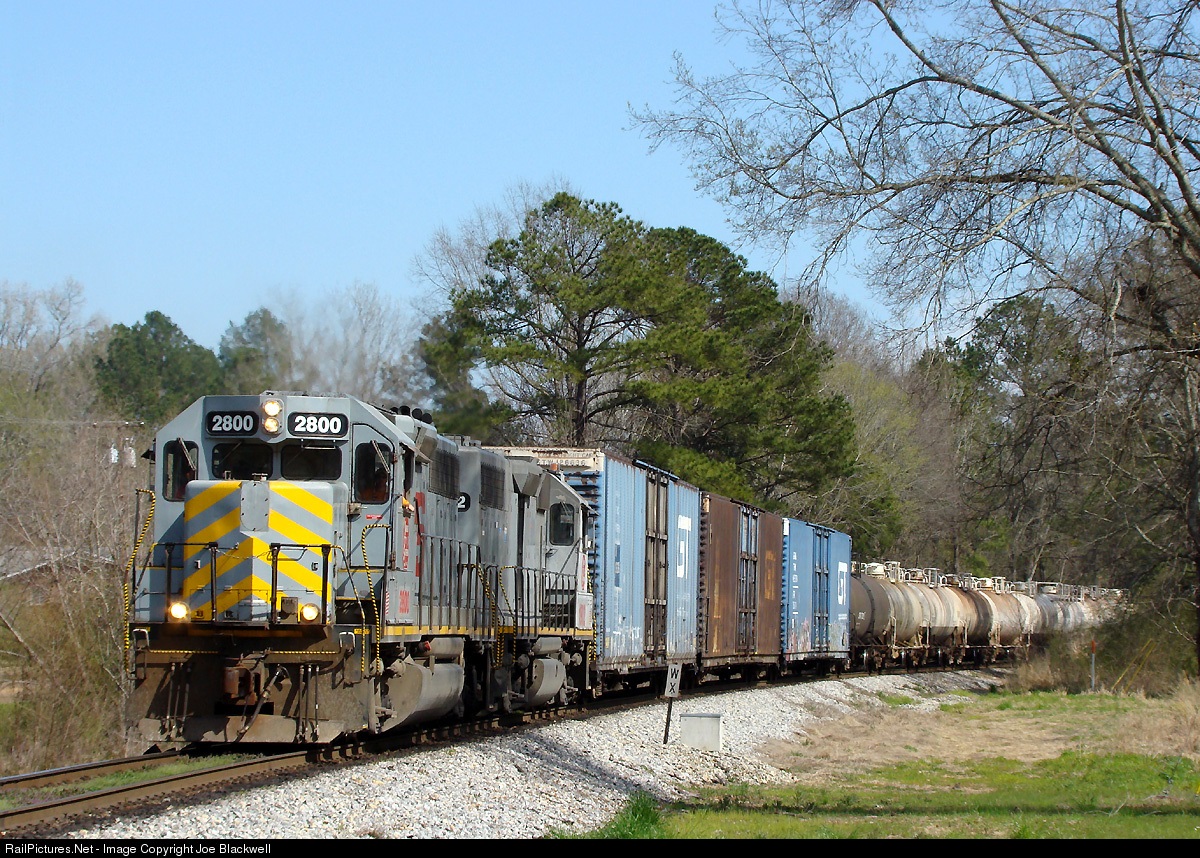
As a modeler growing up in the rural Deep South, automotive operations on the railroads outside of Atlanta, GA seemed vague and unheard. Other than occasional autorack trains passing through, I only experienced the presence of automaker OEM assembly plants and related rail operations on rare trips to greater Atlanta. I remember the first time I saw the large autoparts cars staged near the Ford Hapeville Assembly Plant as my family drove by it on Interstate 75. I grew up an hour south of Atlanta so these cars rarely strayed south. As I got older in my college years, I got to see the NS rail operations at Hapeville and the General Motors Chamblee Assembly Plant with Atlanta based railfans. I did not get to experience the railroad dense operations around major terminals and industrial sites on my later visits to Atlanta. On a few occasions I got to briefly see rail operations the Ford Assembly Plant at Hapeville, GA on the southside of Atlanta, and even made it to the General Motors operation in Chamblee to the north of the city. a few times. My mainstay experience centered around home, where passing autorack trains meeting road switchers and other time freights in the far-flung sidings in Alabama and Georgia held my attention. The very long 86ft boxcars running from automotive industry suppliers to assembly plants was an operation that took place far away and out of my usual trainspotting haunts. With no real concept of automotive operations, I collected autorack cars and random autoparts boxcars only to emulate the passing trains I saw regularly. As a result, my modeling rarely reflected more than a cameo autorack train or random boxcar that I simply had to have for no other reason than its novel appearance.
I read articles on modeling these assembly plants and operations, but there was little connection to these other than the model railroad press. Unlike the authors and their outstanding work, I had nothing in my own experience to relate. These commonplace plants and operations were basically non-existent in my experience. To make matters worse, my only prototype exposure disappeared with the eventual closing of the Chamblee GM assembly plant followed a few years later by the razing and annexation of the idled Ford Hapeville Plant as Hartfield-Jackson Airport claimed the building and land for its planned new International Concourse in the late 1990s. With these prototypes gone, I had less reason to model any concrete automotive industry or related railroad operations. Since a good modeler usually models what he/she knows, I gravitated toward the timber and pulpwood operations I regularly watched in my part of Alabama and Georgia. Ironically, KIA would build its North American plant in West Point, GA and I would find work there as a supplier representative with access to most parts. Rail operations were limited to the autorack yard and ramp behind the General Assembly building. This resurrected my interest in the Automotive Industry as I now saw autorack cars regularly moving in and out of the plant.
I became involved with Chris Palmieri and his HOMESHOPS LLC business in 2022 when he was looking for prototype freelance modelers with mature concepts to feature in his new enterprise. He and I exchanged emails and conversations over the years as we both shared an interest in modern Prototype Freelance modeling, he with his “Meridian Speedway” idea and I with my “Georgia Road Transportation” concept. He launched his HOMESHOPS LLC inaugural run of private road freelance cars in the form of Tangent covered hoppers in during this time. I had a hand in creating artwork for Anthony Lorch’s Kansas Pacific Railroad (KP) that was part of the initial offering. Chris came back and I again did design work for his second release, which happened to be based on the new Tangent 86ft single double door auto parts boxcar. I would create artwork for a Cincinnati & Lake Erie Railroad (CLE) autoparts car for a jointly owned concept created by Ed Lewis and myself along with concepts for Scott Nelson’s Virigina & Atlantic Railway (VA). Ironically, this particular car and the automotive industry it represented had very little bearing on my plans to build a Deep South version of my Georgia Road. The CLE was completely without base for my modeling, though it was held as a far off and unmodeled subsidiary.
Chris sent me a set of cars once the run was completed as a thank you for my efforts. I purchased several of the Tangent covered hoppers in his initial run months before and was blown away with the quality result of Chris’ work through his HOMESHOPS LLC. business. These autoparts cars exceeded my expectations, and I found myself searching for a plausible reason for using these beautifully done cars as something more than just cameo equipment on through trains on the planned Georgia Road layout. Unfortunately, I could not find anything prototype in the region modeled that would justify any appreciable operation using these boxcars in my focus of middle and north Alabama. There were several foreign automakers in AL and Georgia at the time, but these were highway based except for similar autorack loading ramps at the respective Assembly Plants. With the exit of GM and Ford from Atlanta, I found nothing to justify regular use of these purpose built auto parts cars.
THE PROTOTYPE AND MODELING
Fast forward over a year later and I was watching the newest video released by Louisiana Rail Productions on YouTube. The creator lived in Louisiana near the KCS Meridan Speedway and regularly released professionally done videos of his travels and railfan journeys. This particular video was entitled “Magnolia State Railroading” and documented the KCS Meridian Speedway between Shreveport, LA and Meridian, MS. About 30 minutes in the video, he followed the KCS Rankin Turn out of High Oak Yard (Jackson, MS) eastward toward Brandon, MS. To my shock, he noted that it regularly switched 86ft autoparts cars from the various GM suppliers into a recently constructed General Motors Autoparts Redistribution Warehouse near Brandon, MS. Boxcars full of carbody parts such as doors, side panels shipped in on the boxcars and the Rankin Turn regularly worked the warehouse as part of its road switching duties. (Go to 36:00:00 to see KCS Rankin Dodger LL40 working the warehouse lead.). After watching the video several times and locating the place on Google maps, I set out to find more information. The pictures and links here are the results of more than a few late-night searches.
The General Motors Southeastern Region Redistribution Center collected spare parts from OEM suppliers for warehousing and eventual resale and shipment to the GM auto dealership network and affiliated body shops across the Southeast. If spare parts were ordered through the GM dealership network for wreck repair or replacement anywhere in the Southeast, the parts likely originated from this warehouse. It received parts from OEM suppliers using both rail or truck, warehoused them until purchased, and then shipped them to requesting dealers by truck. To my excitement, car body parts came in on (…yep, you guessed it…) AUTOPARTS CARS!!! While not an OEM supplier or Assembly Plant, this redistribution warehouse was a regular user of the very cars I wanted to add to my Georgia Road layout operation as more than just cameo rollingstock.
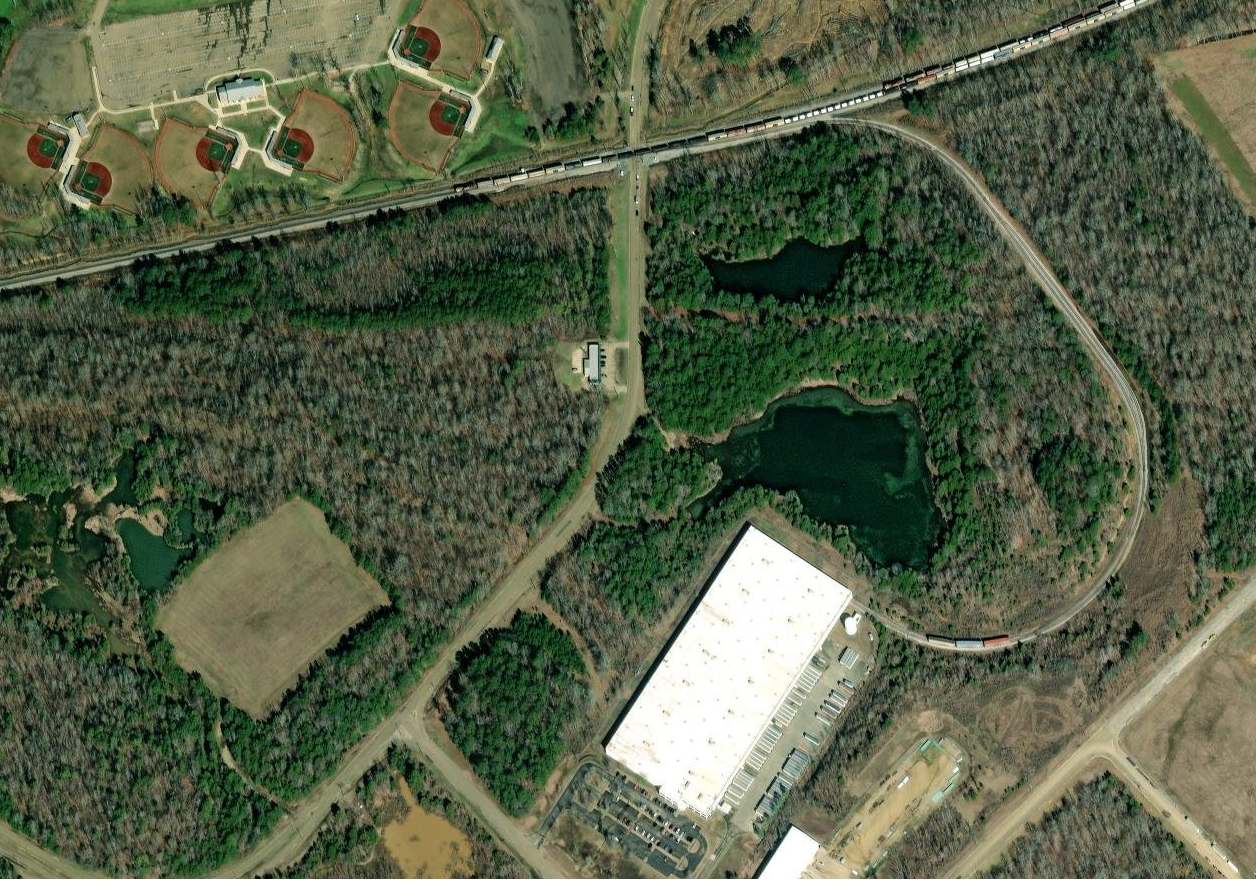
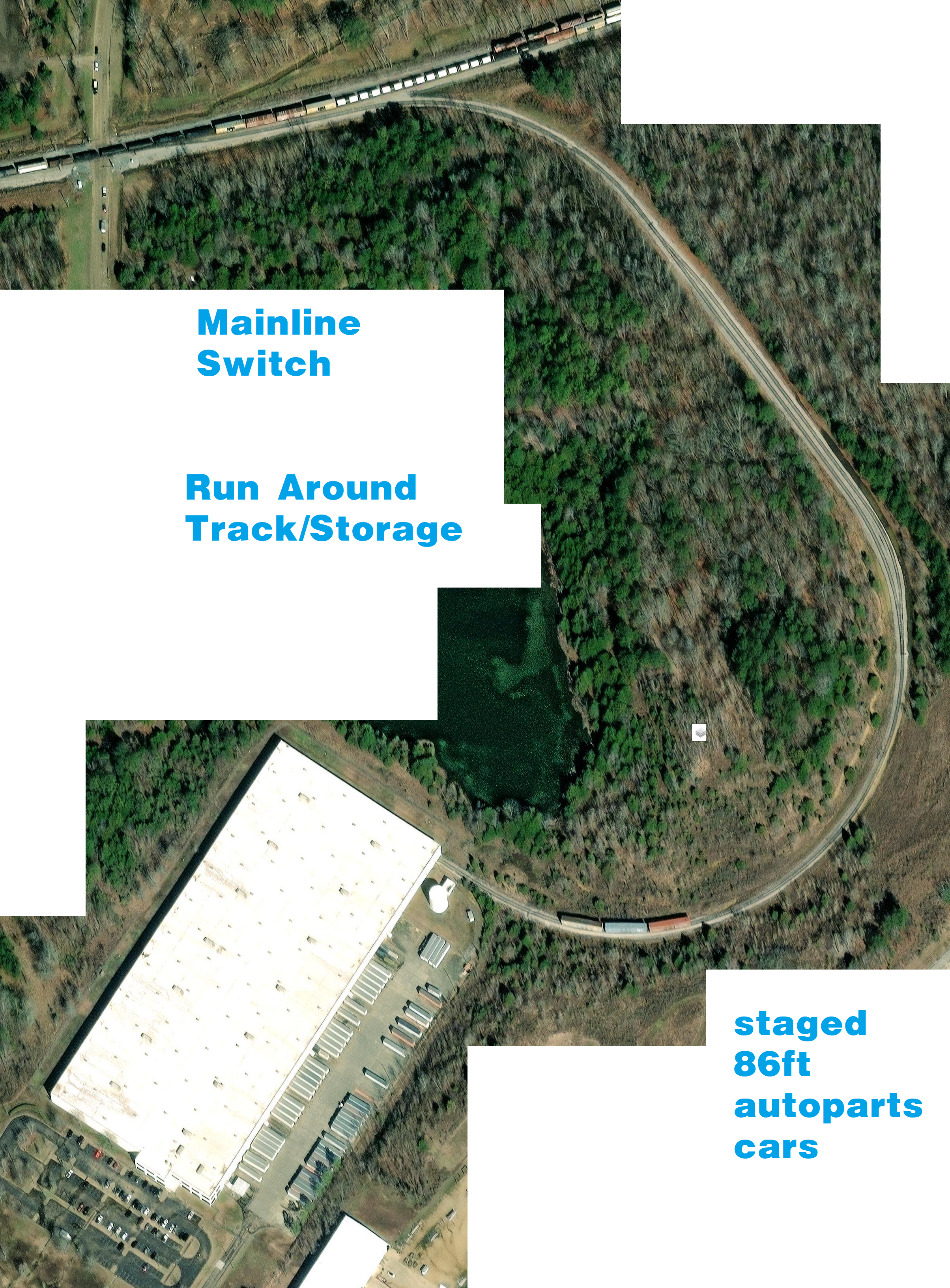
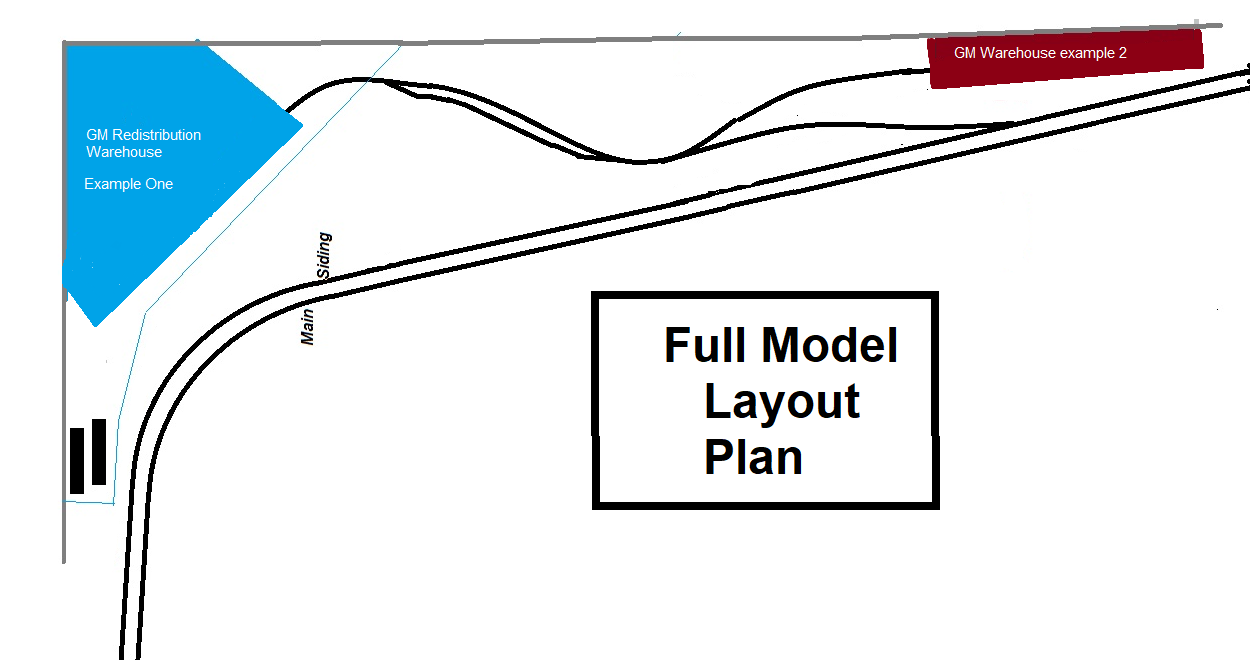
Modeling this industry and operation is pretty straight forward. The building could be built as a backdrop flat, or at the end of a lead engaged into a corner or island. As noted in the LRP video, the lead pulls off the CPKC Meridian Speedway line and travels about a quarter mile into the woods to the back of the warehouse where rail access is at the very end of the building. A lead into the woods where cars are spotted on a spur would make a most basic model representation as seen on the LRP video. This would be ideal for a small layout design or even a larger one where modeling the actual spur and warehouse is not possible. To give the impression of the industry, a rail gate with GM signage could be used at the clearance point of the switch into the warehouse with modeled trees covering the last few car lengths of the spur. An example of typical operation would see a regular local switcher arrive on the main or siding and swap cars out of the hidden spur. The switching order may be directed to only pull a portion of the current spotted cars in the rear half of the spur, requiring the head end cars to be swapped back into the spur behind inbound cars on the local switcher. This would require several moves to reorder the cars going into the spur and pull out the outbound cars. Remember also that switching cannot begin until permission is garnered from the plant to unlock the rail gates. Additional operational twists could be added if the local switcher arrived facing the switch. It would have to use the siding to run around the cars first. If the siding held overflow cars, these would have to be dealt with also. In what seems like a basic switch move with minimal track, operational requirements can easily keep a local crew busy for a considerable time. See FIGURE ONE below.
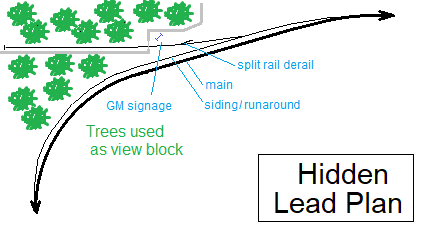
For modelers interested in modeling all or part of the warehouse, the large warehouse could be built along the backdrop as a low relief structure. The runaround track/storage inside the gate of the warehouse could be modeled with a lead loosely paralleling the main. Additional industries could be added to the lead to represent a larger industrial park as the overall plan below in FIGURE TWO suggests. One could also opt for either the blue configuration with building detail and runaround as on the prototype or singly as the burgundy color example using a low relief structure against the backdrop. The Georgia Road version will be something like the overall plan with some modification to suit the space it will occupy.
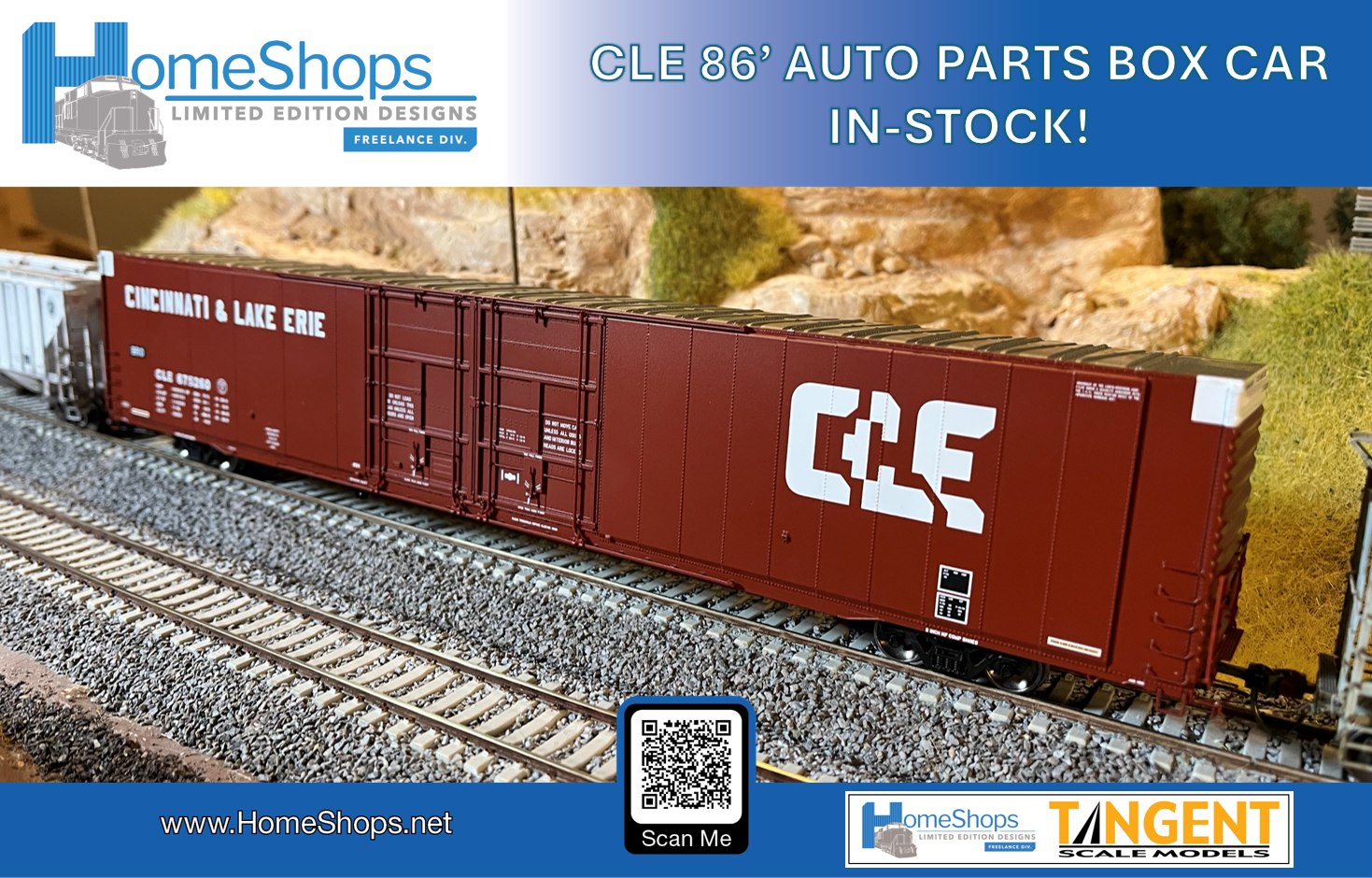
There is a plethora of available models of the autoparts cars. Along with the custom freelance runs from HOMESHOPS LLC, Athearn, Tangent, Walthers, Class One Modelworks and others have released models over the past 20 years or so. Athearn cars go back to the 1980s with its now long out of production Blue Box American made kits. Shorter 60- and 70-foot cars could also be used if the long cars pose a problem due to limited layout curvature radii. Athearn, ExactRail (now ScaleTrains) has these.
The warehouse could be kitbashed from several modern offerings from the likes of Walthers Cornerstone, Summit Custom Models and Pikestaff kits to name only a few. It would require some basic kitbashing or kit reconfiguration, but the level of detail is only limited by the constraints of the space used to represent the operation and modeler desire.
The Georgia Road operations will work much like the CPKC Rankin Local featured in the LRP video linked above. The backstory goes that Ford added a new redistribution center on the Georgia Road in the early 2000s located at Yolande, AL, about midway between the modeled Birmingham AL to Tuscaloosa, AL Alabama Interstate RR Division. (I chose Ford as a nod to my departed dad, who would own nothing else). The Brookwood Turn, a daily road switcher on the modeled portion moves the cars to and from the warehouse. Georgia Road uses the term “Turn”, to describe its locals because they typically leave a base of operations, switch down to the end of assigned limits, turn the train and switch back to their base. The Georgia Road Brookwood Turn, officially called L26 on Georgia Road paperwork, works from its origination at Leigh Yard in in the southwestern suburbs of Birmingham, AL westward to Brookwood, AL serving all online industry. Once L26 reaches its farthest limit at Brookwood, AL, it “turns” around and returns to its origination at Leigh Yard, switching any industry missed on the trip out. The Ford redistribution warehouse is located in a small automotive centric industrial park in the small hamlet of Yolande. The location was picked due to access to two railroads and a nearby Interstate. The Georgia Road main line and regional Alabama Midland RR (AMRR) secondary merge and cross here. Spare body parts for various Ford suppliers regularly move in the large boxcars for delivery to the warehouse where inbound loaded cars are traded for empty cars. These cars originate on the CLE which serves several Ford suppliers in Ohio, Indiana, Michigan and Illinois. Georgia Road manifests receive these cars from the CLE at East St. Louis and move them to Birmingham, AL where they arrive at Leigh Yard. At that point, cars are added to the daily L26 Brookwood Turn for delivery to the warehouse in Yolande. Empties go back to Leigh Yard and catch the westbound counterpart manifest back to East St. Louis and the CLE connection. CLE provides may of the 86ft autoparts cars in the pool, though any road name in the larger pool of 86ft autoparts cars is likely to show up in small numbers. The AMRR actually spots the cars as the warehouse is on the AMRR after the Brookwood Turn leaves them in the interchange yard at Yolande.
FINAL THOUGHTS
So much for not having a prototype in the beginning and thinking I would never utilize these 86ft autoparts car models. With the discovery of the prototype operation on the CPKC in nearby Mississippi, I found the perfect inspiration for modeling. Seeing the daily local busy working the Ford warehouse with 86ft cars at the Yolande Industrial Park is something dreams are made of for a prototype freelance modeler who stresses the prototype as much as the freelance idea. The equally common and many times simultaneous appearance of the massive cars as they pass by on the nearby Georgia Road mainline in manifest trains will be the proverbial icing on the cake. These cars be more than a simple cameo that fails to do these factory custom cars justice. Instead, these cars will travel in remarkable numbers and prelude a detailed switching operation that mimics a modern real-life operation. The relative uncomplicated design of the industry in model form gives the modeler a substantial return in operations with reasonable time and cost. As a result, if you need a notable modern boxcar industry with unusual 86ft boxcars, an OEM redistribution warehouse is definitely an option to consider!
END OF LINE
 Georgia Road Transportation