OVERVIEW AND PERSONAL EXPERIENCE
Some forty years ago in my mid-twenties, I decided to run off and join the railroad as a track laborer for Norfolk Southern Railroad. Unlike the modern 2020s, jobs were scarce and highly y competitive in applicant pools. My dream was to break into train service, but my only lead was a listing at a Department of Labor that was buried in listing and somewhat vague. I answered the listing on impulse, applied and never thought I would ever hear anything else. Instead, I got a random phone call and wound up in a room full of applicants for only a scarce few of job openings. Following a hard-core job brief aimed at culling the uncommitted and weak of heart, I remained. I got an interview and eventually got the job after several months in limbo. What I thought would be a local gang job in nearby Atlanta, GA turned into a yearlong stint on a traveling production gang. I wound up an average of five hours from home during my twelve-month active tenure. I was given the job title of general track laborer and attached to Norfolk Southern Railroad Tie and Surface Number One, or T&S #1 in NS parlance. This gang was a highway-based production tie replacement super gang assigned to the whole former Southern Railway trackage. I lived the gang life a working season, and through this article hope to add some insight into modeling accurate gang operations and equipment in HO Scale.

Several weeks after the initial interview, I was called for a full physical and health screen and background check in Atlanta by what was supposed to be my new local gang supervisor, The hiring process not only violated my physical privacy, but left me waiting for almost two months with no idea if I had a job or not. I finally got the call with a gruff individual that told me if I was serious about a railroad job, I was to report to a gang four hours from my home in South Georgia. He was the Gang Boss and I quickly found out I was nothing to him but a potential workhorse. I don’t think he every really knew my name, other than reading it on paperwork. If there was such a thing as a Senior Drill Instructor on the railroad, he was the epitome. I only had one run in with him in my early days. I was not working fast enough, and he drove up at a road crossing in his pickup, glared out the driver’s window and reminded me that he would gladly send me home if I could not keep up. As I adjusted to the physicality of the work, I improved enough to meet minimums.
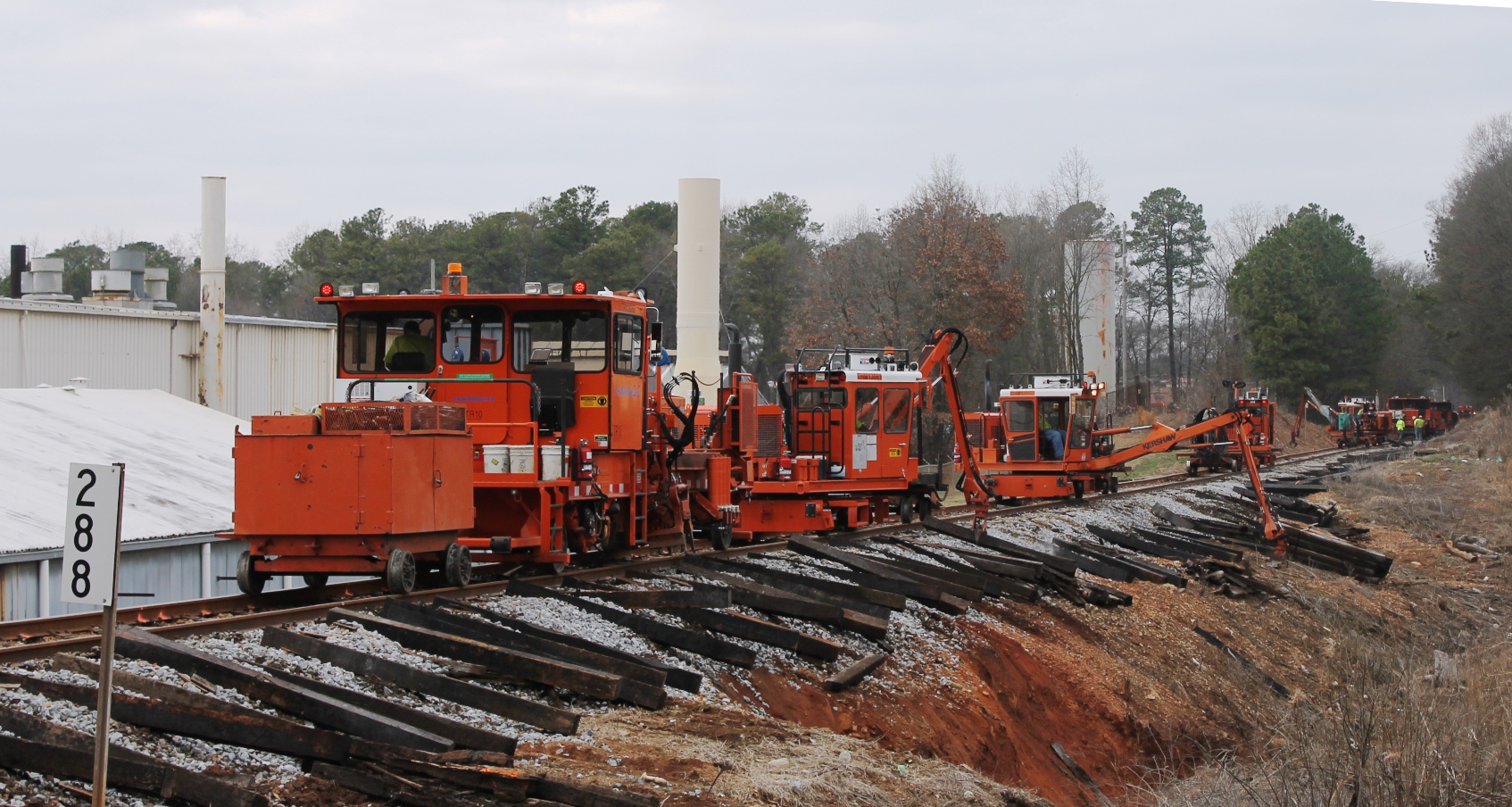
As it turned out, when I was finally hired, I was immediately rolled over from the local job I applied to a shorthanded gang that called the whole Southeast region home. That was my first lesson on all important seniority and how the lack thereof made all the difference in the world. I wound up in the middle of nowhere on the NS GS&F mainline between Macon, GA and Jacksonville, FL. After a few hours of orientation, I was put on a Nordco hydra-spiker loading spikes opposite the two operators on a machine charged with gauge spiking the rail back down to newly replaced ties. That was not so bad, but my easy job quickly morphed into “flipping chips”, where my job was to walk behind a fast-moving brand-new Tamper TRI-10 tie remover and fish track plates with a metal rod out of the ballast. This was done so the track plates could be reused and not accidently buried when the new tie was injected. These plates weighted anywhere from 25-35lbs each. I flipped an average of 3000 per day at a brisk walk, through disheveled and uneven track structure. It was the hardest job I ever had outside of a few days of pulp wooding with my uncle on a prior summer. (see picture above as two laborers “flip chips”)
I was both a model railroader and technical railfan at the time, so I understood general railroad operation and even some maintenance activities. This earned me the nickname “Train Professor” from the guys I lived and worked closely. I found it was odd that they knew everything about MofW and gang life, but very little about the trains that worked around them as well as the general industry landscape of the time. My wanderlust for railroading and work ethic kept me useful to the gang, I still loved railroading in general, but at times my fascination was dampened by the reality of extremely hot, heavy and arduous pace that my job required. I lasted one year, or in gang terms, “a full season.” I learned a few months in that the gang would shut down during the winter months and I would have to bid elsewhere to keep working or find other work until the restart in the Spring of the following year. With less than a year of seniority and a seniority district that I found out after the fact was not opportune, I was facing unemployment, something I never worried about in the manufacturing plants at home. With a background of inside plant manufacturing, outside conditions work was a complete reversal from my experience. Having a job run out was foreign all together.
While determined not to give up, realized I was facing forces in the industry that would undermine any attempts to get into train service or land the coveted “local to home” MofW jobs. I was hired on Central of Georgia seniority out of Columbus, GA. I knew the territory and watched as NS systematically sold off and abandoned much of what was my district. I chose the CofGA as it was closest to home. I had no idea that the rationalization that railroads were doing after the 1980s mergers was so profound to a fledgling track worker. I the CofGA folks were outnumbered, somewhat resented due to better union work conditions (what those were was never apparent to me), not always welcome, or retiring out and being replaced by those with system seniority directly tied to the controlling Southern Railway side of the business.
Railroads employ a series of local and production gangs to maintain the railroad infrastructure. Local gangs are typically smaller assignments with members who have seniority to hold jobs close to home. These gangs handle everyday issues and repairs under the supervision of the Roadmaster or Project Manager. Gang members can hold positions ranging from general laborer (as was I), equipment operator, supervisory foreman, mechanical to name a few. They can be mustered from all over the work district, worked standing positions or fill out with at large bidding for any qualified persons with required system seniority. Production gangs are inherently fixed gangs that are responsible for infrastructure renewal on a large basis. Their work is planned in advance, specific and high priority. Many times, program gangs draw on local gang personnel to assist, pre-stage or clean-up for the gang. Sometimes, if short-handed, these system production gangs “absorb” local MofW workers to fill minimum personnel compliment. Being “rolled” to the gang was not by choice and absolute. I found this out on my first day on the job which suddenly moved to a T&S#1 in South Georgia. At the time they were on some remnant CofGA trackage that would later be abandoned during my official hire date. By the time my paperwork was ready, T&S #1 was back on the Southern/GS&F district. I was “rolled” on my hire date but did not start until several weeks after the gang was off my district. Needless to say, these were underhanded practices to keep the production gangs staffed. These gangs HAD to work AS designed and got priority over everything. My local job sat vacant until the next hiring session. By then, I was somewhere in Florida working toward Jacksonville on T&S #1 with no hope of return on a district that I had no seniority. A newcomer could hire into a local assignment but keeping it was tenuous when the production gangs came calling. Knowing all this beforehand would have benefited me greatly. Since I was a first-generation railroader with no familiar ties at NS, I was on my own with no idea how the culture worked. It was no wonder the guys I worked with on T&S #1 viewed me as a suspicious anomaly. Several even swore at first, I was nothing but a management plant. My railroad knowledge did not help much there either. After a few weeks in the trenches, they found out I was just another greenhorn, maybe greener than most.
Seniority was everything. With much of my home district disappearing almost daily, the running jibe directed at me was I would be an old man traveling with the gangs as my seniority district would eventually disappear into a shell of its former self and I would have seniority over nothing but traveling system gangs. Southern would eventually move all but local traffic from Central of Georgia duplicates and branches. The railroad worker unions at the time were giving all sorts of concessions and I found I was working at a percentage of the basic laborer rate of those around me. It would take at least five years to reach full pay. No matter how I assessed the possibility of a long-term railroad career, I could see no way forward with low pay, low seniority and a withering home district. I bid off T&S 1 as it headed north toward Washington DC on the Crescent lines of the Piedmont District. With travel time now taking over six hours one way each week between home and the gang I could no longer afford the time or cost. I never went back, choosing my previous career in manufacturing with better pay and conditions. I left in good standing, with my bid cancelled and listed a furloughed. Several times I almost went back, but I realized in that year I would always be a better railfan and modeler than a boomer. I made some lifelong friends, earned respect and gave it. While my time was brief, the railroad matured me and to this day part of me still quickens when I see the gangs work into town. Add to this overall thrill of chasing trains and I am still just as hooked as ever. Maintenance of Way (MofW or MW) is a large part of my railfanning and modeling some thirty years later. I still search out and document the men, equipment and operations of which I experienced.
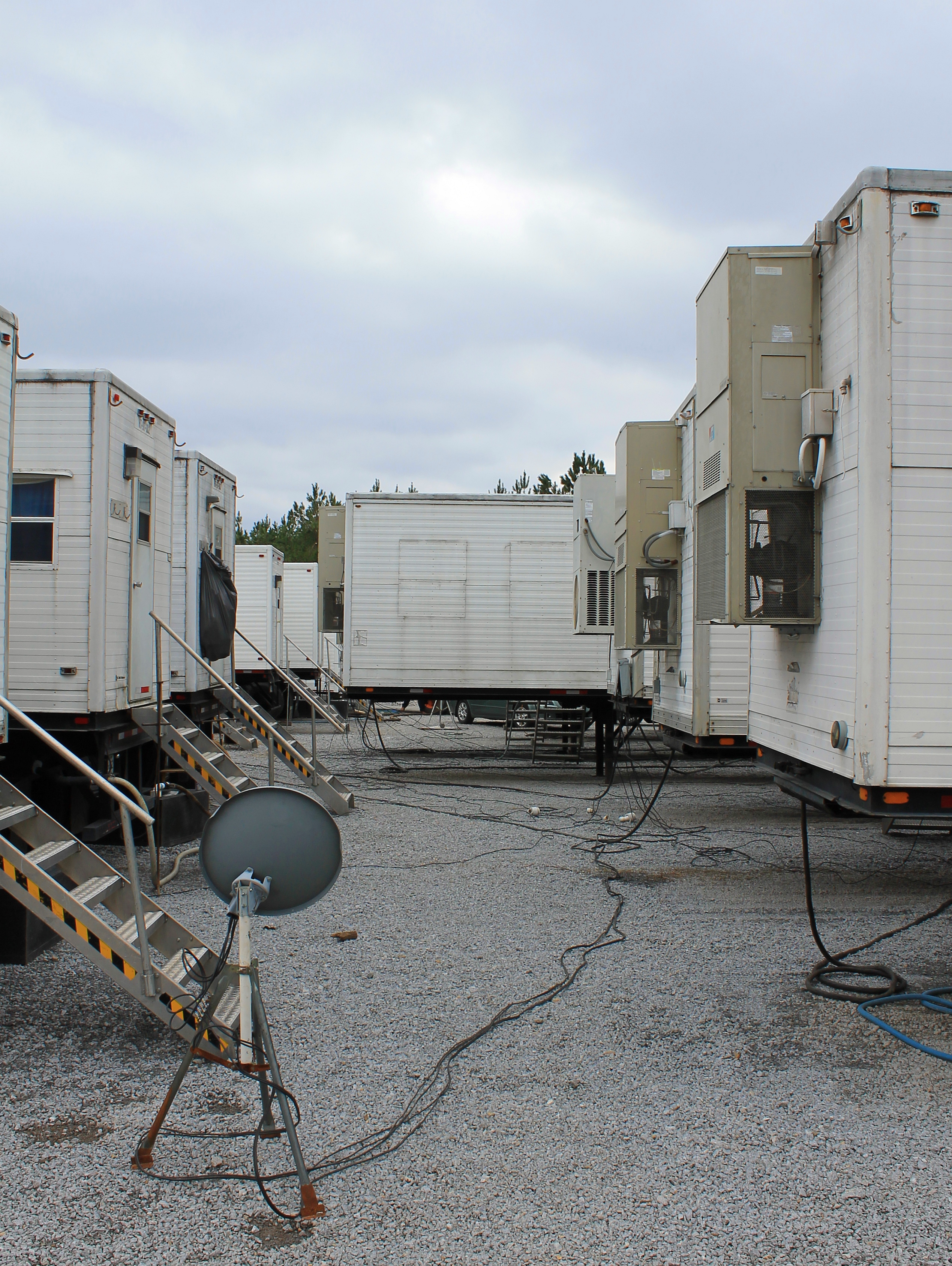
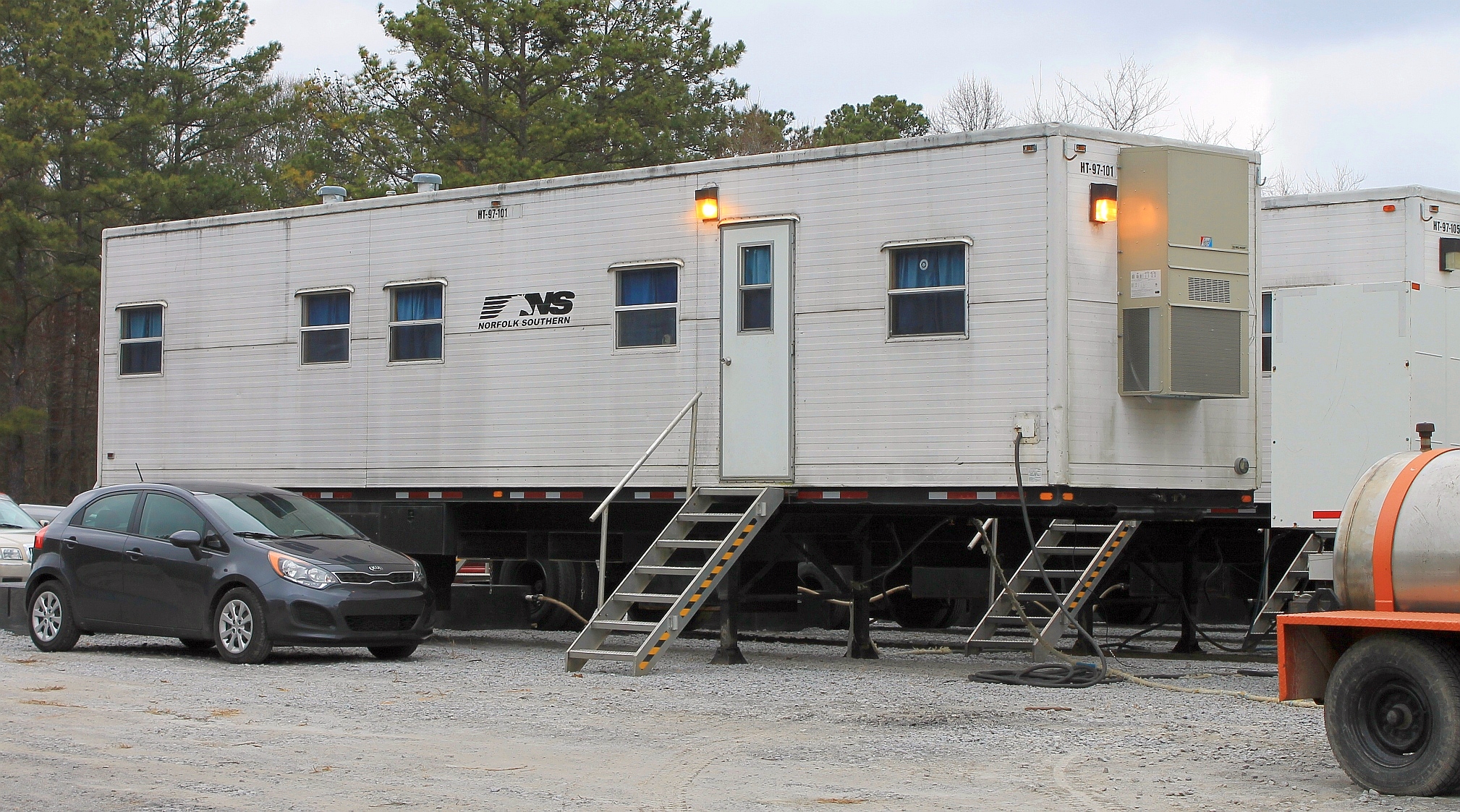
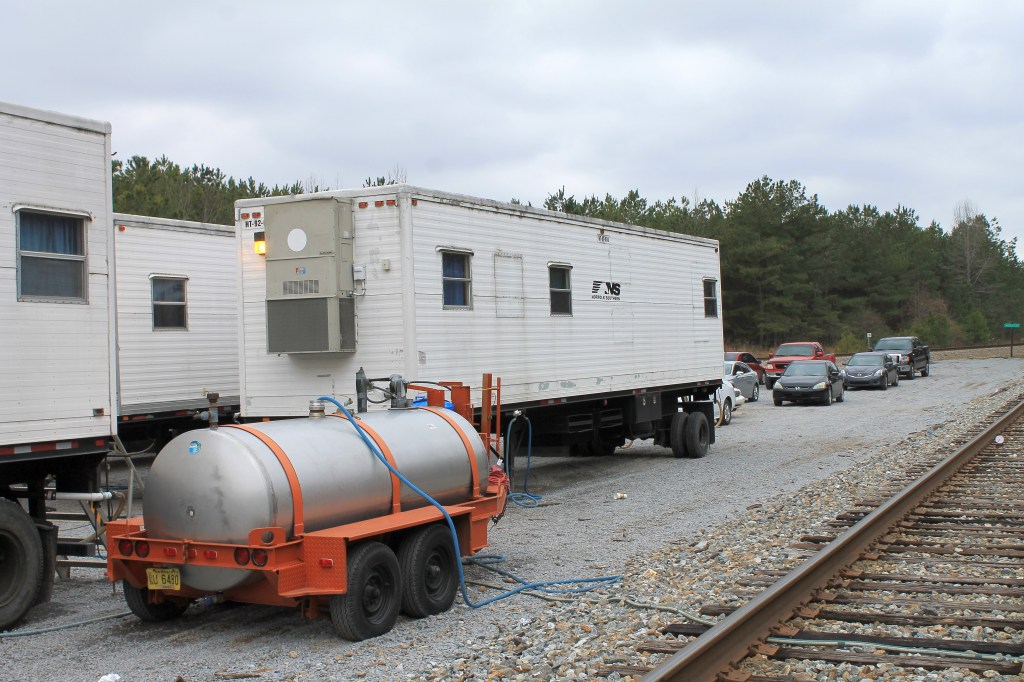
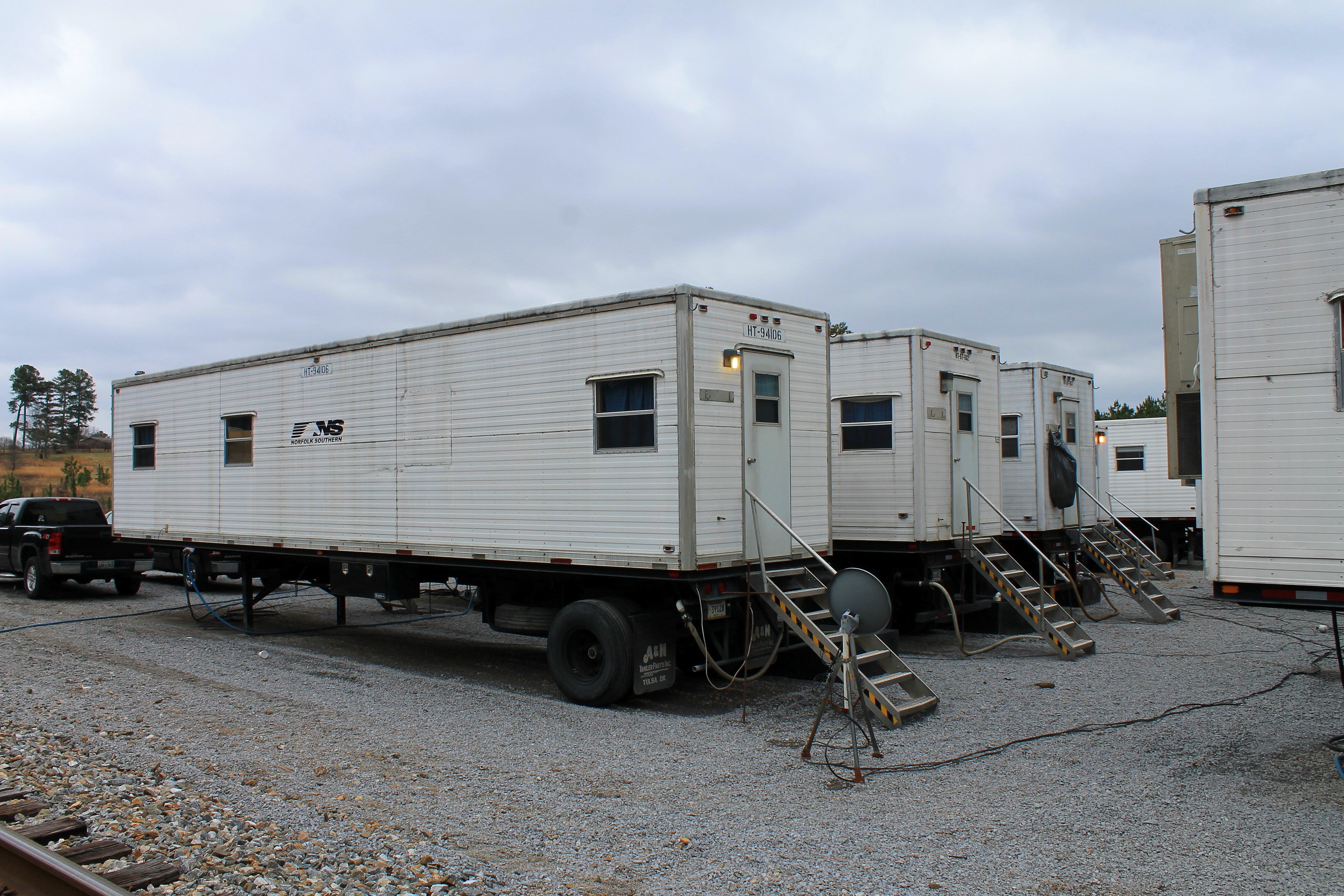
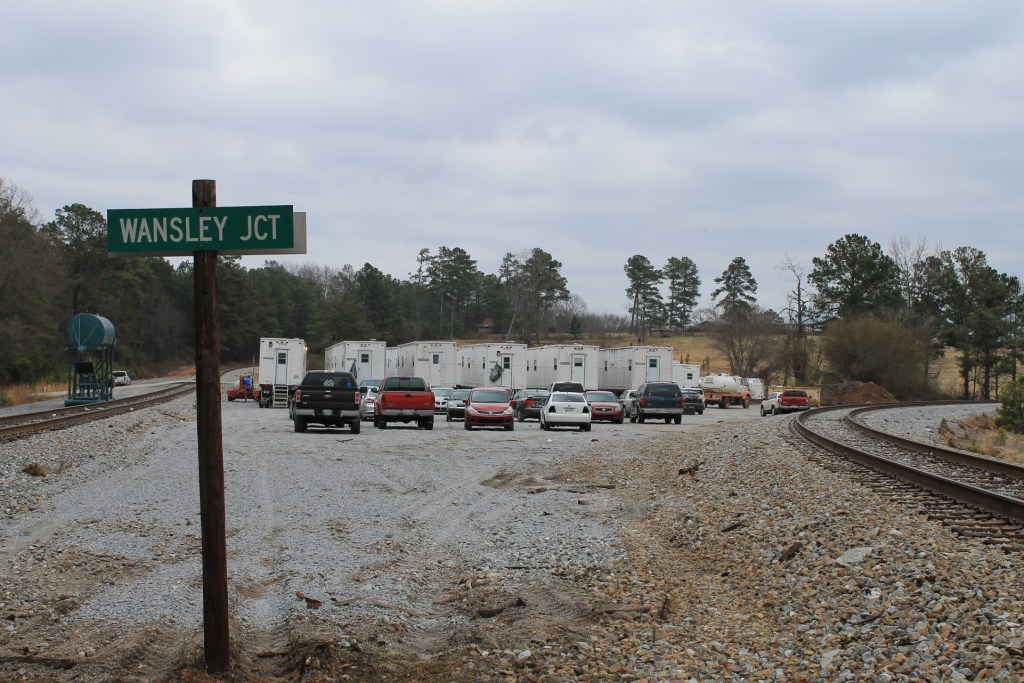
Studying the overview picture of NS T&S 1 at Wansley Jct above shows the large footprint of a highway based super gang These campsites required a large level area usually outside of town with easy access to the side from a major road. These sites were picked when the T&S #1 highway gang idea was implemented and maintained year to year. Walking grade ballast was spread over the area for good drainage and camp trailers were laid out in clusters around water trailers and power generators. T&S #1 hopscotched over the various districts the same way year to year. NS worked ties in five-year cycles. Mainlines were broken up into five section strips usually in twenty-mile segments. A different section would be worked each year, and by the fifth year the gang would start over with the section it worked five years earlier. This way, all the ties on a well-used section of mainline would be renewed ever five years. This was not a hard rule, however. Less traveled lines and branches may go much longer. It some cases, these would be worked in total once every 5-7 years. Smaller gangs were usually assigned here or for yard track renewal. Due to the size of T&S#1 and its need for large production to justify cost, it primarily worked on busy mainlines each year to maintain Class One track structure requirements. It is not hard to find these flat graveled lots all over the GSF, SOU, AGS and CW districts where T&S #1 frequents. As a modeling note, T&S #1 would be a diorama unto itself. While notable, this gang is too large to model expeditiously with limited layout space. As a result, the focus will be on smaller rail-based gangs typical of modern operations in the post 2000 world.

THE INSIDE TRACK–GANG OPERATIONS, EQUIPMENT AND THE CAMP
I observed NS, CSXT, UP and BNSF maintenance of way practice over the years and find while there are hierarchical differences, the processes, manpower and machines are pretty much the same. UP and BNSF use large Track Renewal Machines that complete a full renewal of track structure, including rail, ties and ballast in a single pass. CSX and NS deem these configurations too expensive and cumbersome for their needs. CSX tended to be more automated with machinery, reducing the need for laborers. NS was more traditional. If a man could do the work cheaper than the cost of a machine and higher paid operator they would not hesitate. BNSF and UP both used a combination of railroad camps or hotel accommodations, depending on the union work rules and remoteness. CSX opted to retire all the camp trains in the 1990s. I will focus from this point on of what I know, which is CSX and NS maintenance of way when it comes to program gangs. I have direct knowledge of these from my experience and that of the many workers I talked to over the years. NS and CSX have very different views of how production gangs are run, quartered and arranged.
CSX no longer maintains camp cars and onsite living but instead leases rooms for gang members in motels local to the work site. NS claims convenience and cost savings by maintaining traditional camps at or near the jobsite. NS was a stalwart in traditional railroad operations opting to continue and expand use of rail and highway-based production gangs. NS wanted workers close, and under tighter control. Tighter control meant better production standards. CSX seemed to lean toward better quality of life in general, though their gangs worked in month long cycles instead of weekly cycles. As an example, I ran up on a CSX T&S gang while working that fateful year with NS on T&S #1. I was aware of a CSX T&S gang working on a nearby CSX line. With work done early in the evening, I wanted to sightsee and decided to stop by the CSX gang. I managed a conversation with some of the mechanics and off duty laborers. Where my T&S #1 gang averaged 3 miles and 3000 ties, the CSX gang averaged 2000 ties. In the defense of the CSX gang, it was slightly smaller with fewer machines than the NS one but were also highly automated. There were very few general laborers, mostly machine operators. CSX moved to system seniority, so workers came from all over the CSX map. The pay was better, so CSX gangs did not usually “roll” local workers to fill gaps in personnel. This improved morale as all were very positive about gang life on CSX. Workers lived out of a local hotel with meal and motel allowances which they arranged individually. NS bragged they could feed 55 men with less than 1000 dollars a day with camp-based cooks making three meals per day. We ate lunch beside our machines on a folding table on NS. CSX workers had to bring their food or eat at the hotel. NS guys were forced to shower in the camp cars together, and toilet accommodation was a row of pungent port-a-johns cooking in the summer heat next to the gang. The NS guys were constantly growling about the quality of food as everything was based solely on cost control. I have to admit, some meals were not fit for consumption.
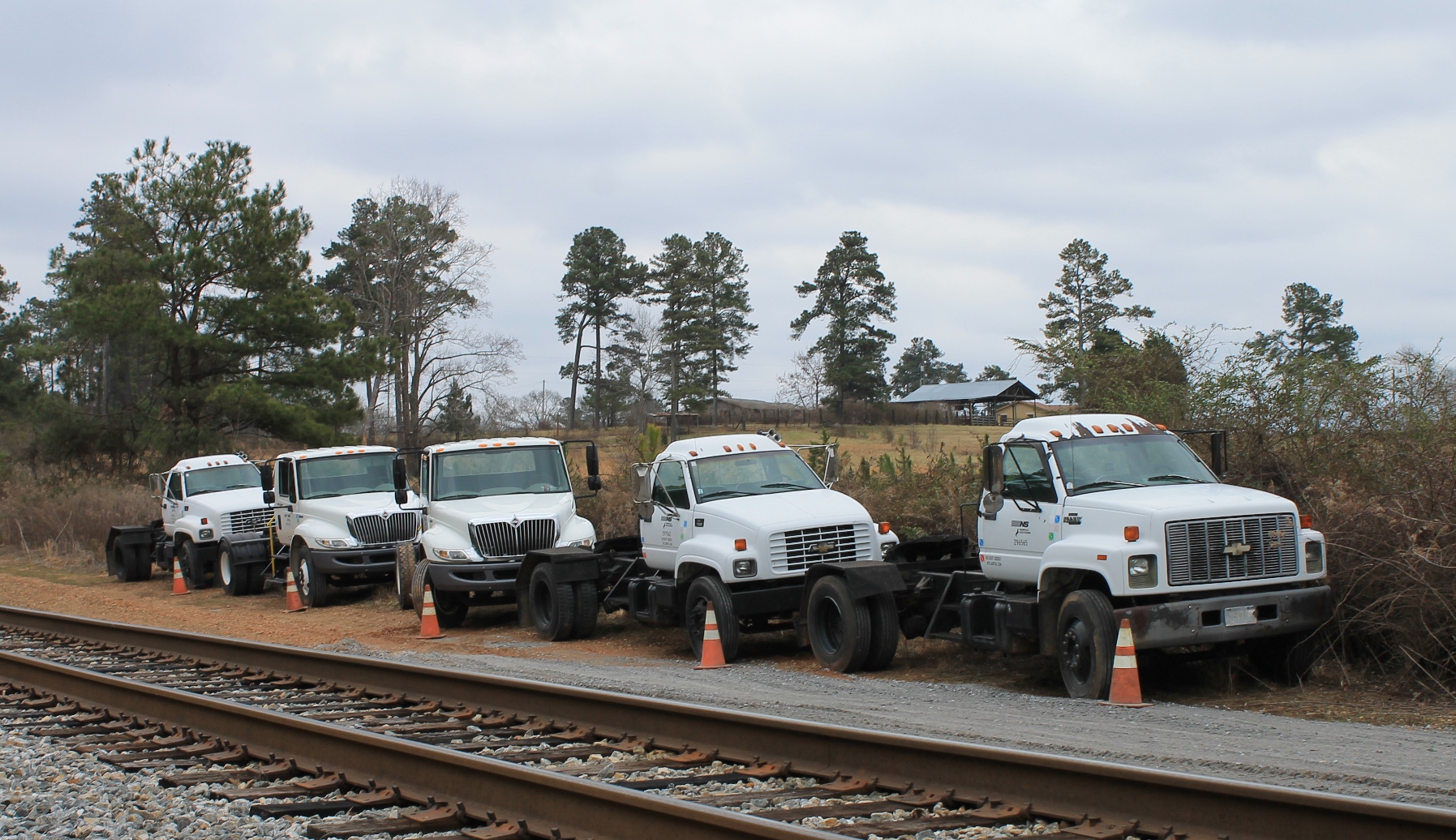
The railroad camp was a whole world in its own. The focus here is NS, since CSX has none with no plans of reinstating them. With the break-up of Conrail, NS kept the CR gang-camp structure and related equipment, while CSX abandoned it to align its part of CR with the hotel-based system seniority structure. As a rule, NS assigned a railroad camp to all program maintenance gangs, tailored specifically to the size of the gang. The size of the camp is directly related to the number of machines assigned to the gang. Each machine or operation has a base compliment of gang workers to maintain production standards. My experience with Norfolk Southern T&S #1 during the 1990s involved a total compliment of 23 machines and 55 men. This did not include three foreman positions, the gang Superintendent called the “Gang Boss” and his deputies, usually one or two Assistant Superintendents called the “Mini Boss or “Junior Boss”). Camp accommodations were based on six men per Univan trailer. Foreman supervisors lived in Univans that were set up as two person Univan “suites” containing separate office areas in them for administrative work, payroll, supplies requisition and production reports. The superintendent and his deputies actually stayed in nearby hotels at night as a perk of the job. Their office was typically their assigned crew cab trucks during the day and a hotel suite at night and on the weekends. There were four to six mechanics assigned to the gang also, working out of their service trucks during the day and also staying in hotels at night. A camp cook and assistant lived in one side of the kitchen car. One to two men, usually old timers, were tasked with maintaining the camp. This included refilling potable water tanks, keeping camp power generators fueled and running and moving outfit supplies to and from the gang storage cars to worksites. They also supervised regular supply drops of machine parts, food and personal items needed by the camp or gang.
NS gang design changed during post Conrail years, favoring former CR equipment. The CR equipment was more modern, standardized and in better shape. This fit the penny-pinching NS philosophy squarely. NS began retiring some of is older gang equipment and moved back to rail based camp trains instead of highway-based camps. The exception was T&S #1. In the mid 2000s, CR equipment became prevalent even on the Deep South ex Southern lines. NS seemed to adopt MofW gang standards used by CR, as colors changed from Southern Orange or NW dark green to CR grays. Equipment mixed CR yellow with Southern orange, but after a few seasons all the CR yellow equipment was in the long-standing Southern orange. In the later 2000s, rebuilding and remodeling the camp trains further blurred the lines, but a close examination seemed to always find a gang with equipment from NW, SOU and CR.
Studying the overview picture of NS T&S 1 at the Wansley picture at the beginning of the article shows a large footprint gang that would be a diorama unto itself. These campsites were maintained through the years, since the camp hopscotched over the various districts using the same campsites through a production year. For modeling purposes, while notable, this gang is too large to model expeditiously with limited layout space. As a result, the focus will be on smaller rail-based gangs typical of modern operations in the post 2000 world.
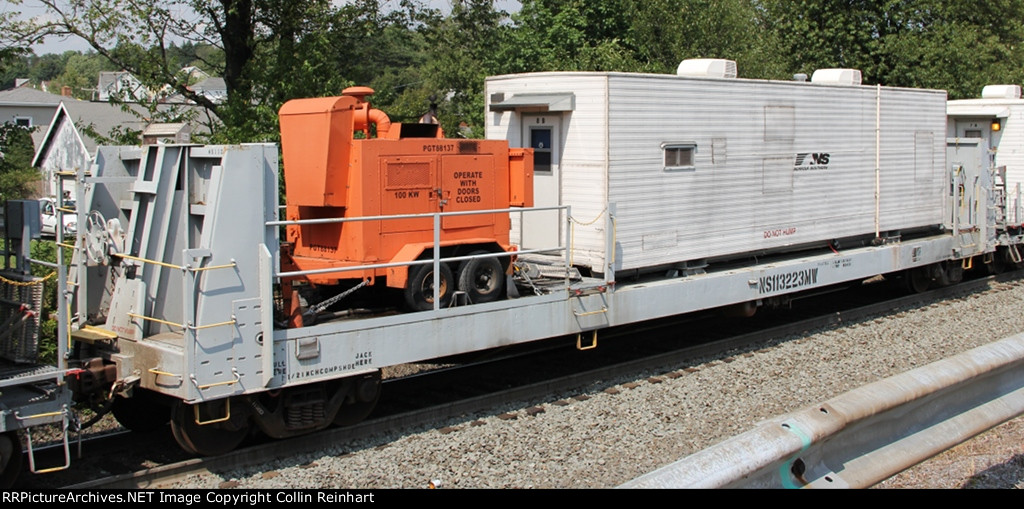

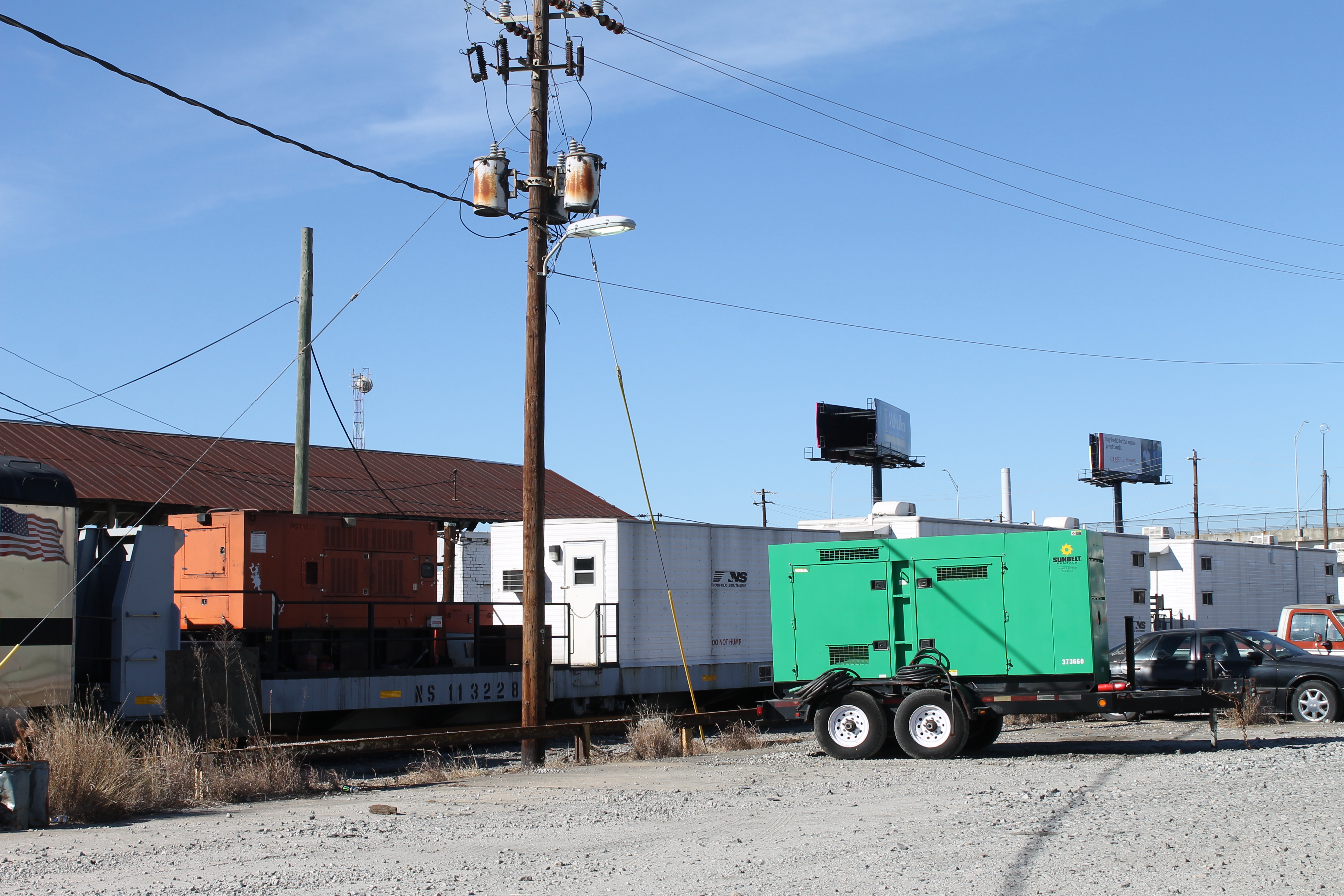
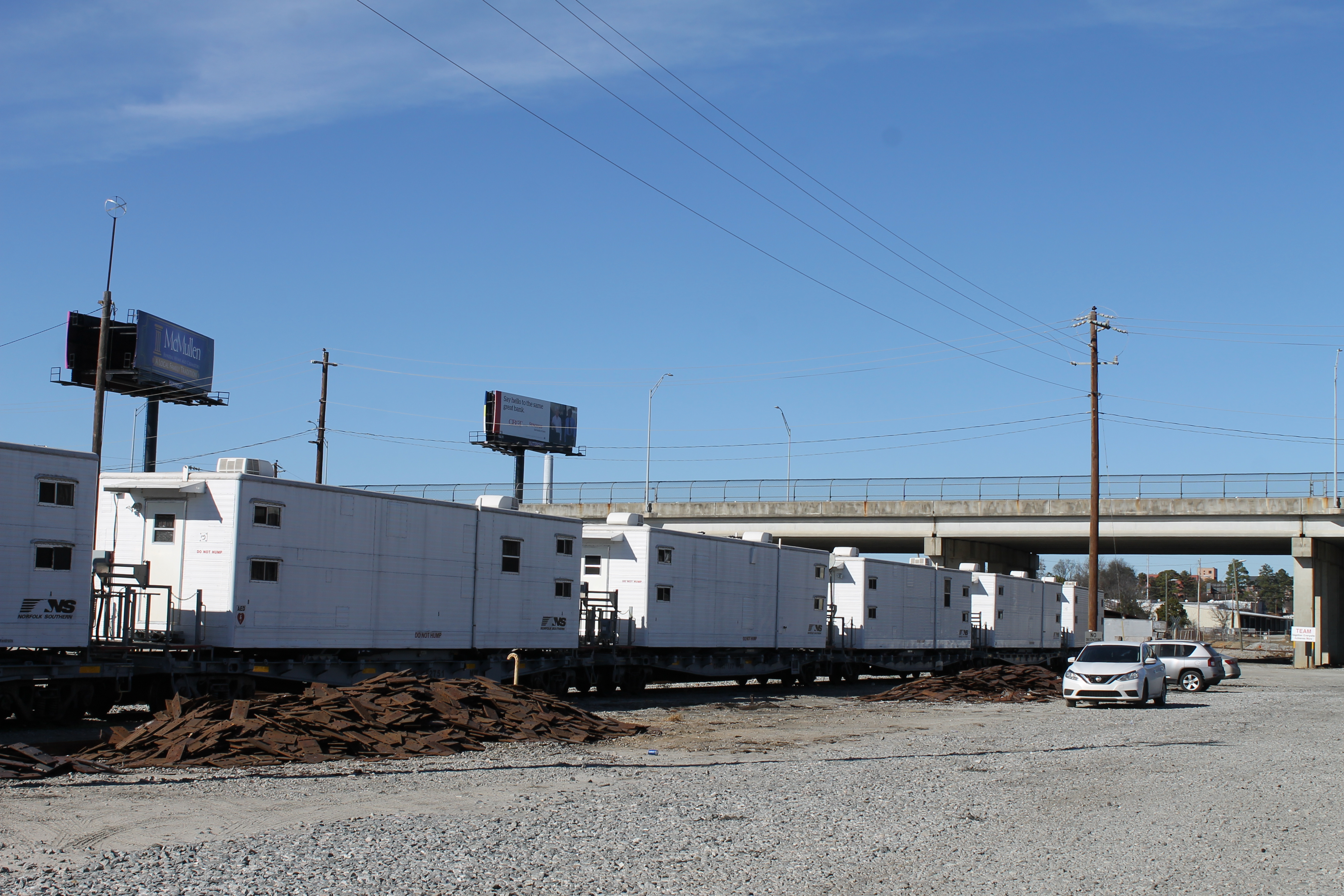
The two pictures above represent the camp of NS T&S 2, a standard sized tie and surface gang typical of Norfolk Southern in the mid 2000s. With the maturation of cloud based IT accounting and highly automated mechanized machinery, a standard gang is small and compact. This gang was working the Central of Georgia Railway P-Line from Columbus, GA to Birmingham, AL. This was my old work district, and to this day remains as a secondary line with little traffic. The camp was located at the remains of the CofGA Columbus Yard at the idle car shop lead. Apparently, the generator mounted to the repurposed pulpwood rack turned gang generator car was having issues, and a lease unit on a trailer was actually providing hotel power to the camp. The generator shares the old pulpwood conversion car with a half sized Univan that contains power control panels and feeders that run the length of the camp train. This allows each car to be isolated if needed for transport or repair/replacement.
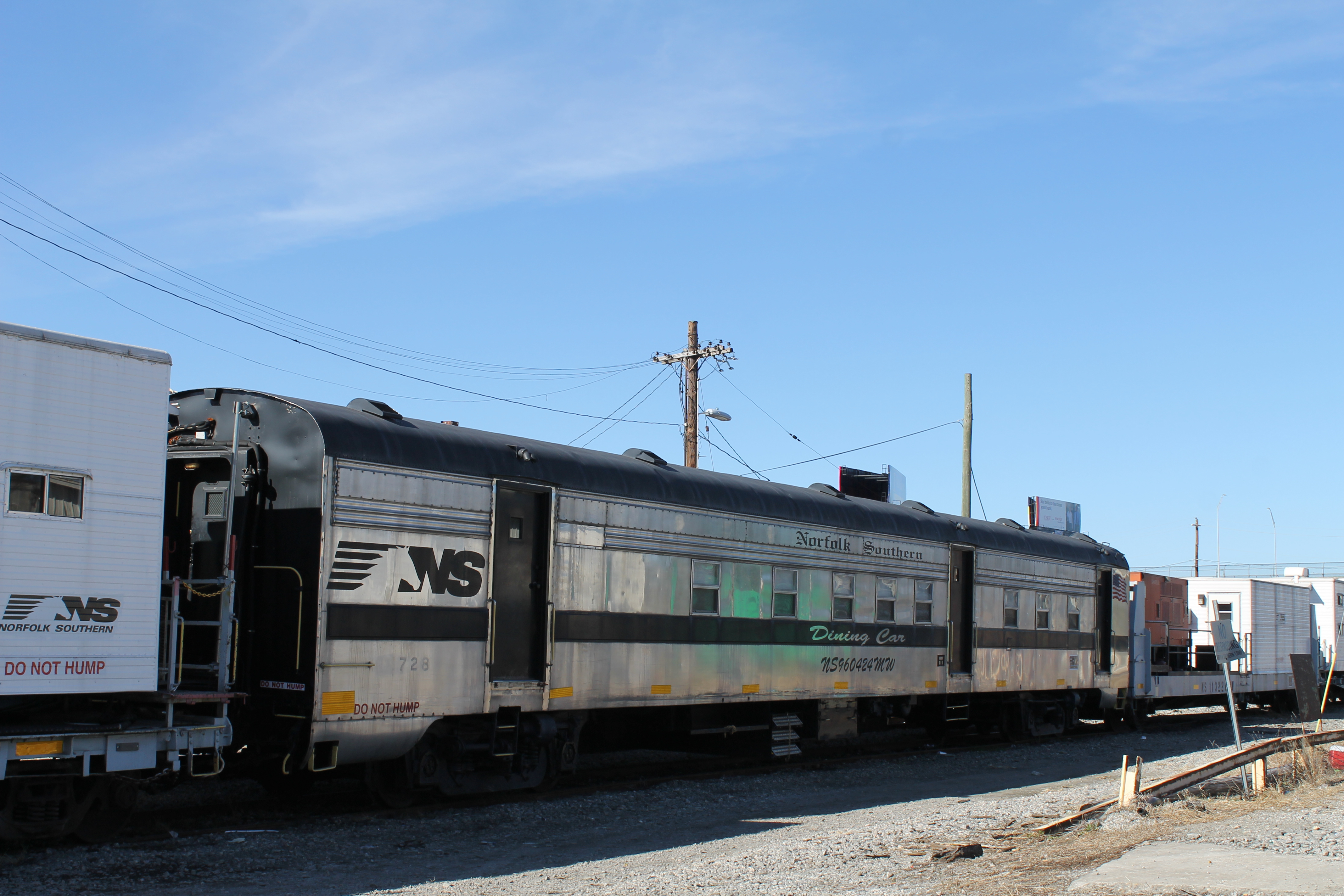
View of lightweight passenger car rebuilt into a diner. This car replaced the Univan diner to provide not only space for meals but room for training and gang meetings at large. These cars typically have a long bench/table running the length of the car. Notice typical passenger windows and doors were replaced with typical units found in commercial building construction. These gangs spend years traveling far from shops so efforts are made to standardize components so they can be replaced on site, wherever that site may be located. Foodservice would be buffet style on the end closest to the kitchen Univan to the left.
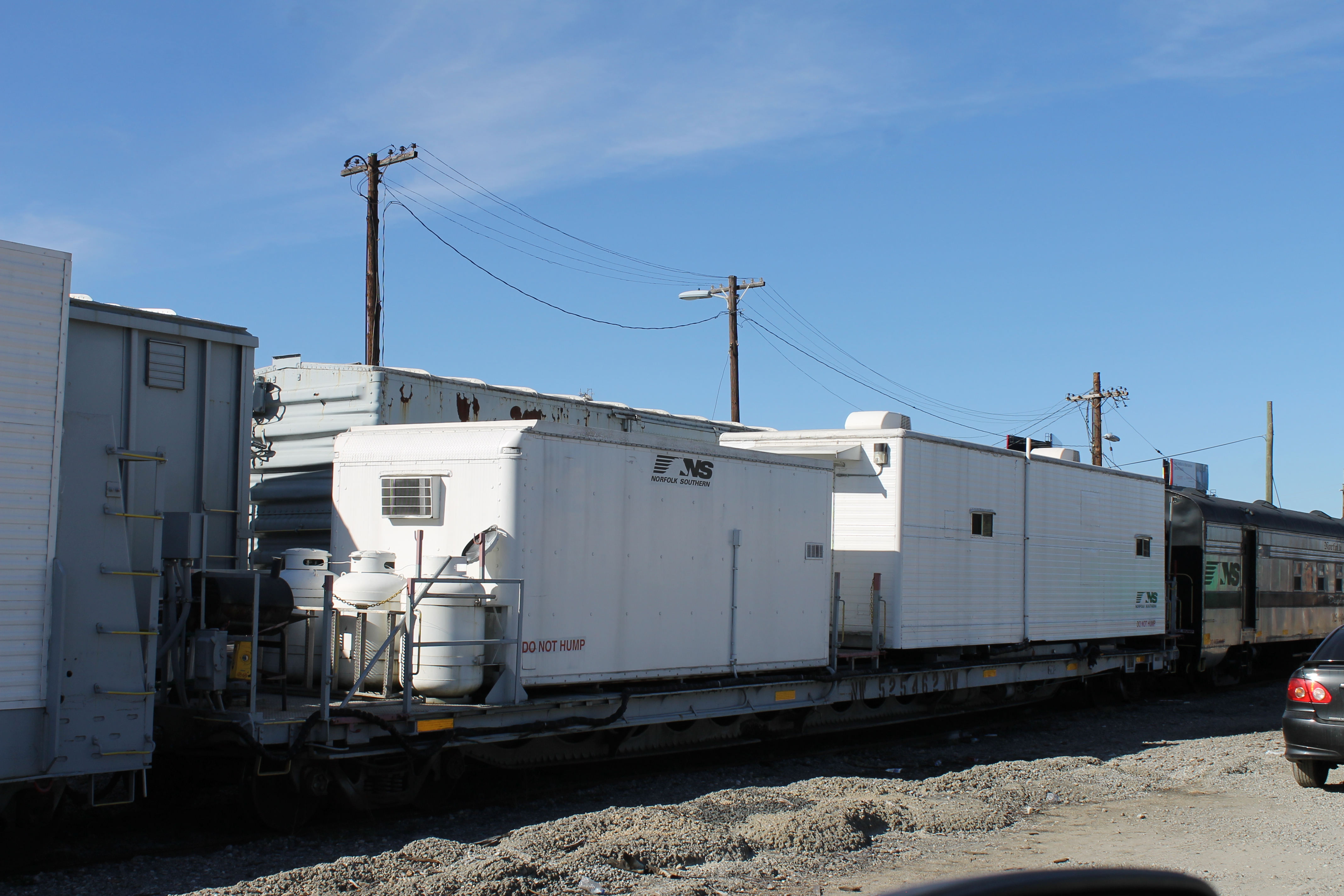
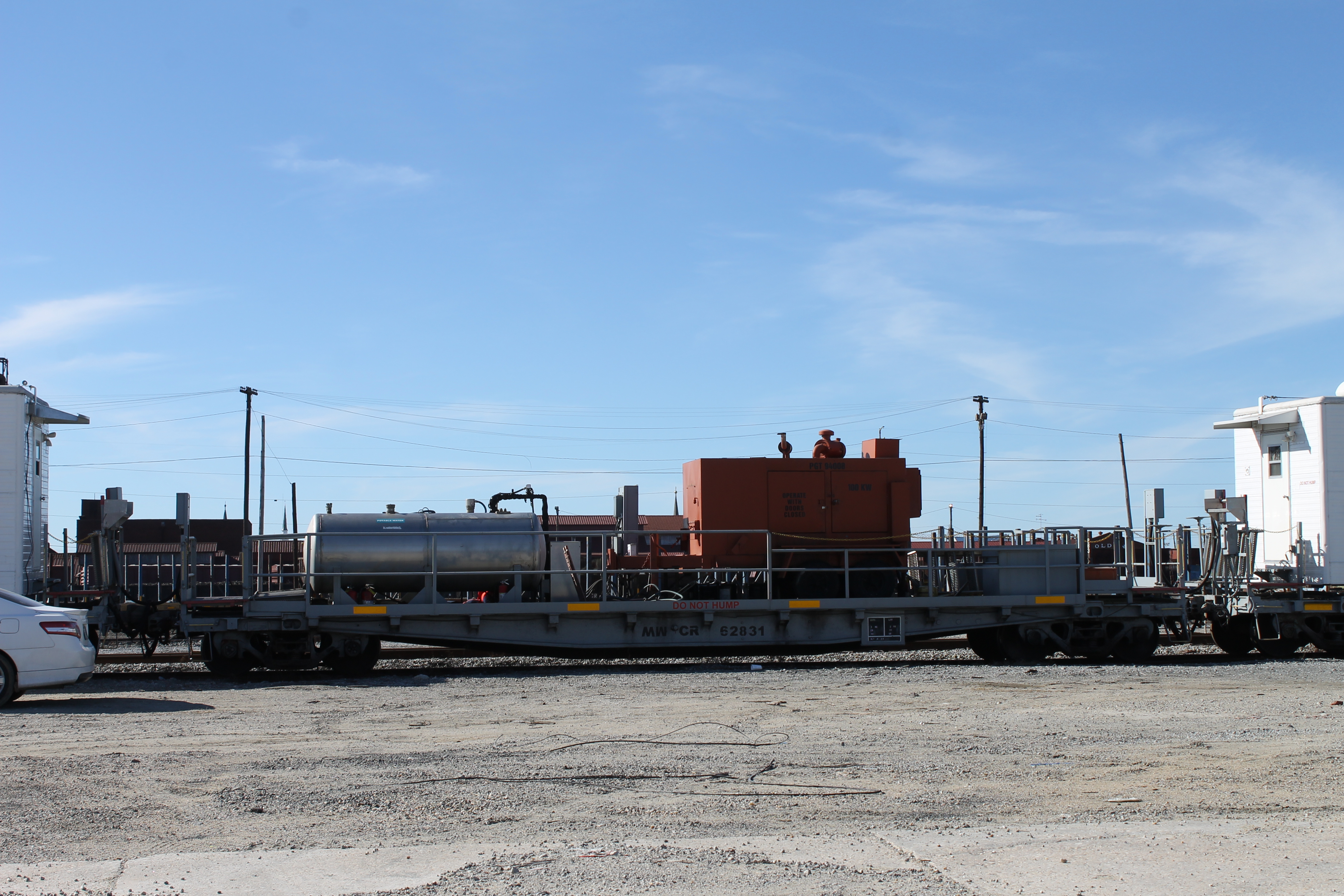
Potable water service for the gang is provided by this flatcar conversion. This gang relies on hook up to an outside water source such as a fire hydrant. Camps are located where water utility service is available. The stainless tank is likely a pressure tank to create water pressure for showers and basins. NS typical uses porta-potties rather than a shower toilet system with waste retention. Some gangs do have a dedicated shower and toilet facility car which operates much like a typical RV camper system, but on a larger scale. Unfortunately, there is some supposition here as my experience was systemically different when it came to water and waste service for the gang.

A GANG CAMP PROTOTYPE
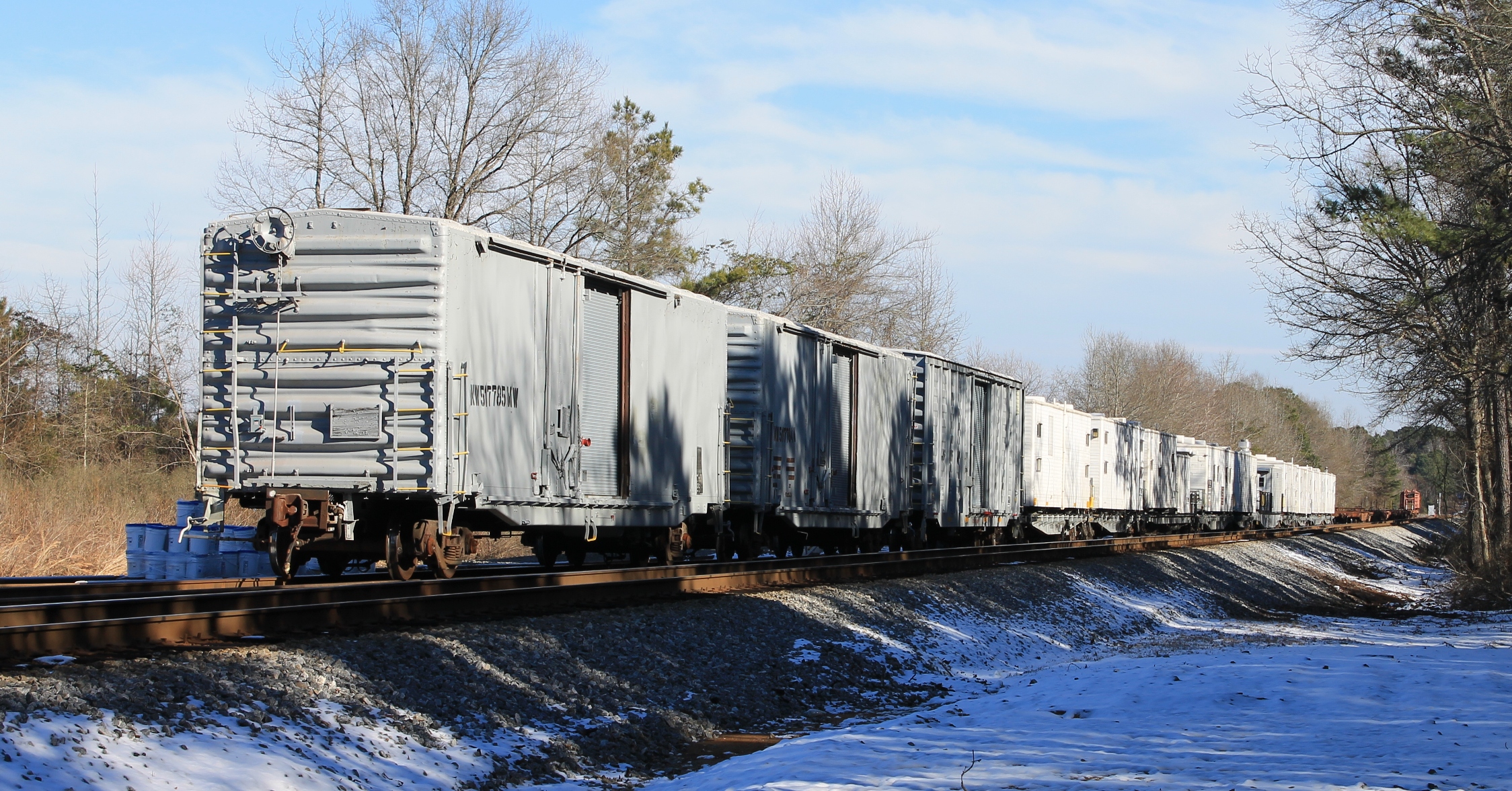
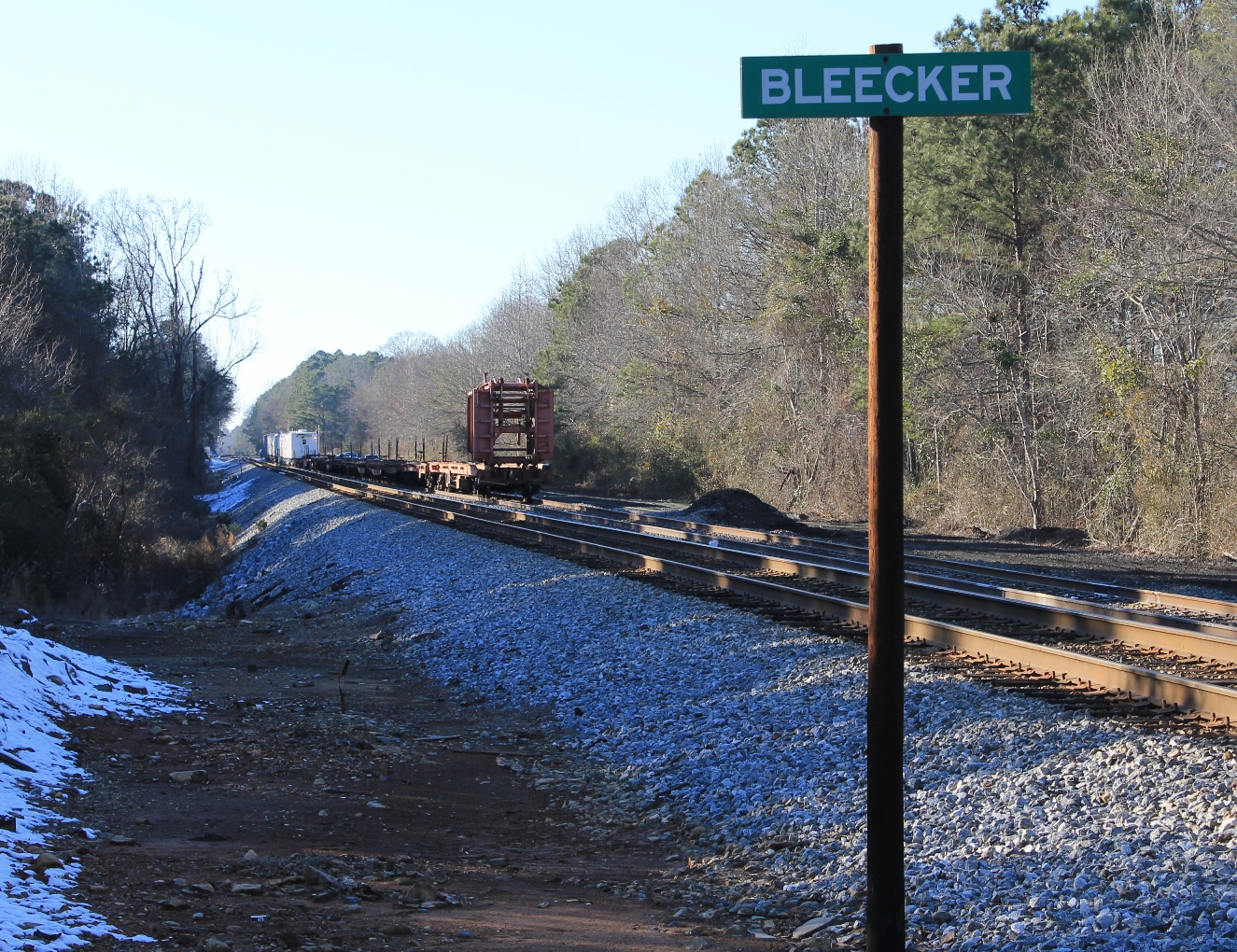
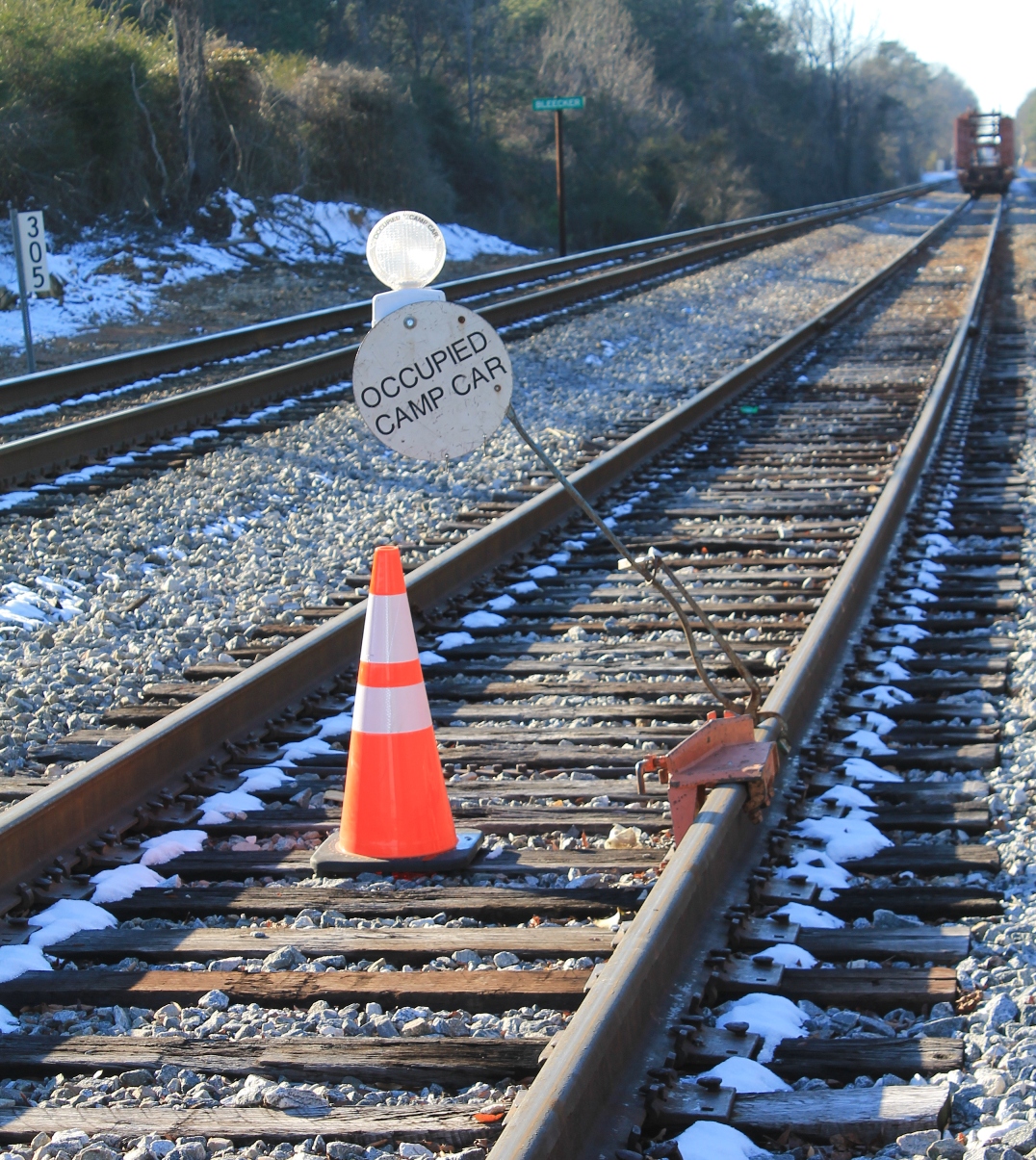
This section focuses on a particular gang in 2016 documented on the old CofGA P-line mainline between Columbus, GA and Birmingham, AL around 2016. The gang was the Norfolk Southern R-11 Rail gang camping 30 miles north of Columbus, GA at Bleeker, AL (pronounced bl-E-KUR). The camp location was chosen outside of the yard in Columbus, GA as the work started at Bleeker and continued north toward Birmingham, AL. East Alabama Water and Fire District had water hydrants at the road to supply water. The customary portable toilets lined up next to the camp train. The R-11 program was replacing and gauging worn curve rail with new rail strings dropped several weeks ahead of the gang arrival.
Here is the gang by the numbers:
| Gang Position Order | Reporting Marks | Car Type | Notes |
| (Begin) | |||
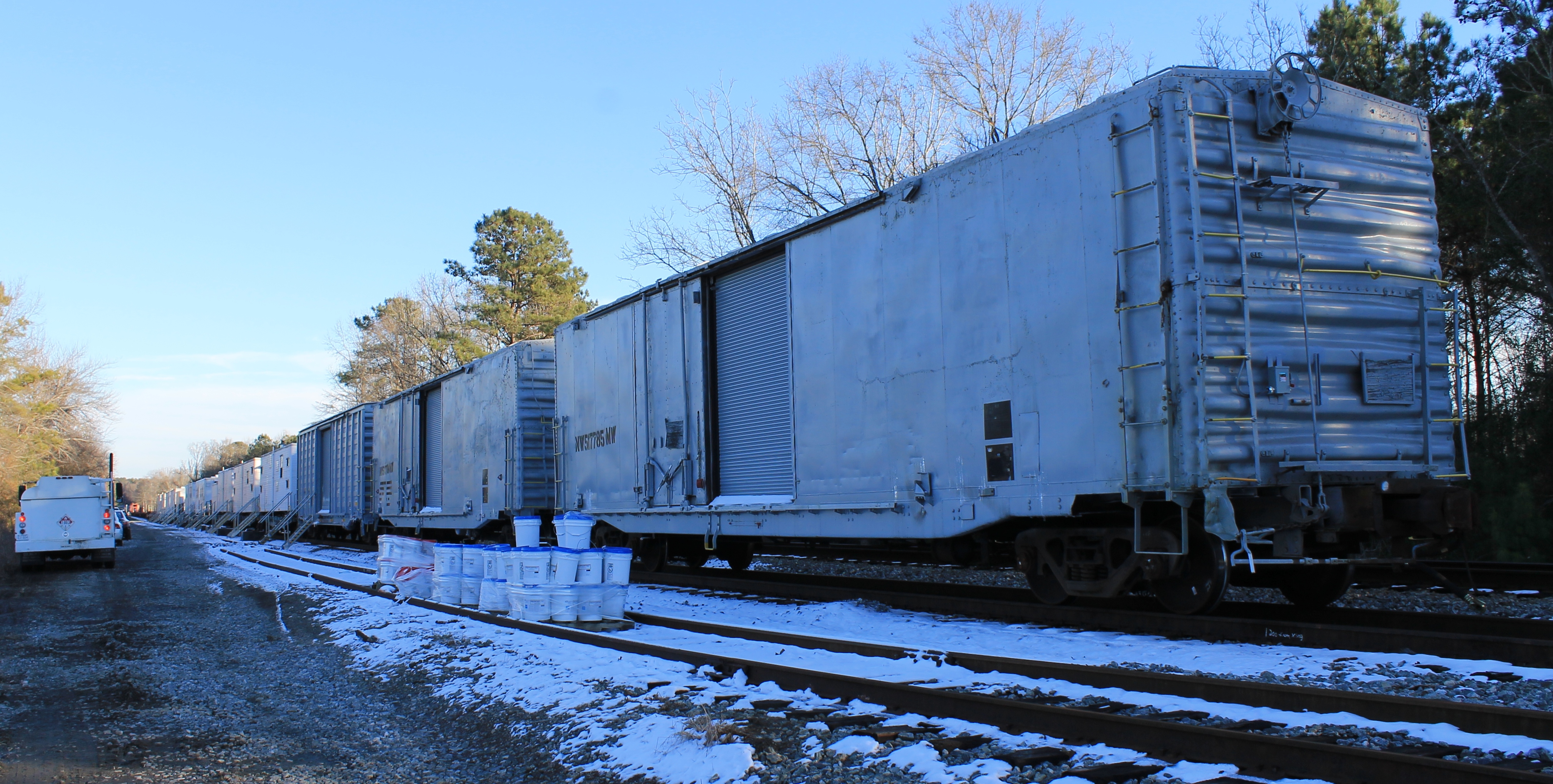
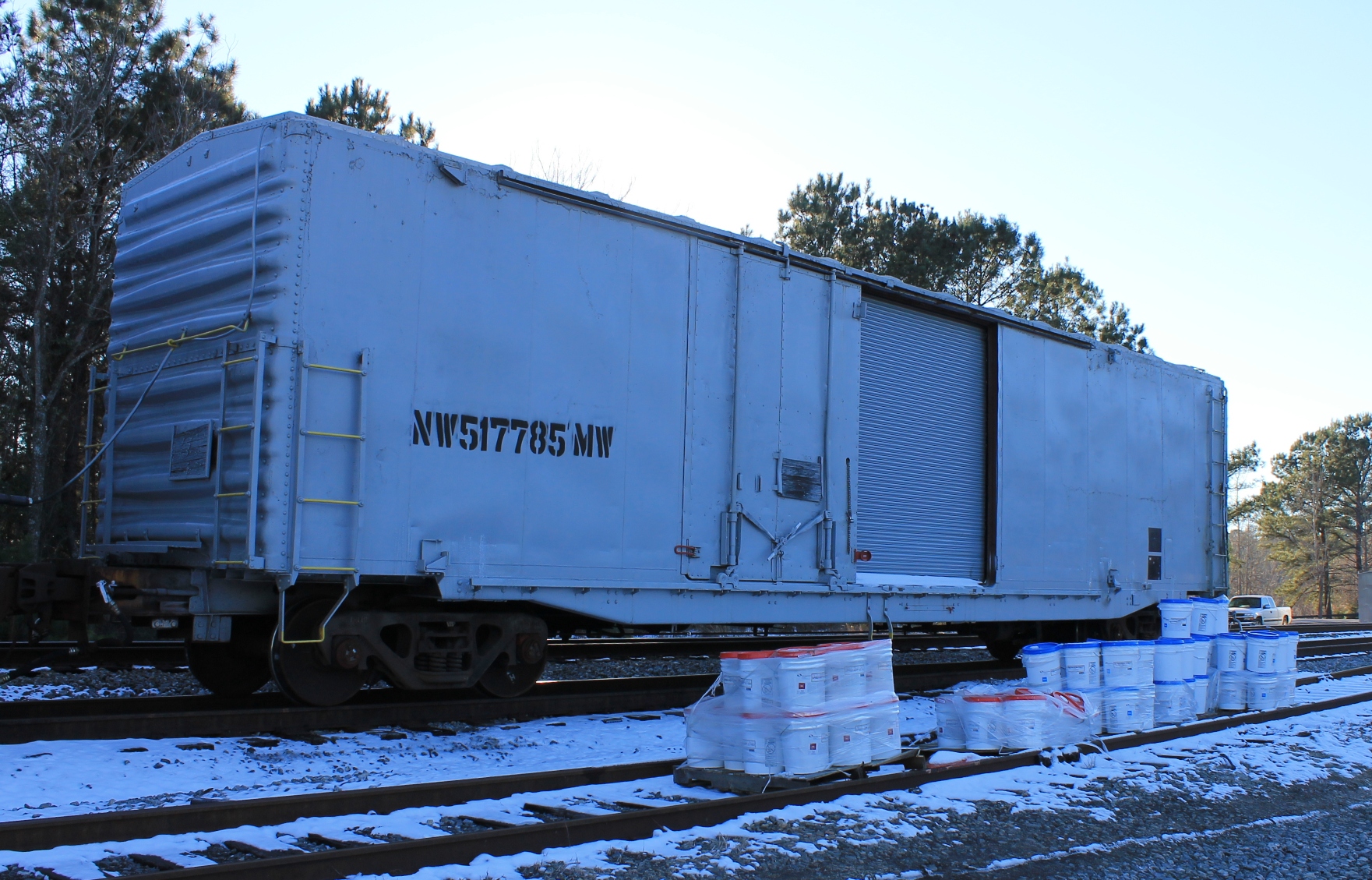
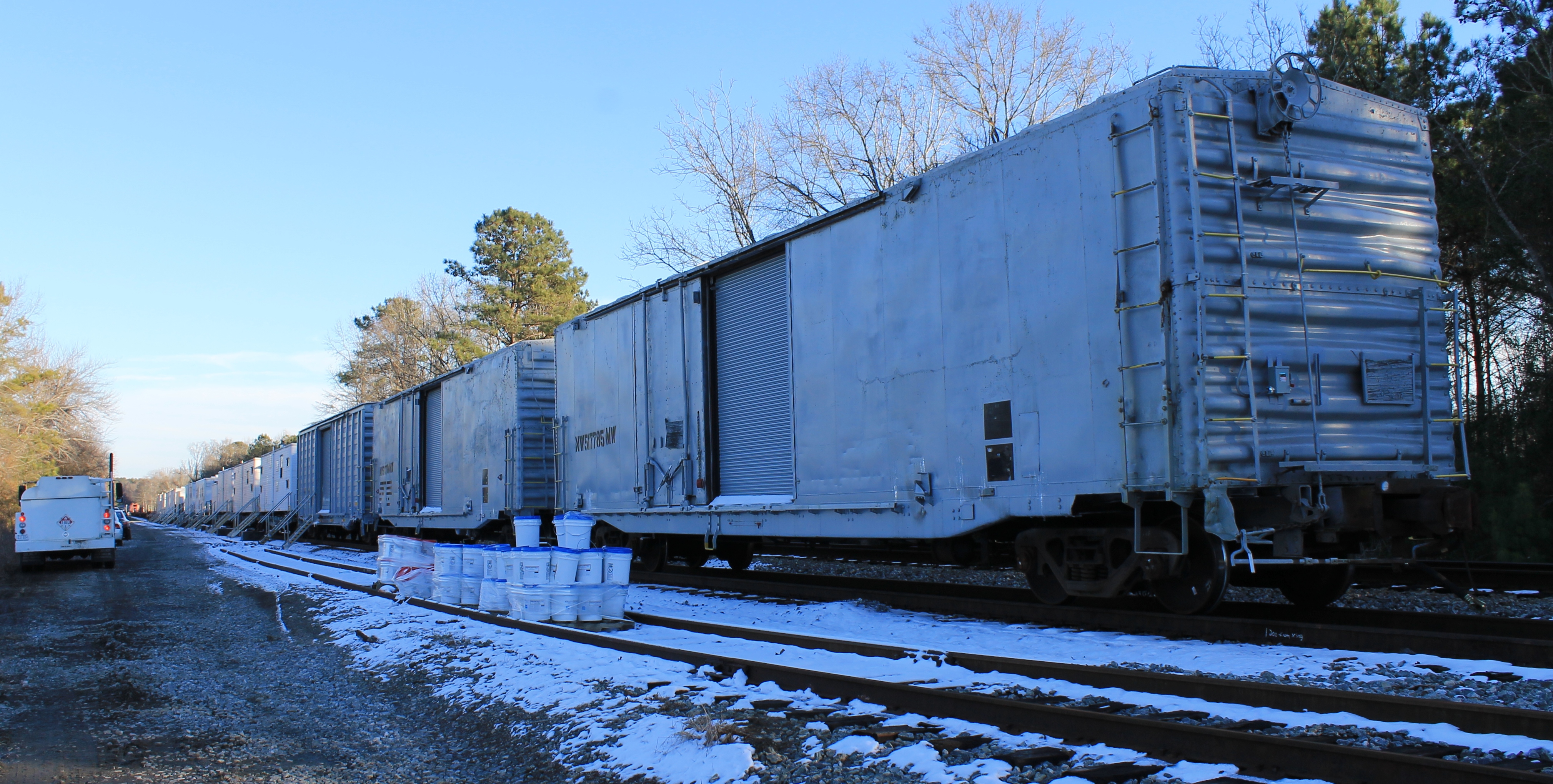
| First | NW 517785 MW | Outfit Car–consumables | Former Pullman- Standard double door autoparts boxcar |
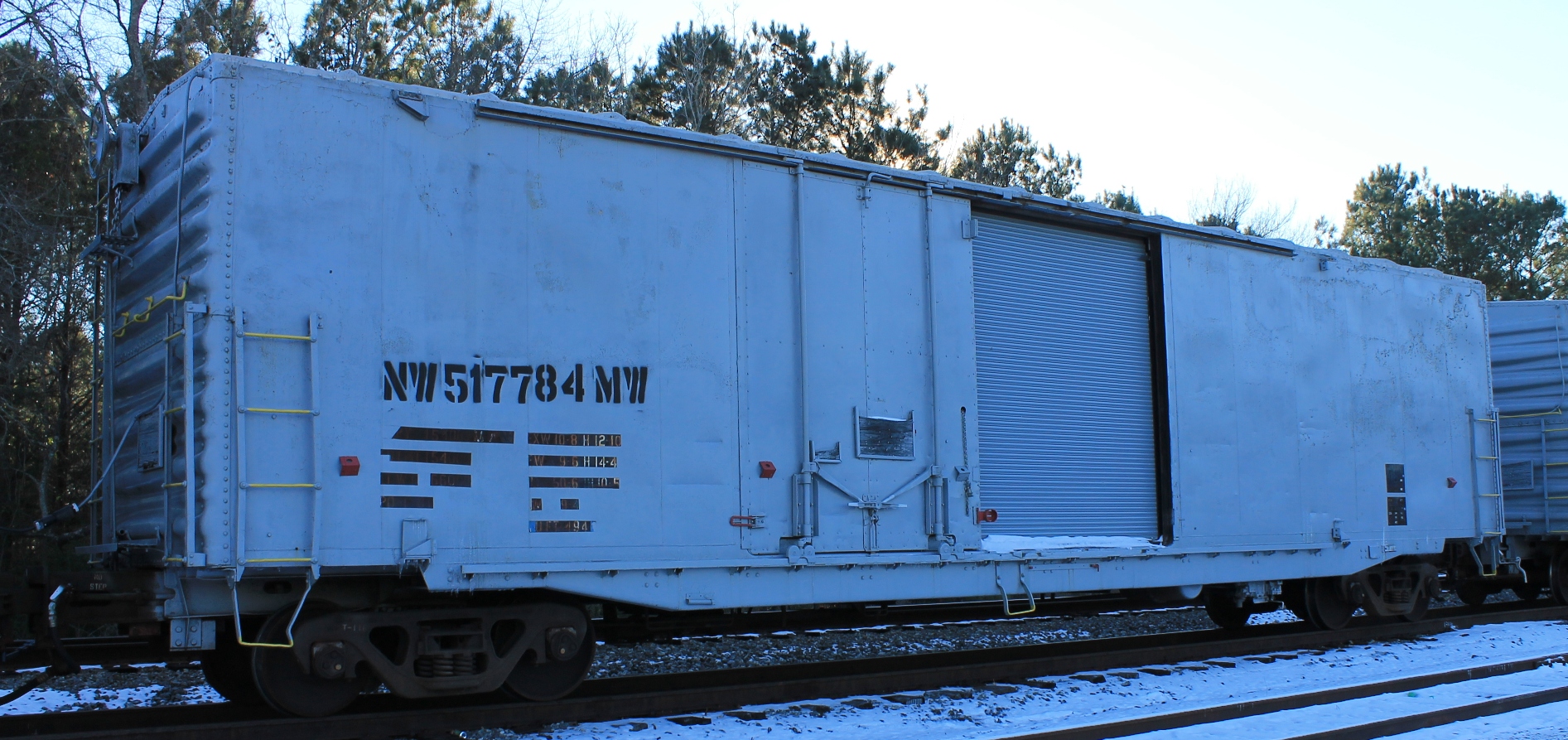
| Second | NW 517784 MW | Outfit Car–machine consumables/parts | Former Pullman- Standard double door autoparts boxcar |
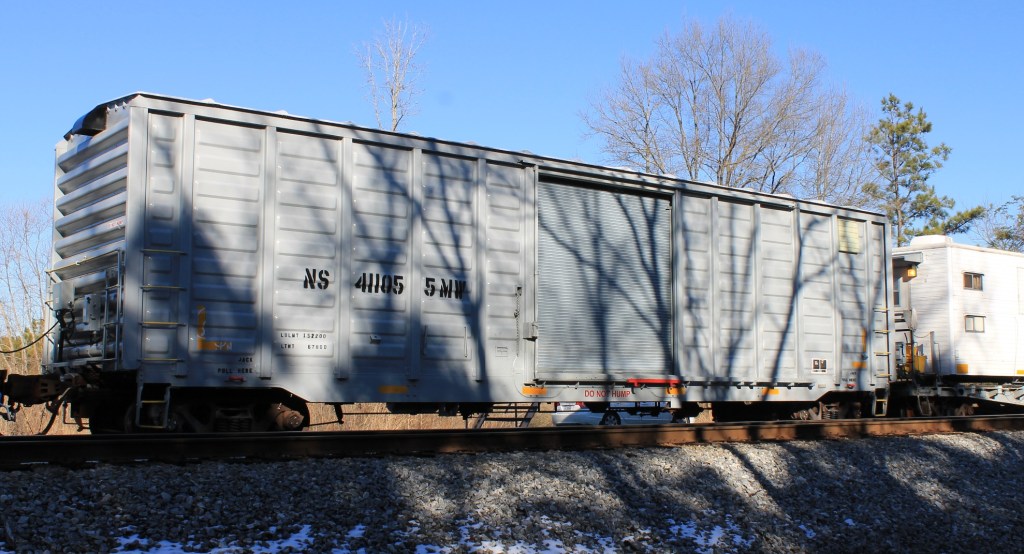
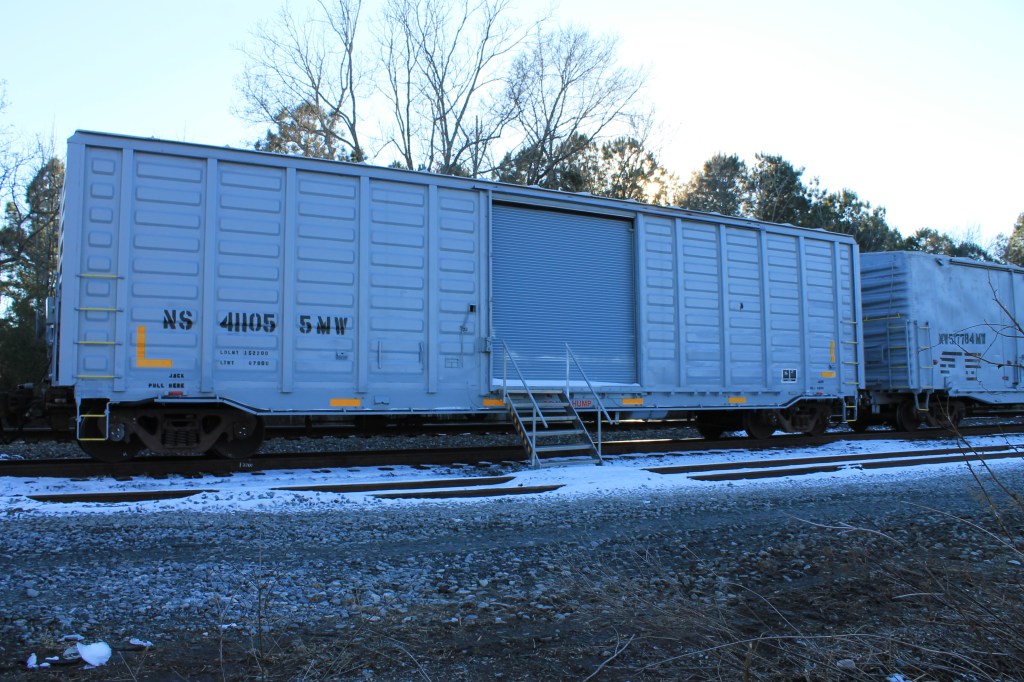
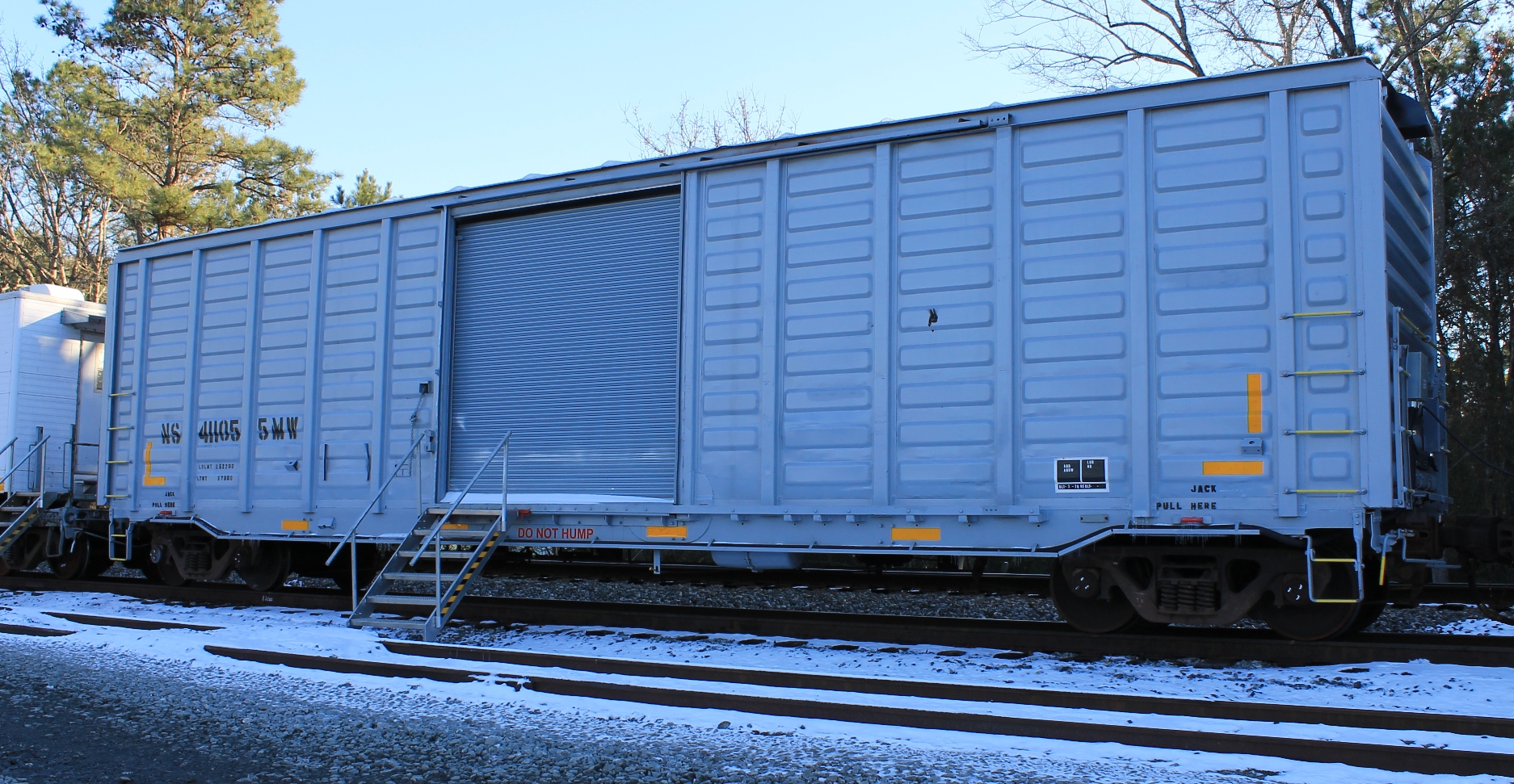
| Third | NS 411055 MW | Outfit Car–machine parts and workspace | Former SOU waffle side boxcar |
| Fourth | CR62621 MW | UNIVAN office/supervisor quarters | GSC customized flat car |
| Fifth | CR 62820 MW | UNIVAN Kitchen | GSC customized flat car |
| Sixth | NW 525460 | First UNIVAN 20ft Food Stores second UNIVAN 40ft Cook/Camp Staff Quarters–grill/smoker storage | 86ft Long flat with two UNIVAN short trailers |
| Seventh | NS 994977 | UNIVAN Diner/ Assembly Room | GSC customized flat car |
| Eighth | SOU 991481 | Generator/Power Distribution | 60ft Long flat with stand-alone generator and control station |
| Ninth | CR 62521 MW | UNIVAN Sleeper 1-4 | GSC customized flat car |
| Tenth | CR 62565 MW | UNIVAN Sleeper 5-9 | GSC customized flat car |
| Eleventh | CR 62596 MW | UNIVAN Sleeper 5-8 | GSC customized flat car |
| Twelfth | CR 62151 MW | NIVAN Sleeper 9-15 | GSC customized flat car |
| (Break) | |||
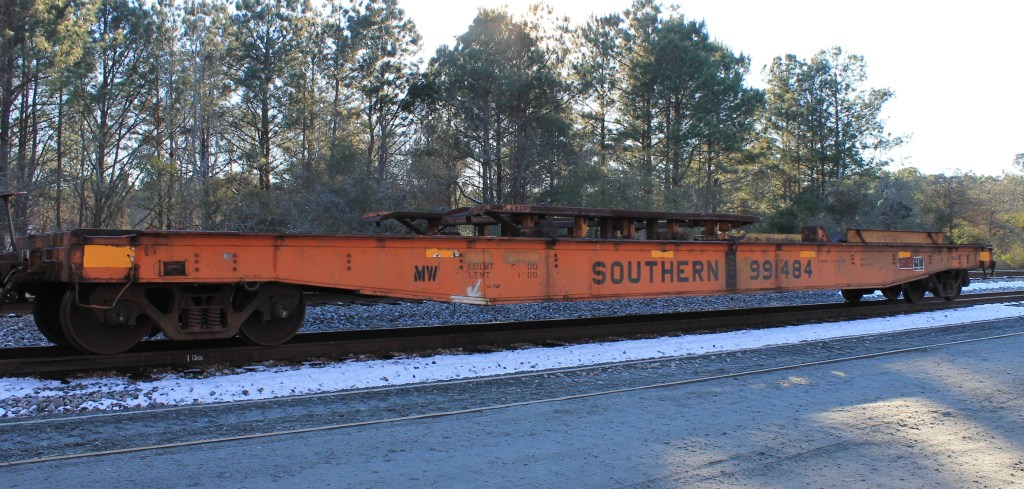
| Thirteenth | SOU 99484 MW | flatcar with removable loading ramp for wheeled equipment | |
| Forteenth through Twenty-First | SOU-NW-NS | Various equipment transportation flat cars | repurposed older equipment including vintage 1928 riveted car |
| Twenty-Second | NS 986313 MW | 89ft flat with Kershaw built Scorpion automatic Ramp | outside channel ex TTX 89ft intermodal flat |
| (END) |
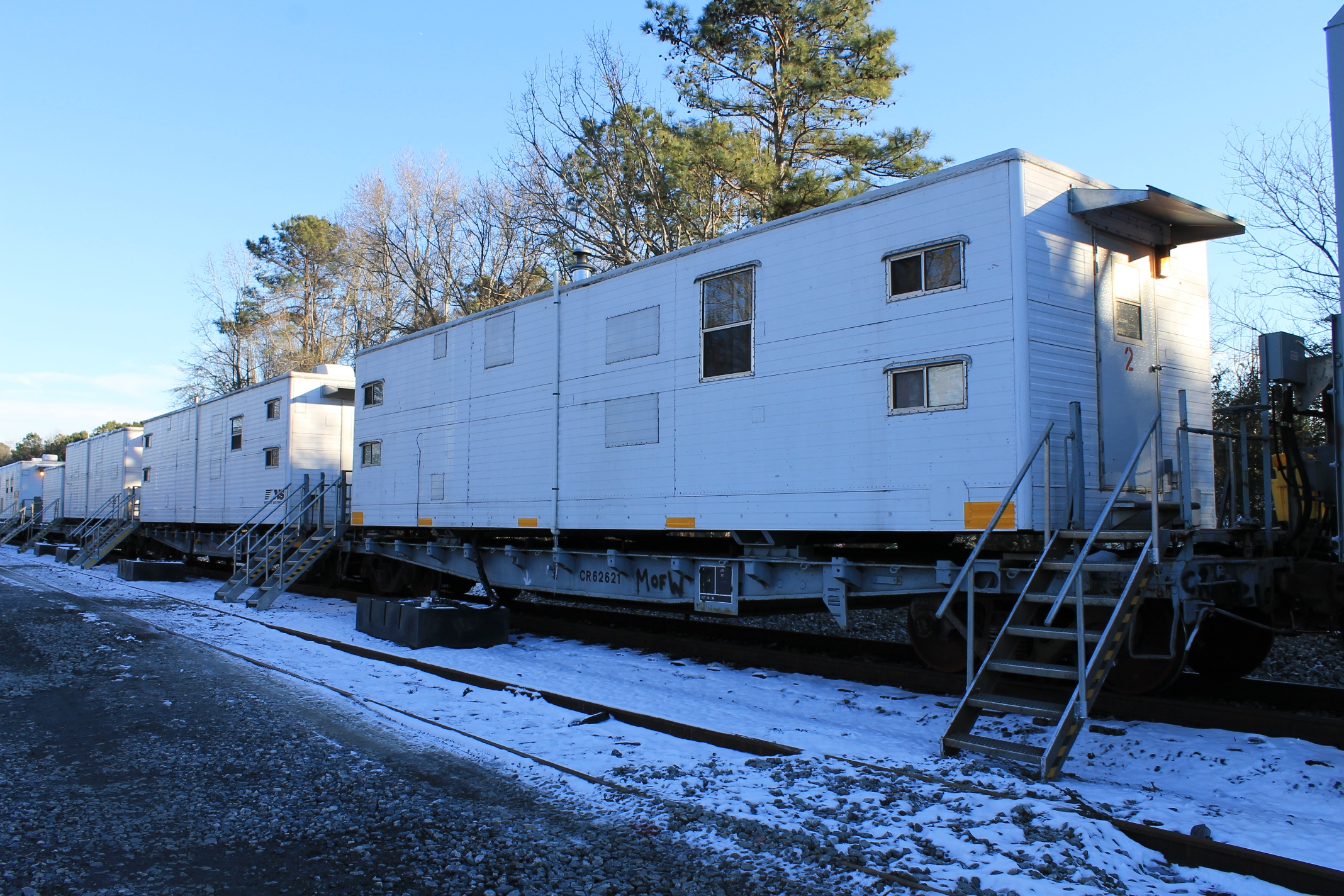
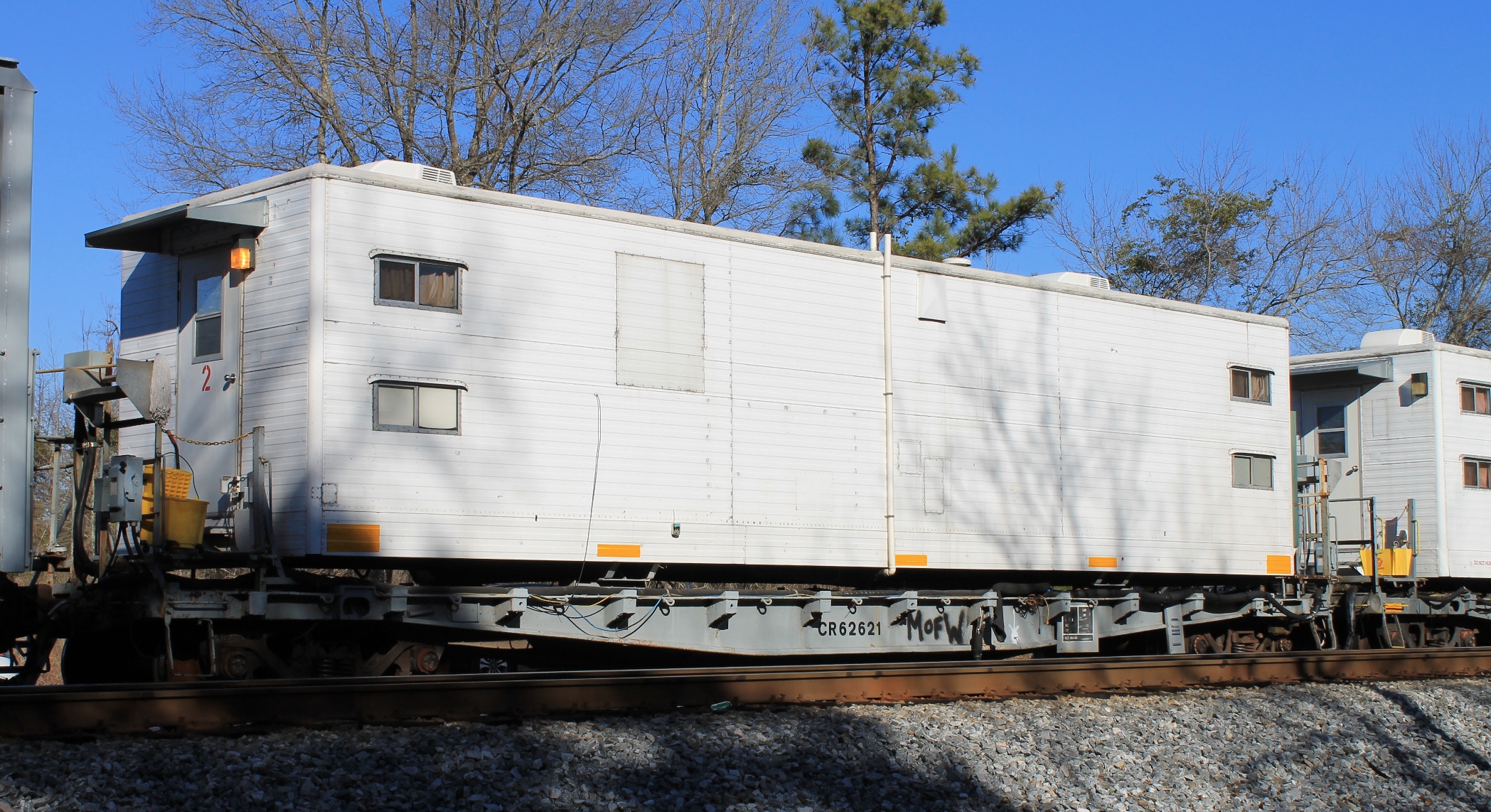
Fourth in gang is the CR 62621 and appears to be the supervisor quarters and office. This is a UNIVAN on a modified GSC flat and is a former CR car. Notice the changes in windows. With so many retrofits and rebuilds over the years, it is hard to figure use from simply studying elevation shots of the cars. With less paperwork and most administrative duties “on the cloud” fewer supervisors and managers can do more in less time. As a result, cars are reconfigured over the years to better fit needs of the gang.
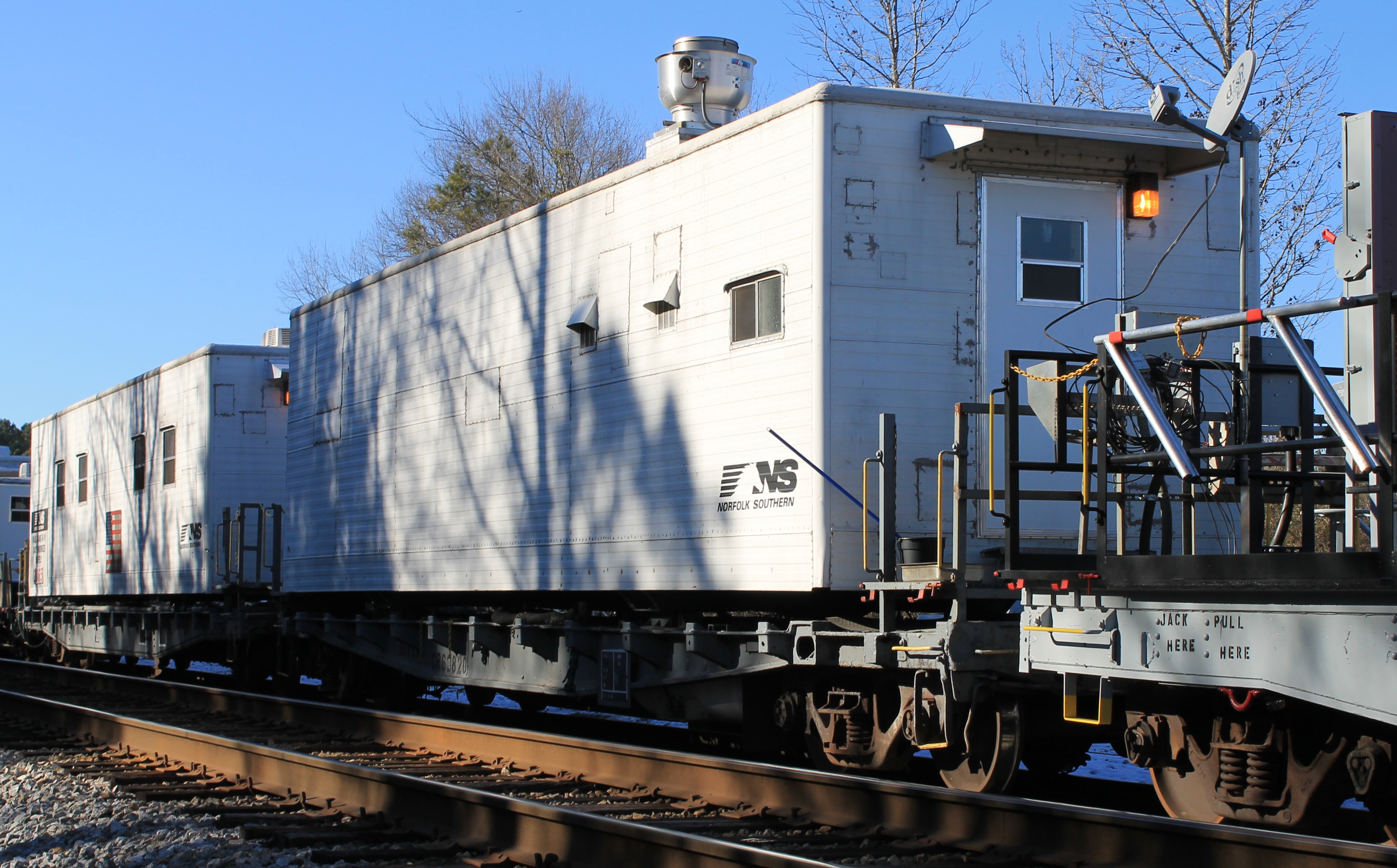
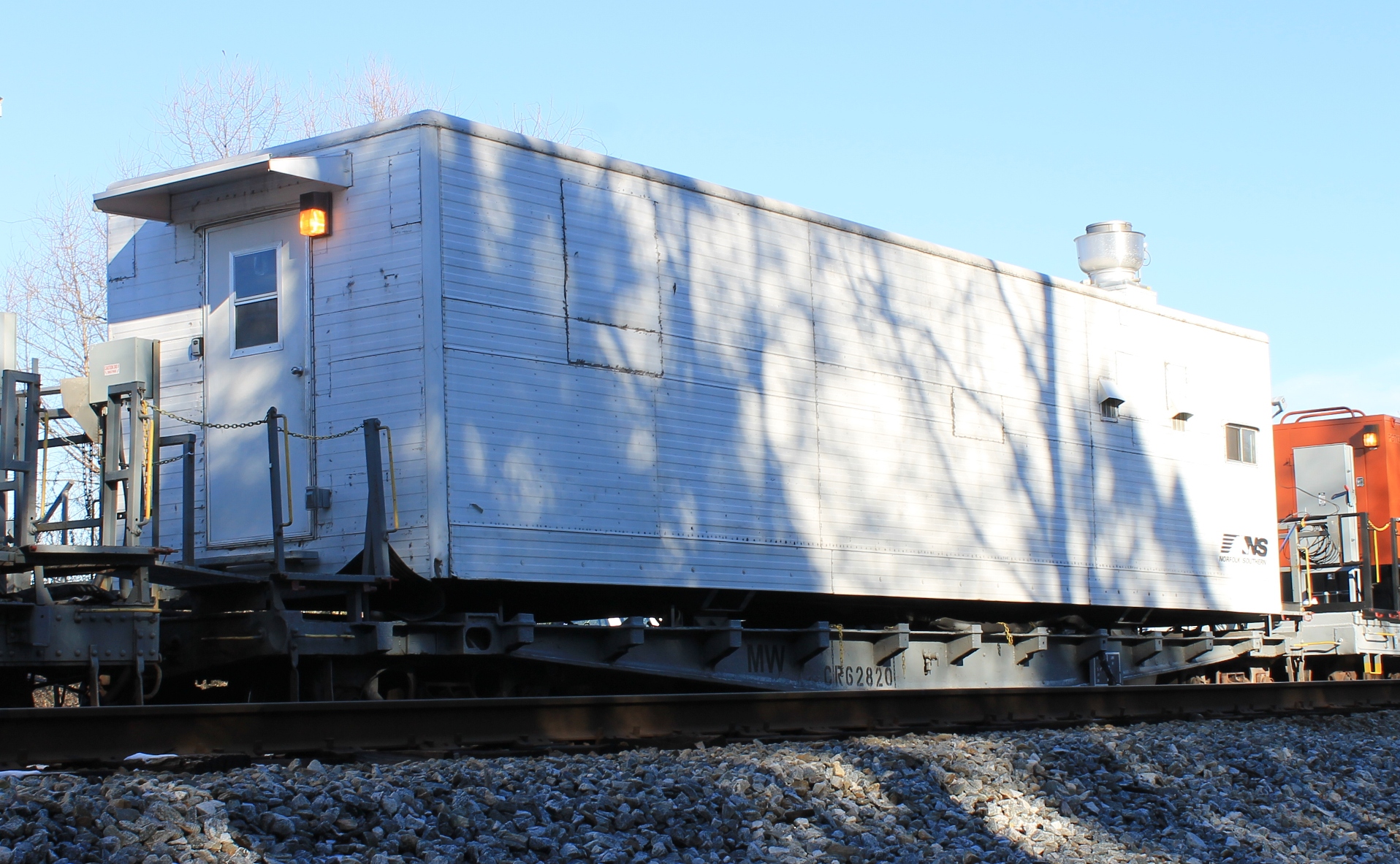
The fifth car in the camp train is the Kitchen car. The large exhaust hood vent fan is the only real spotting feature. As you can see here, this car was converted from an office or diner configuration to a kitchen. No two camp trains are exactly the same so other than the hood on the roof, window configuration does not help.
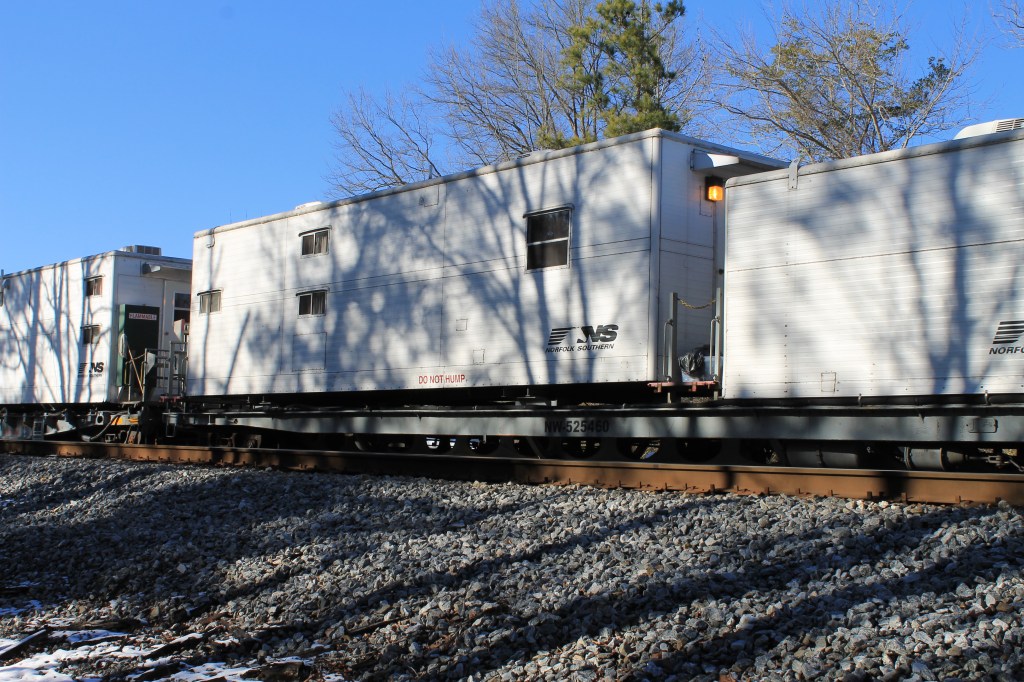
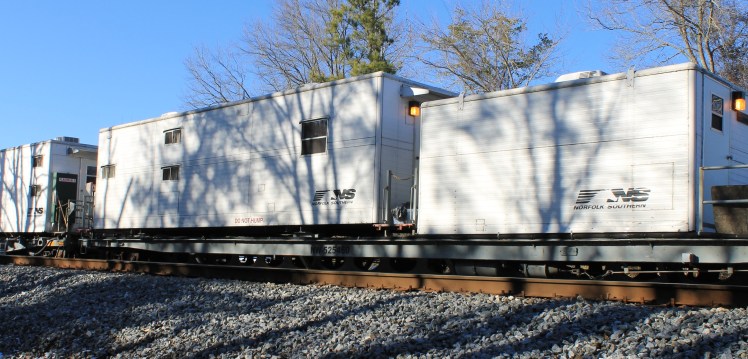

Occupying the sixth position of the camp train is an 86 flatcar that contains the food stores and the Cook Staff bunk. The car was so long I could not get it in one picture, so I settled for a panorama of three shots from left to right. From left to right is the 40ft Cook staff UNIVAN bunk, followed by the food stores and a deck area to grill or smoke food. NS quarterly set aside days for the gang to train and relax with barbeques and afternoon movies. These days helped break the monotony that set in when the gang worked multiple weeks in a row due to work window constraints on busy mainlines

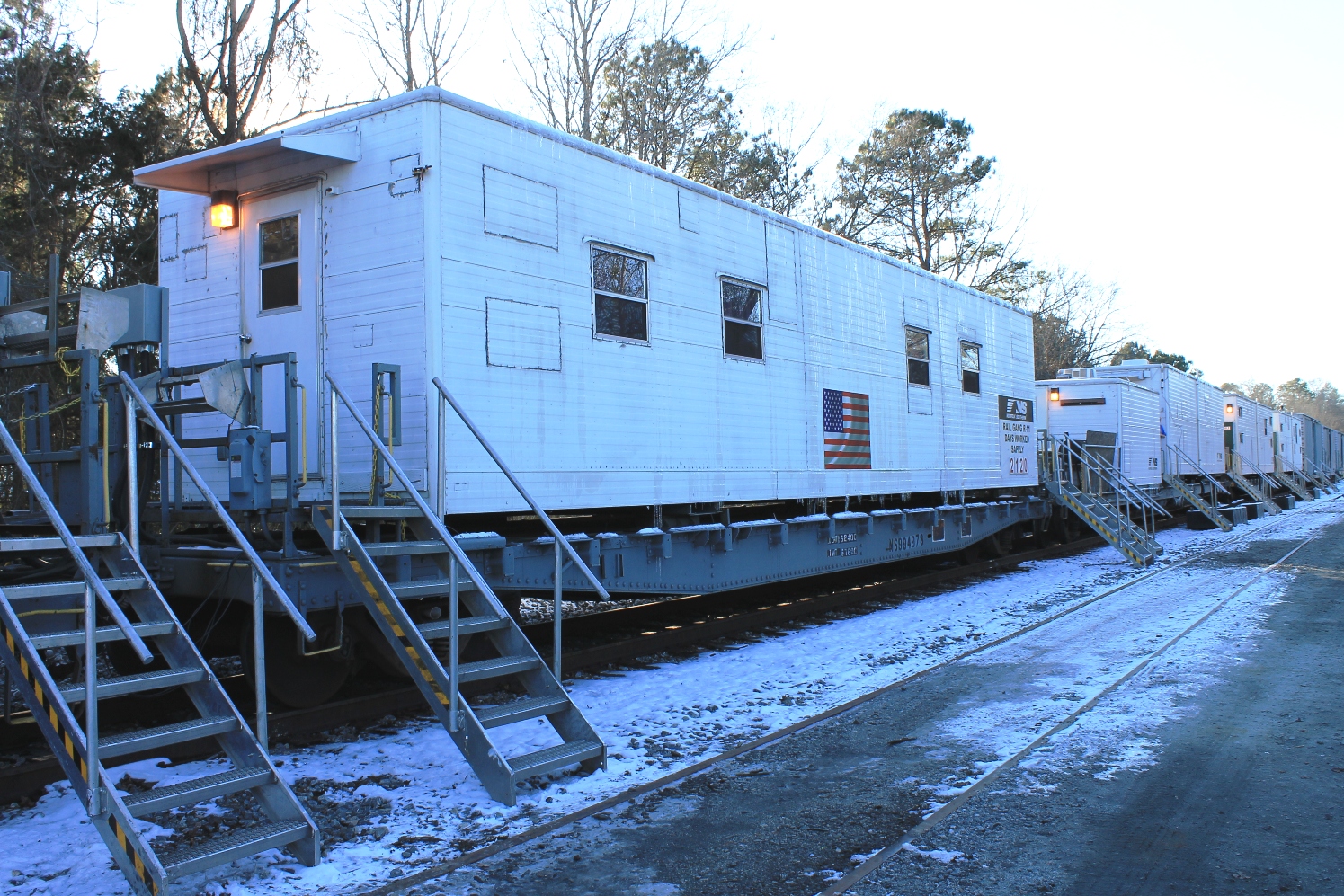
Seventh out in the camp train is the UNIVAN diner. This car uses bench style seating with a long table running the length of the car. The car is also used as a meeting room for gang training and assemblies. Many times at night on T&S 1, gang members gathered after dinner and watched movies or whatever TV our makeshift antennae could catch.
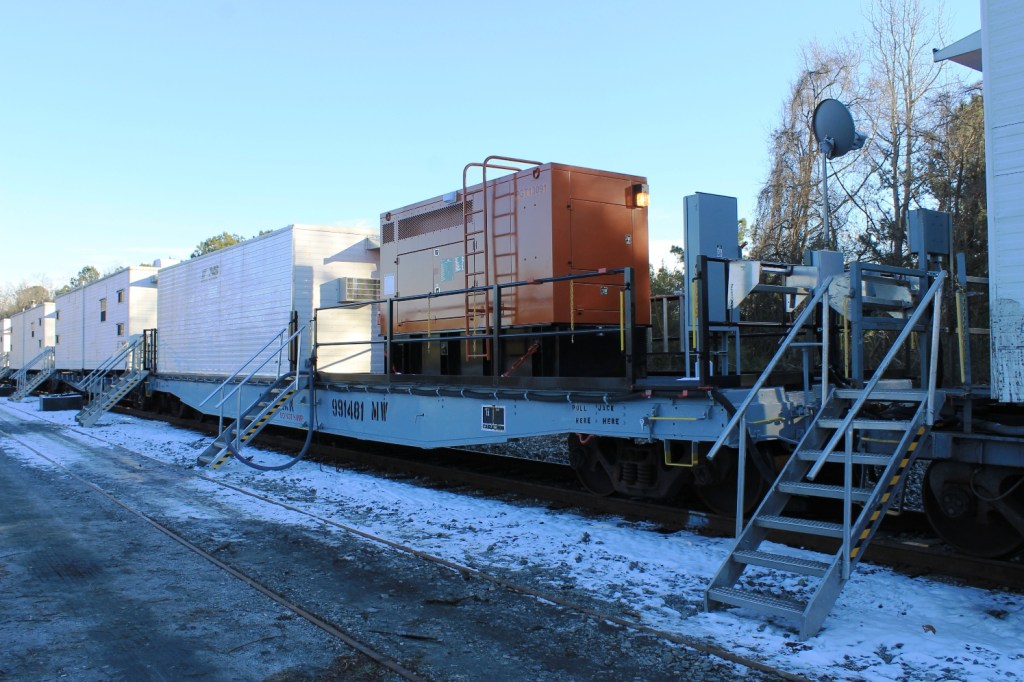
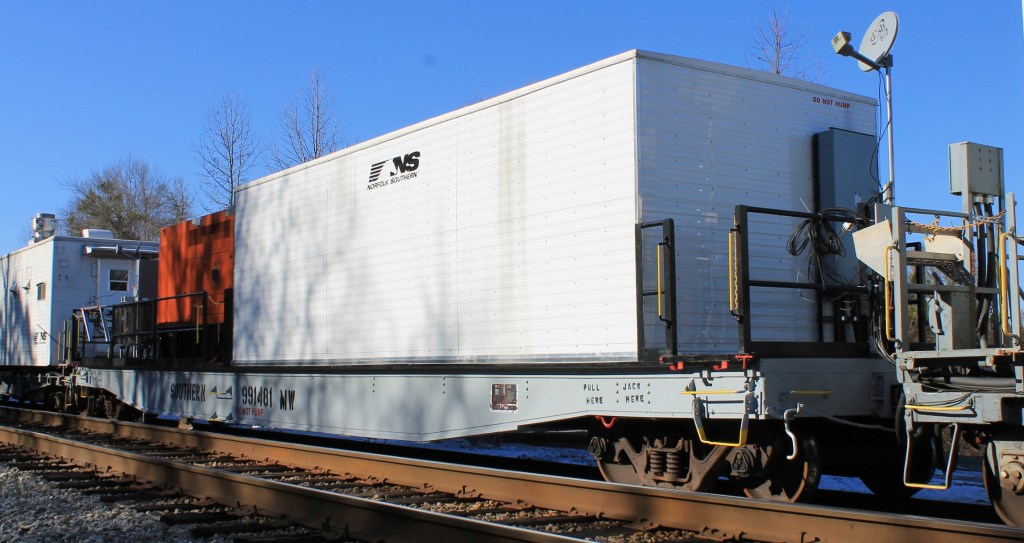

The Generator /Power Distribution Car was eight in the camp train. The generator could easily provide hotel power for the whole camp. Beside it was the power control shack, a 20ft UNIVAN with all the panels, breakers and wiring harnesses used to power the camp. The control shack allowed centralized control of each individual car in the camp. Cars could be isolated for repair or switch out without running high voltage jumper extension cords. On the 1990s T&S 1, power was provided by smaller generators directly to camp trailers in small clusters. These clusters had to have power cords manually pulled and strung between trailers and the generator providing power. Walking overpower cables and water lines was never given a second thought but changes in regulation have improved the safety and reduced set up time.

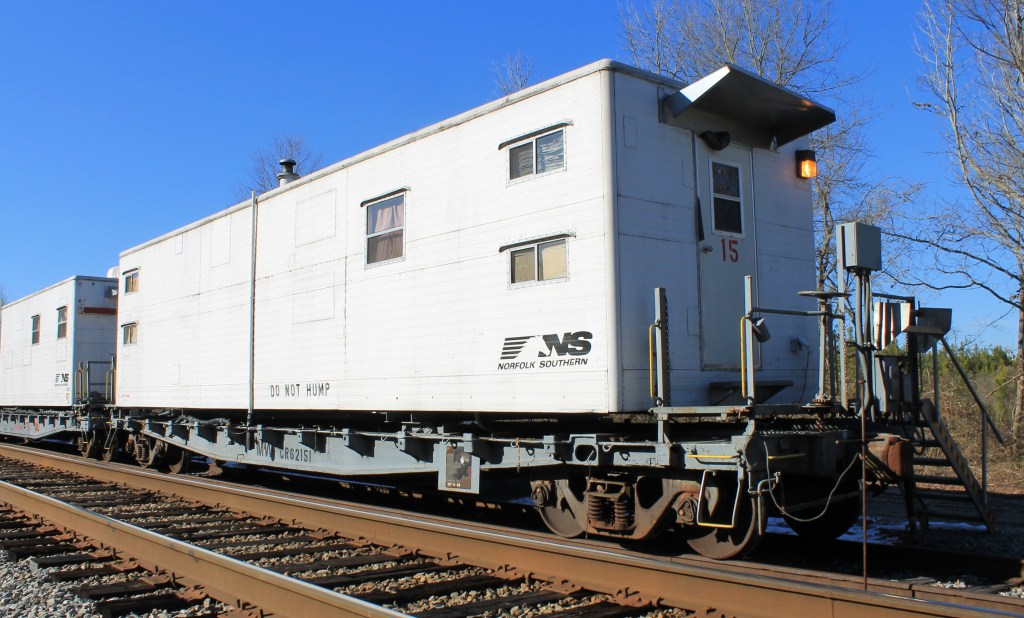
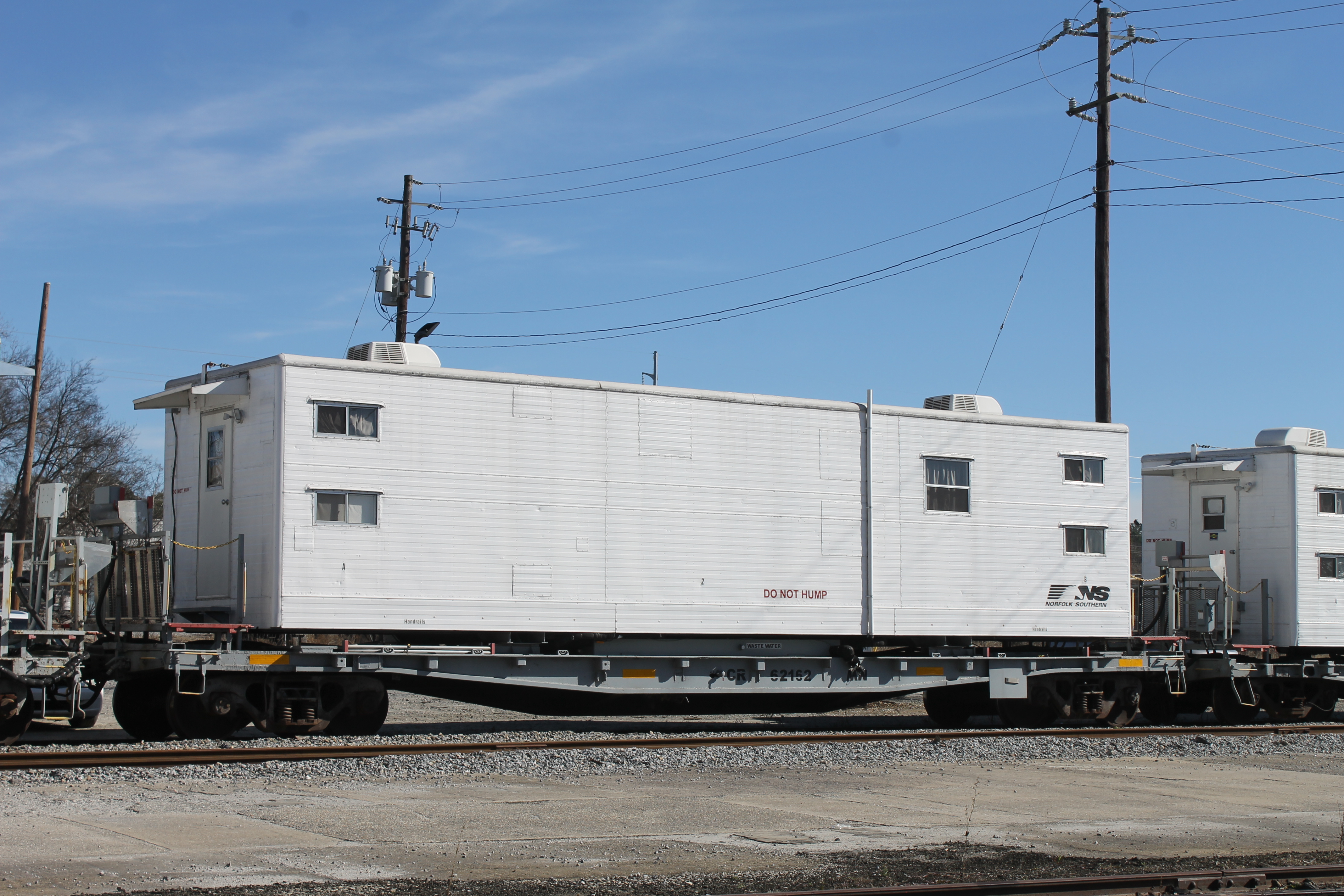
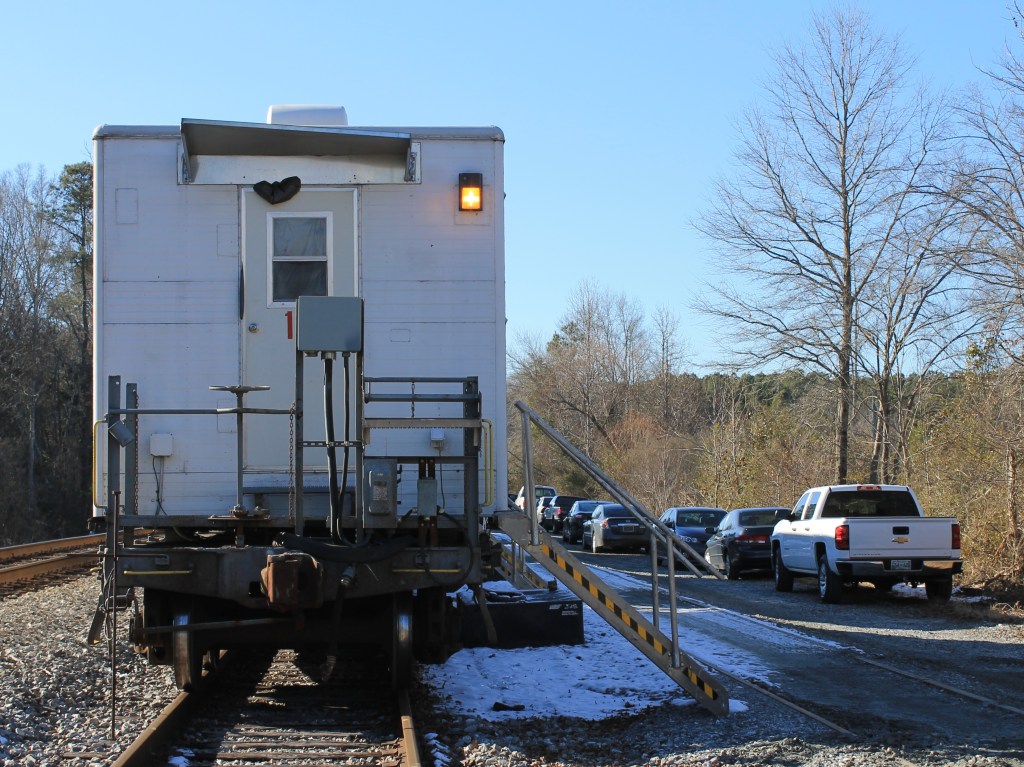
Occupying the remaining positions in the gang were the UNIVAN sleepers. By the 2000s, union work rules reduced the occupation size of these cars from six to four personnel. Stowable stairs were provided at each end of the camp car usually opposite the mainline side of the gang. The small windows represent the bunk locations, two stacked on each end. The common area is in the middle, adjacent to the shower stalls and basin area. The vertical pipe in the center is a breather vent for the drains.
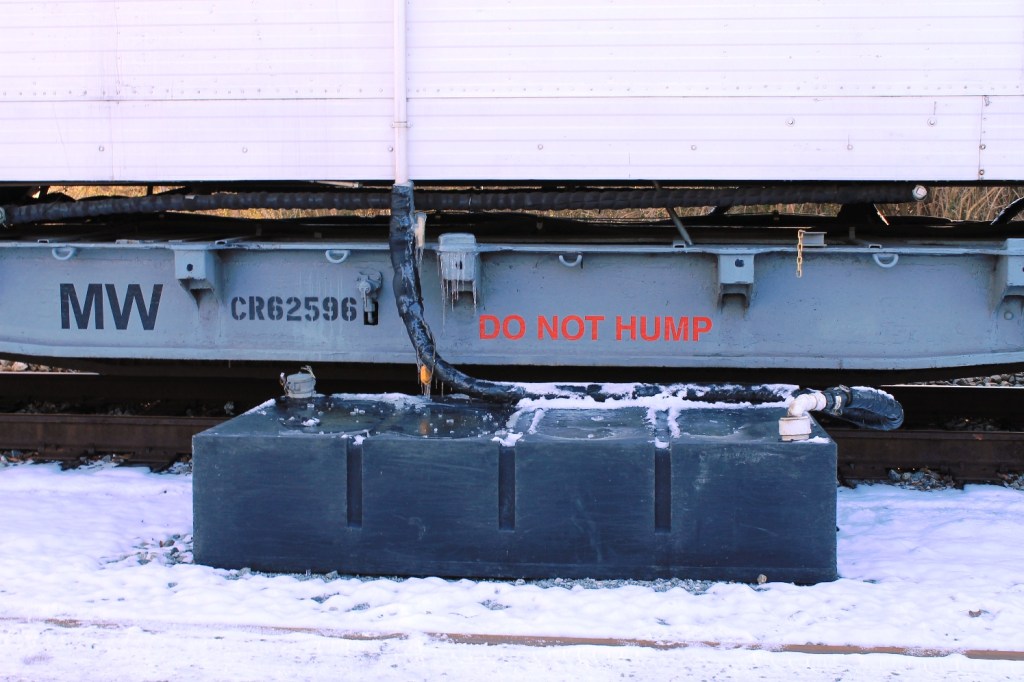
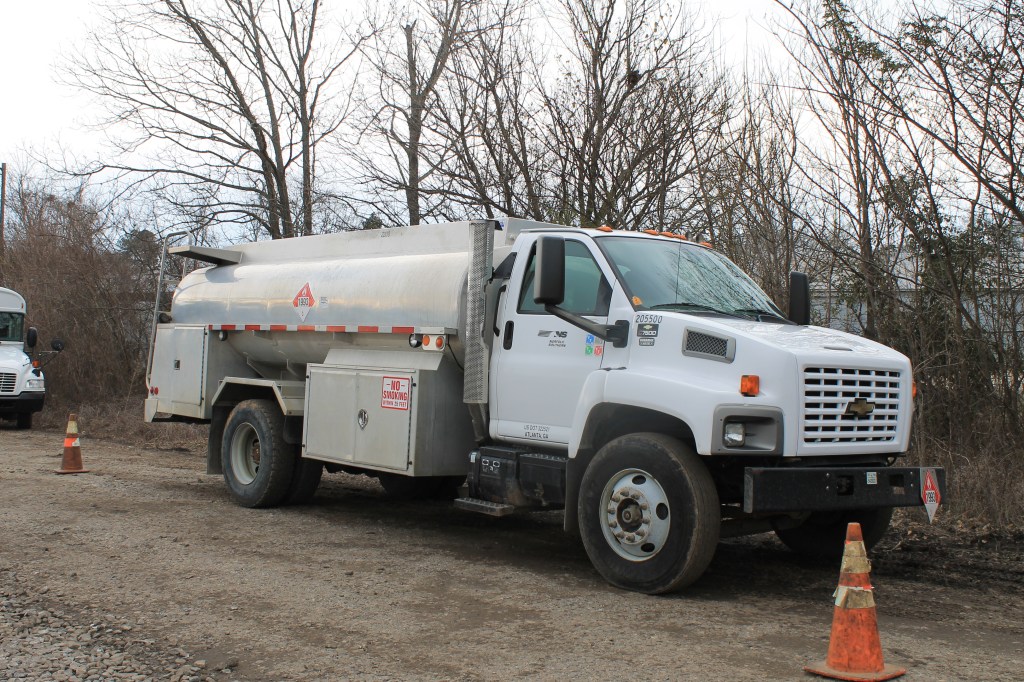
As noted earlier, toilet facilities were provided in the form of a row of portable toilets provided by a local contractor. These contractors usually removed the gray water generated by the showers and basins as well as maintaining the toilets. Gray water was collected in black holding tanks at each sleeper as seen above. During my time in the 1990s, gray water was usually dispatched onto the ground outside of the camp area via a long drain hose. Complaints by workers having to live with the dank smell of gray water running on the ground encouraged NS to capture the water and dispose of it properly. Potable water was pumped directly off contractor clean water tanker trucks moving water from a utility hydrant at the road. Trucks were filled, move to the camp cars and hooked directly to the potable water supply inlets. In most cases there is a camp car outfitted with pumps, pressure tanks and filters pulling directly from a pre-determined utility owned hydrant or water source. This eliminates all the manual water handling. R-11 was working short stints and being half a gang, hauled water so the camp could be closer to the work.
Gang transport flatcars on NS were a distinguished collection of cars dating all the way back to the 1920s. These cars were rebuilt multiple times to modern standards of the day, but since they never left home rails, remained in service far beyond the forty-year lifespan requirement of the FRA for interchangeable equipment. Cars ranged from pre -WW2 riveted 40ft flat cars to a nearly brand-new Kershaw Scorpion ramp car. Southern and later Norfolk Southern knew how to squeeze every penny of use in its operations and equipment. It saw little need to replace old cars that still labored reliably for the program and maintenance gangs.
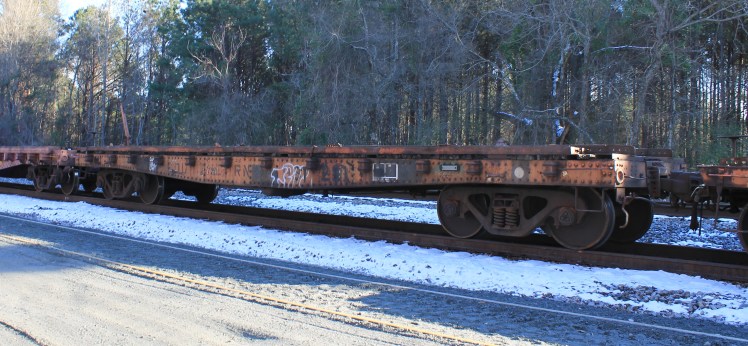
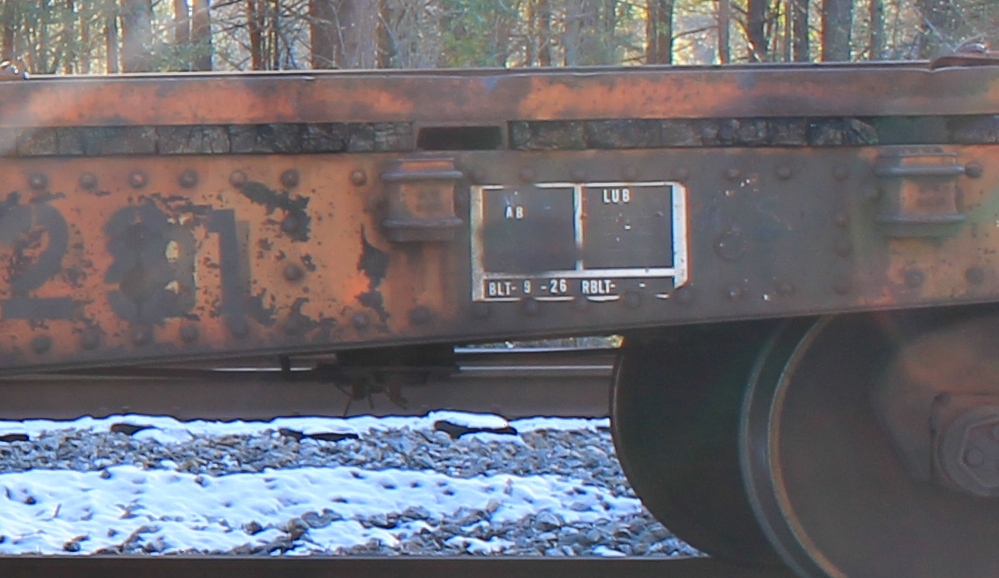
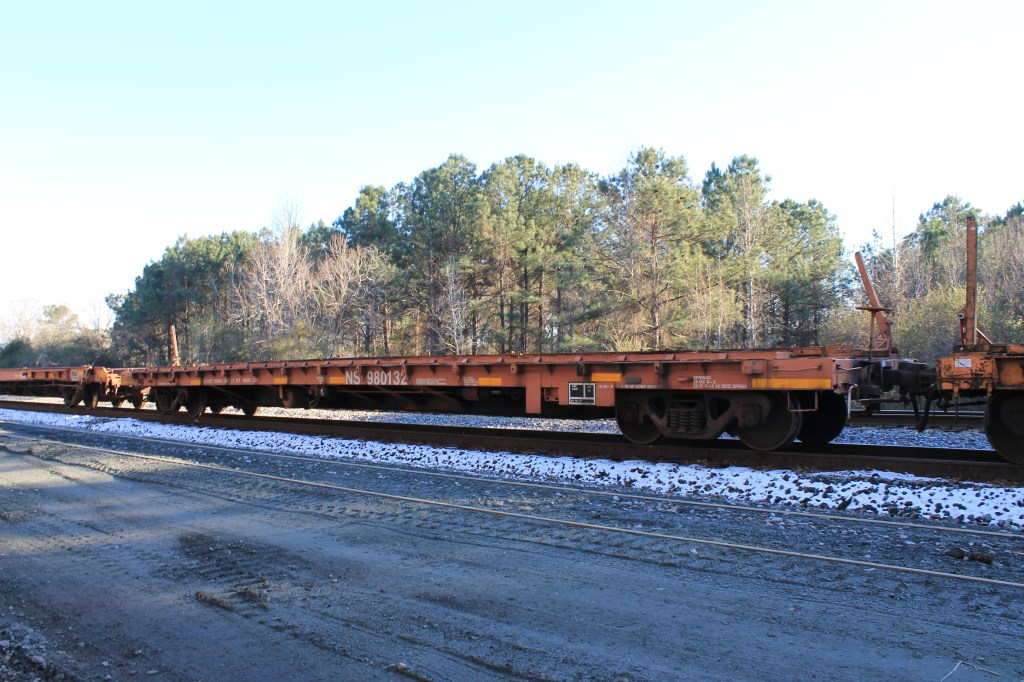
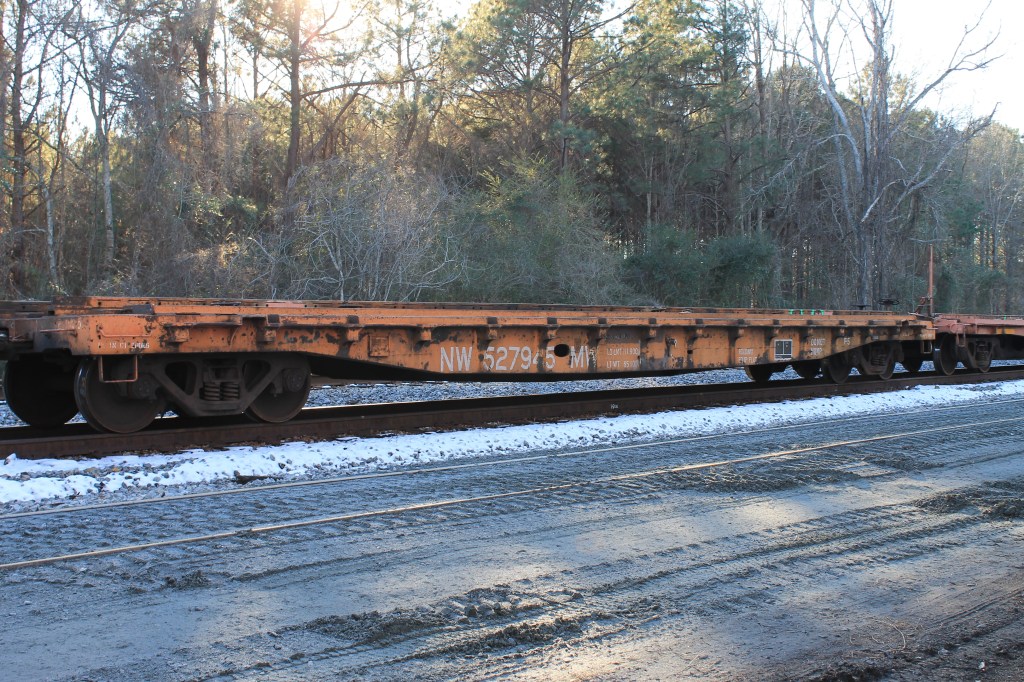
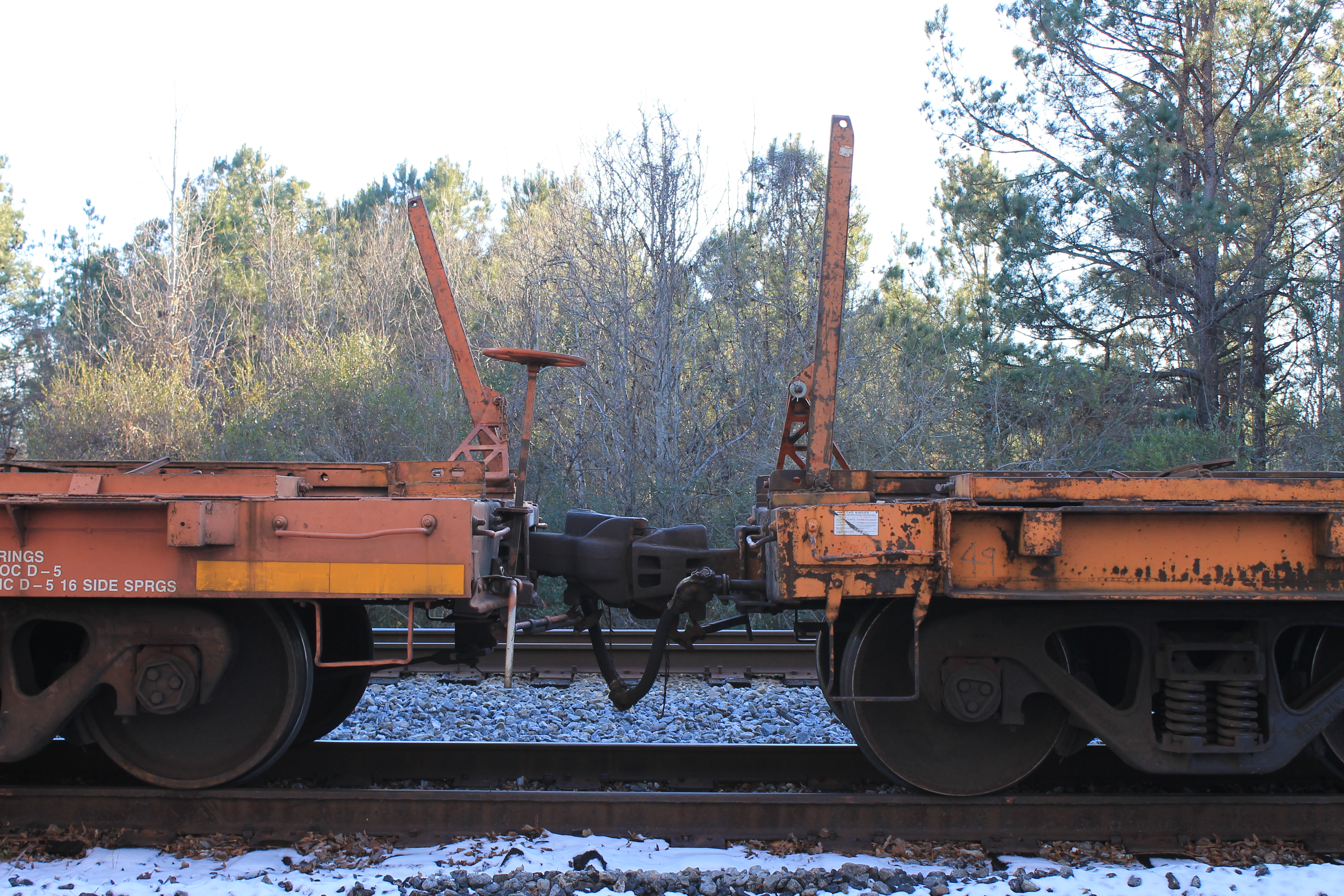

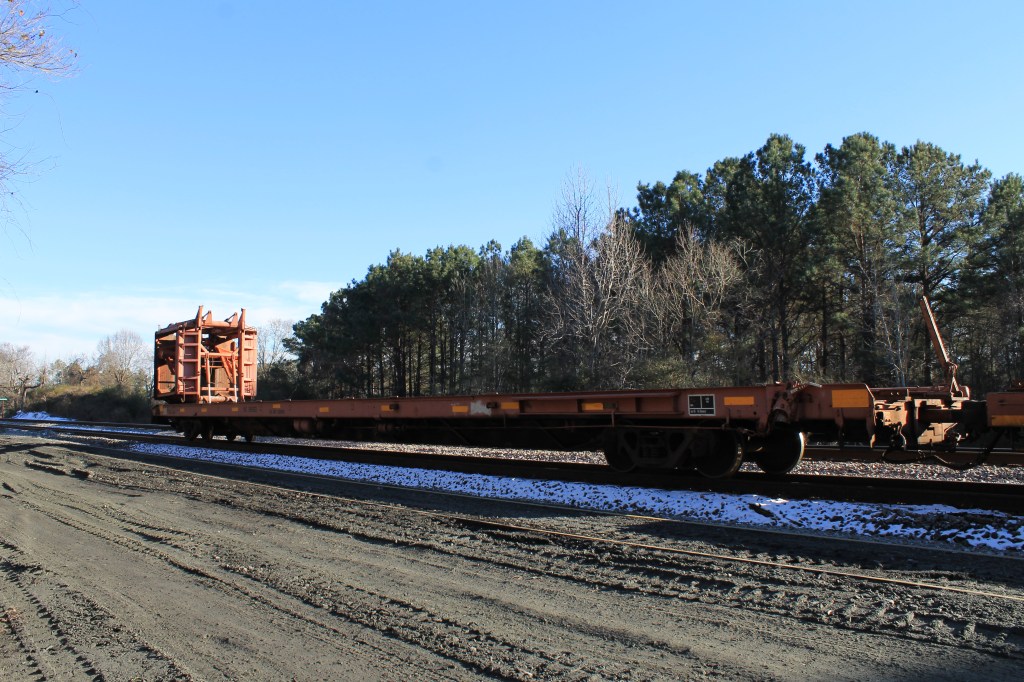
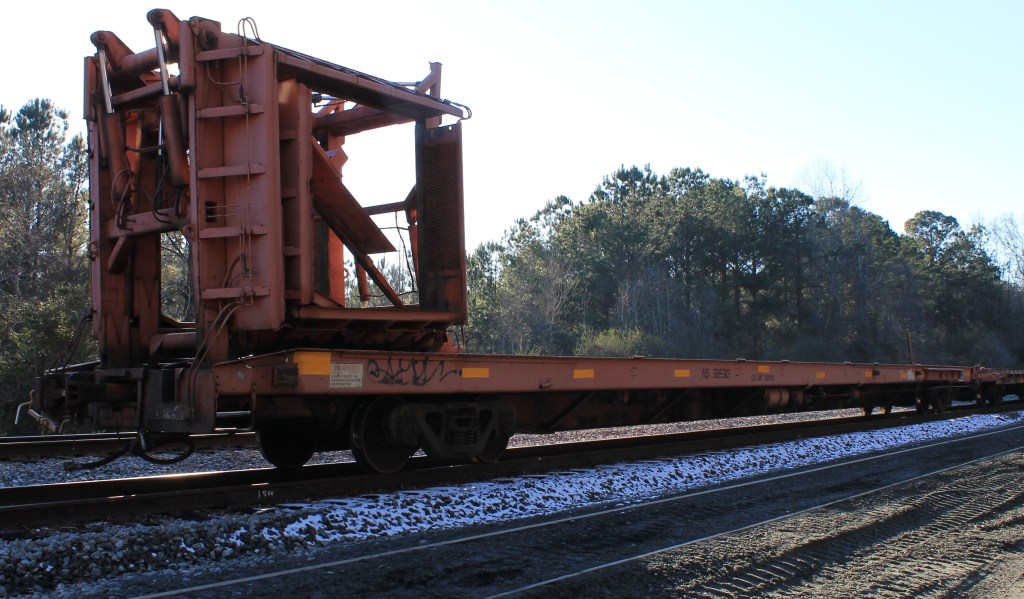
The new hydraulic powered Kershaw ramp car was a conundrum to me. In the 1990s, we had to piece together a ramp from collection of pieces stacked and chained to the rear flat car on the equipment transport train in order to load and unload machines. This loading exercise took most of a day to unpack the ramp pieces, assemble them in by hand, chain everything together so nothing moved during ramp use and finally load machines and equipment. The last machine up the ramp marked the beginning of the reverse process of disassembly, stow and securing its pieces on the end flat car so the train could be moved to the next work area. This did not include chaining every piece of equipment with a minimum of a four-point tie down system, nor having to return to the camp and break down access steps, hoses and electrical runs so drivers could move the camp. Production on these days was slim and sometimes none. The one interesting aspect of using the old built-up ramp in the 1990s was the gang bosses tried to avoid loading machinery at all costs due to the loss of a full day of production. Many times, we would start our last day breaking down the camp, finishing up any residual program work and traveling the whole gang as much as 50 miles on the mainline to the next work area. We then tied the gang down in a sidetrack and were ready to start production immediately at the next work shift. The camp would move during the production gap, usually on the weekend while we were home. While the old hats knew the campsite locations, I did not. I was always stressful driving hours to a new site and looking for the gang, hoping for a little rest in the bunk before the new workweek started at the crack of dawn.
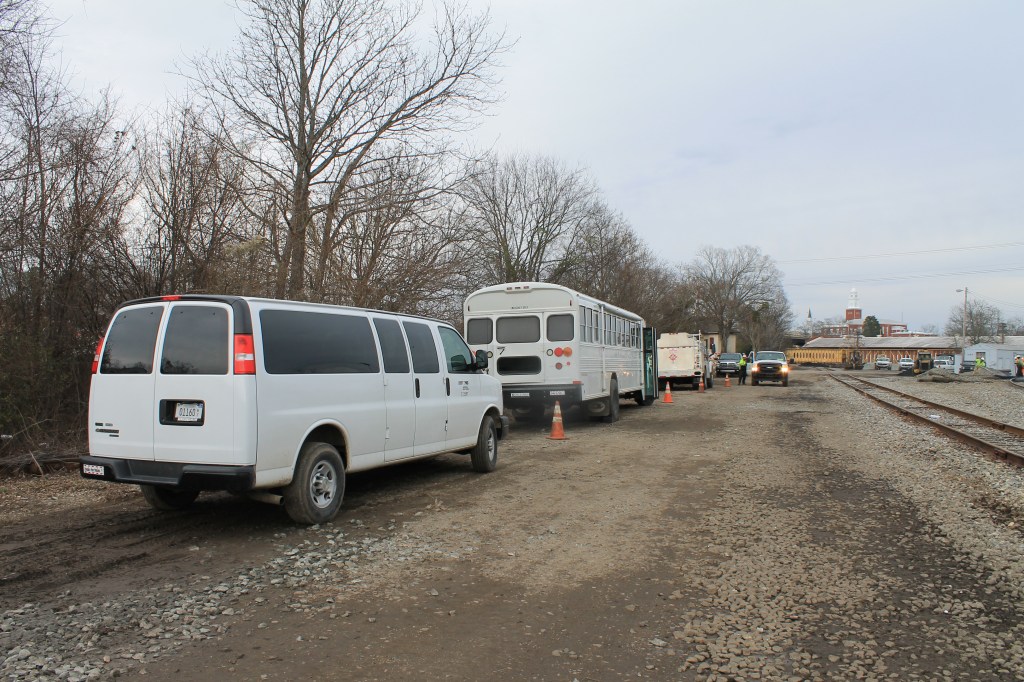
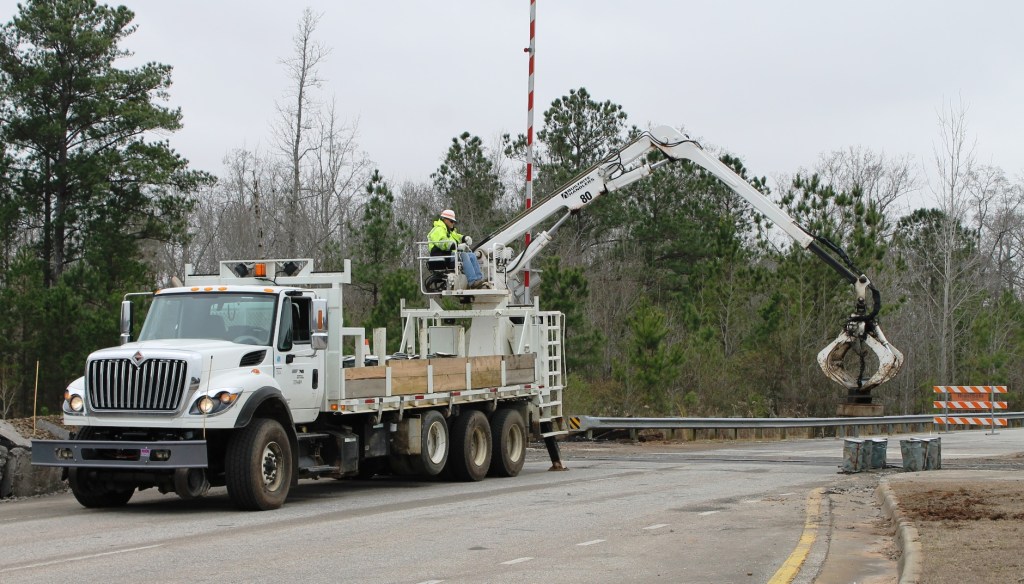
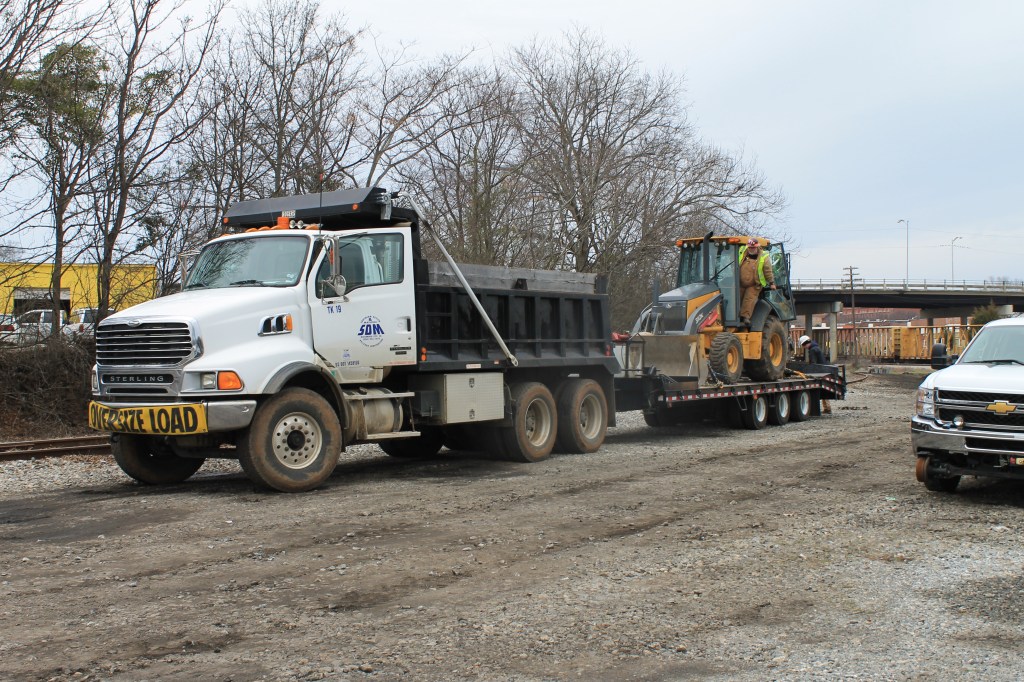
The Kershaw ramp is nothing more but a surplus intermodal flat that the railroad suppliers for Kershaw to mount its patented Scorpion Ramp assembly. The name comes from how it unrolls, similar to how a Scorpion rolls up its tail when moving. A small diesel engine mounted under the flatcar runs a hydraulic pump that powers the hydraulic pistons that unfurl the ramp. unfolds with the pull of a few levers, latches on to the rail automatically and is ready for use in less than an hour. The equipment could then immediately run the ramp and load onto the transport flats. This eliminated hours of hand building a loading ramp, eliminated the extra equipment and weight and literally revolutionized the flexibility of the gang transport trains. The ramp had rails flanked by wheel plates and could load both rail borne and rubber-tired vehicles. I watched a CSX gang load in less than two hours including tying down equipment on their transport flats. Since they camped in hotels, the need to break down camp was unnecessary. They were “one and done” at a blistering pace compared to what we faced on T&S 1 in the 1990s. CSX literally loads everything from the machines, to backhoes, grapple trucks, contractor dump trucks, trailers and even pickups, crew vans and buses. If the ramp is placed at a road crossing, everything can be unloaded at one and in the order to immediately begin production.
FINAL THOUGHTS
It should be noted that the R-11 curve rail gang featured in this article was actually part of a larger production rail gang that was split into two parts to do smaller work during the colder months. It was working at about 3/4 strength at the time. Additional components of the gang were held in temporary storage further up the line. Some parts were actually the shop location for NS MofW being repaired and retrofitted. The curve work would complete in just a few short weeks in the mild winter months in the South. Spring would see the full gang re-muster as a full-size program rail gang through the summer maintenance season.
I chose this gang in particular as it provides a minimalist overview of a modellable camp. If the modeler desires, gang machines and equipment can be staged or work nearby. Since the gang uses buses and vans to shuttle gang members to the worksite, it would not be uncommon to have just the camp sitting on a siding or house track. The transport flats may stay with the gang or be stored in a nearby yard or suitable siding until called up to load equipment. If the gang travels machines between worksites instead of loading them for train transport, the transport flats may be held in storage at a terminal yard or remote track. There would be no need to represent the transport train at all. A small camp like that used by R-11 could be all that indicates program maintenance work in the area. Another interesting model would be the loaded-up train with camp cars moving on the mainline to a off layout worksite. CSX and NS move these trains all over the system on a regular basis.
Western railroads that deal with remote sites often establish year around maintenance bases. Camps, equipment and personnel are stationed in the area during the maintenance season or year around. While the work and machines are pretty much aligned to standard practice, the camp cars and supporting rolling stock range in application and configuration. The temptation to save costs by repurposing old equipment is ever present. Adding the wrinkle of prototype freelancing as I plan to do, further blurs the defining lines of the what if not the standardized why or how.
In part two of this series, modeling a camp train and its equipment will be explored. But for now, if you have a relatively unused siding, house or yard track, consider adding a MofW camp train as a visual layout element. Proper detailing and configuration will add both visual and operational interest. Unlike the 1990s when I traded my railroad work for modeling, companies like Rapido, Custom Finishes, and many 3D printer storefronts offer a myriad of MofW subjects that create believable scenes that can enhance model railroad operations.
H in AL (AKA “Train Professor” on NS T&S 1 1991-1992)
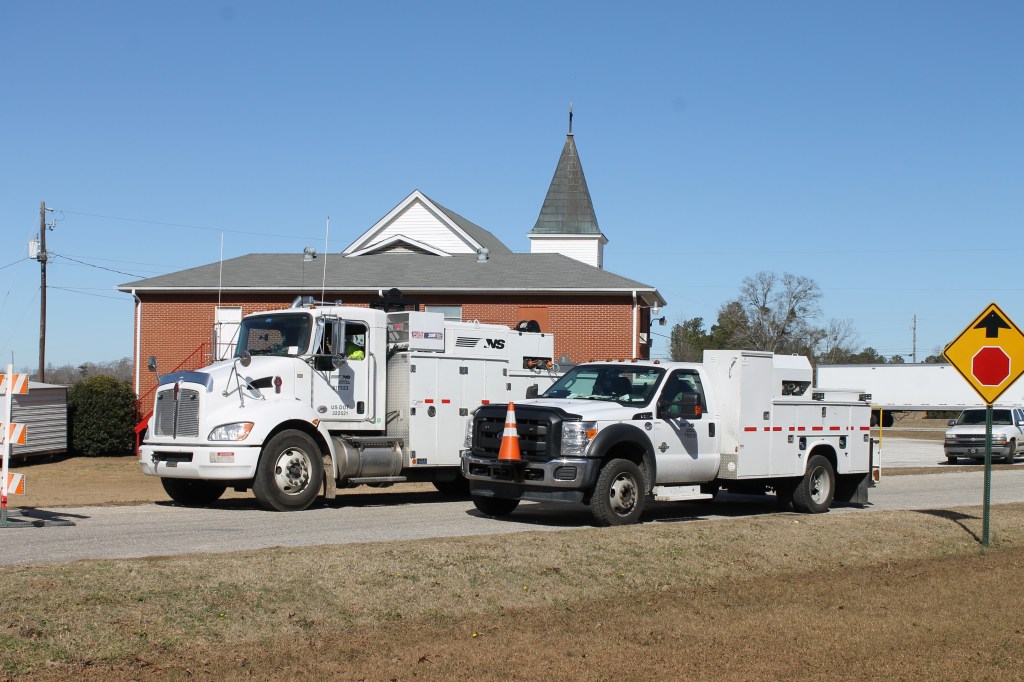
 Georgia Road Transportation