EARLY HISTORY
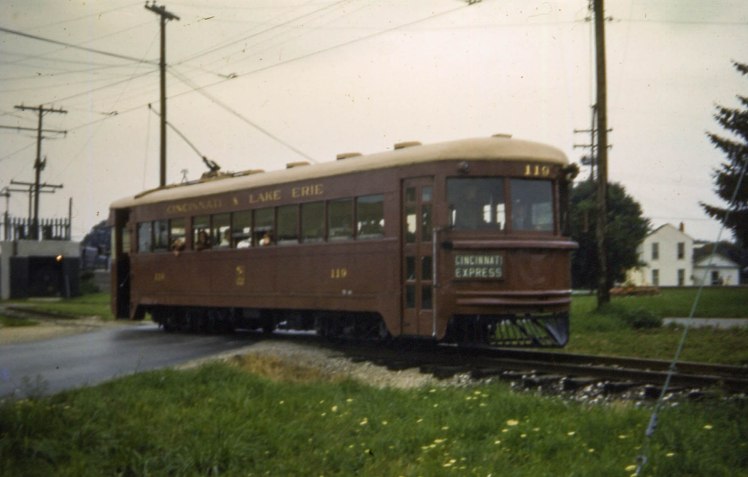
The Cincinnati and Lake Eire Railroad (CLE) found its roots in a midwestern interurban, legally formed as a corporate entity in January 1930, by the consolidation of three existing 1929 electric interurban lines: the Cincinnati, Hamilton, and Dayton (CH&D); the Indiana, Columbus and Eastern (IC&E); and the Lima-Toledo Railroad (LT). The combination of these three companies created an interurban system that operated a south-north line from Cincinnati through Dayton and Springfield to Toledo, and an east bound line from Springfield to Columbus, OH.

The reorganized railroad was directed by Dr. Thomas Conway, Jr., a professor of business at the University of Pennsylvania’s Wharton School of Business. Believing that he could turn the interurban into a very profitable passenger and freight operation by embracing the burgeoning automotive industry in the Midwest. During his leadership, the CLE made substantial investments in infrastructure and rolling stock, including passenger cars and freight locomotives. The interurban’s business and prospects improved as hoped, particularly in the movement of freight. In 1929, it handled 83,000 short tons (75,000 t) of freight in Cincinnati. Conway then contemplated the advantages of extending his railway north to Toledo, Ohio connecting to Detroit, OH where the CLE could tap the shipping business of the automotive industry. Conway expanded the CLE by acquiring the Indiana, Columbus and Eastern and the Lima-Toledo as the two teetered at the edge of bankruptcy. These acquisitions gave him the desired access to Toledo. In early January 1930, the three combined lines were officially incorporated as the Cincinnati and Lake Erie Railroad.
Conway had his new Cincinnati and Lake Erie enterprise issue $3.7 million in stock and $3.5 million in bonds and began an extensive 1930 round of infrastructure improvements and equipment purchases. The timing proved unfortunate as this extensive borrowing was added to the already large bond debt created by the previous purchases just as the United States entered the Great Depression. The requirement to make the large interest payments on these bonds burdened the railway’s normal operating expenses and caused the line to operate at a paper loss every year except 1936 into the years leading up to WW2. The CLE teetered on bankruptcy but managed to survive and operate due to the refinanced bond payments and increasing freight traffic as the war loomed. By the start of WW2, the company became a key route for war effort material, moving manufactured war materials to connecting roads for shipment overseas. The CLE totaled 323 miles in length and consisted of three operating divisions at the time. Company offices and the train dispatching center were located in Cincinnati, OH.
Part of Conway’s effort to rejuvenate the C&LE came during WW2, with war time demand allowing him to improve freight business and quickly add the new technology of diesel locomotives as like most railroads, the CLE was considered critical wartime infrastructure. Interurban traffic was sidelined for increasing capacity to move freight as light electric lines were upgraded for heavy freight moves. In some cases, these lines were moved out of city centers and reconfigured to prioritize freight service over its interurban roots. By the end of the war, the CLE was a more traditional freight and passenger railroad which was worn out with tired equipment. Post War traffic continued to be brisk as manufacturing switched back to domestic production. This allowed the CLE to rebuild its railroad and add the newest EMD and ALCO offerings of the time as the 1940s closed. The interurban passenger operations did not survive into the 1950s, as more traditional passenger trains took their place. The 1950s wore on, with Americans falling in love with cars and new interstate highways. CLE found itself tied permanently to the cycles of the automotive and manufacturing interests of the Rust Belt of the Midwest.
By the 1960s, the CLE was once again struggling as the automotive and steel industry entered the start of prolonged and systemic industry changes. Traffic was steadily being eroded by trucking and typical regional passenger operations were dragging the bottom line. Automotive, steel and coal traffic shifted through the 1960s and CLE experienced its share of booms and busts with the automotive industry on its lines. Passenger service was the first victim in CLE operations and the last scheduled trains ended in the late 1960s to save money and bolster its deteriorating financial outlook. The Staggers Act of 1972 allowed the railroad to re-organize and stave off bankruptcy for the second time in its existence by giving it freedom to set freight rates and abandon unprofitable trackage. It added the newest EMD, ALCO and GE locomotive offerings into the early 1970s to reduce operating costs. The long steel mill strikes of the late 1970s and the onset of import automobiles and steel closed many CLE served domestic OEM automotive supplier plants. The railroad survived through rationalizing the system, abandoning much of its unprofitable remaining interurban lines and acquiring former competitor Penn Central lines parred from the Staggers Act formation of Conrail. The CLE managed to hang on into the 1980s, but the once proud Class One of the early to mid-20th century was now a bare bone regional.
MODERN OPERATIONS
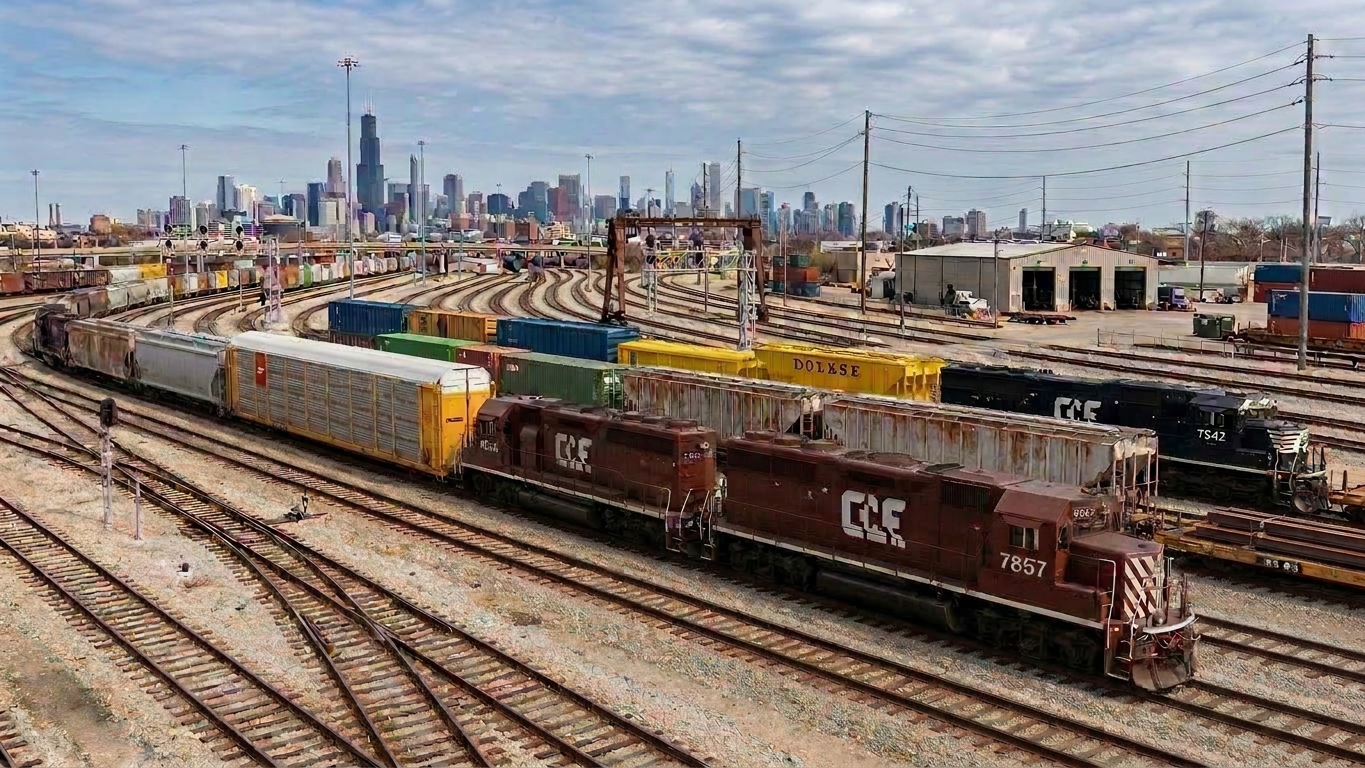
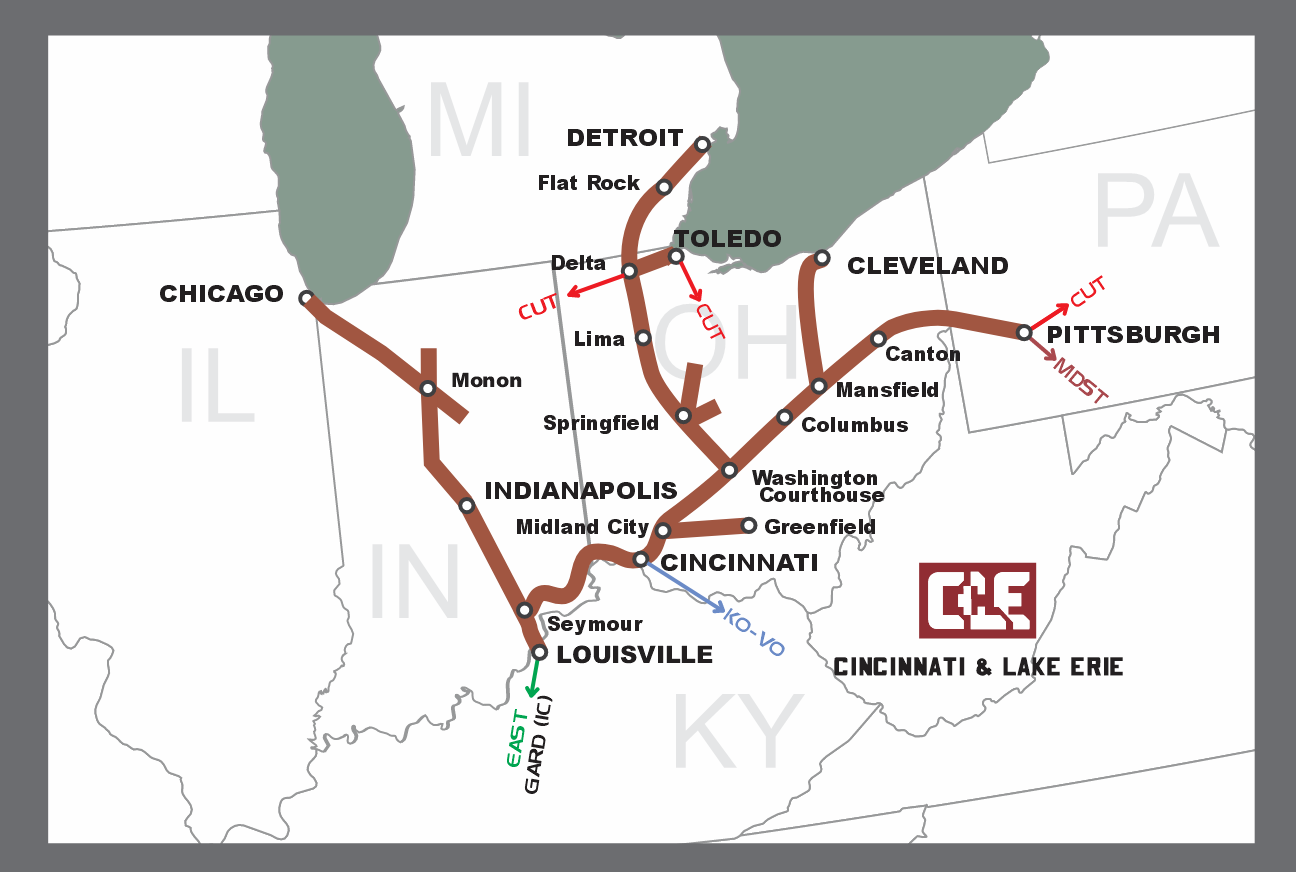
The modern CLE of the 1990s was the product of several line acquisitions that allowed it to bolster its sometime tedious traffic base. It added the remains of the Soo route to Louisville as the Canadian Pacific shed the less profitable portions of its American holdings in the late 1990s. It quickly increased its traffic by picking up branches and sections of former DT&I secondary main lines east of its name-sake Cincinnati, OH. CSX sold a significant portion of the old Monon route to CLE in the early 2000s. The result formed a modern regional that looked very different from the interurban roots it came from.
Traffic moved east-west using the old CP route into to the central Great Lakes region of the US and to Chicago by the early 2000s. With the auto industry in a decade long contraction, and the road worked to adjust its system to maintain profitably in the wake of traffic losses connected with the growing list of closed automotive plants on its remaining original interurban lines. CLE’s purchases of the former Monon and Soo lines gained Midwestern connections at Chicago, with ability to garner overhead traffic between Midwestern connections in Chicago to its ex-DT&I and ex-NW lines radiating east out of Cincinnati. Where its post war CLE system made a living hauling steel, automobiles and heavy manufactured goods originating on its own lines, the 21st century CLE worked to diversify its traffic base with coal, aggregate and overhead traffic in and out of the congested gateway at Chicago. Barge to rail ore trains occasionally moved from the Toledo Ore Docks (TORCO)to Gary, IN. Finished steel moved east and south as the CLE used its secondary routes to give customers an alternative way to move freight out of Chicago. It was a modestly profitable existence, but little was left over for capital improvement.
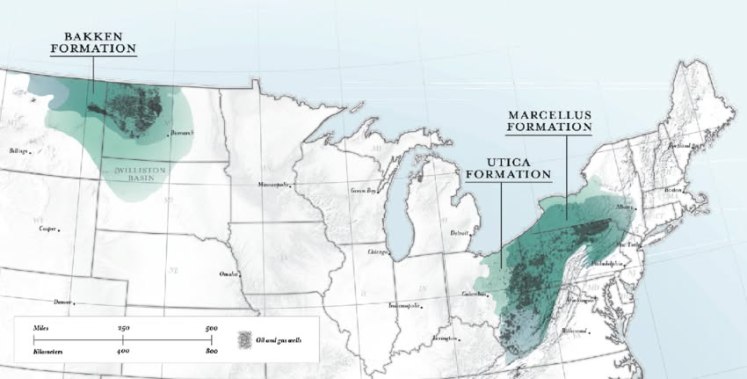
The recession of 2008-2009 proved a continued drain on the online customer base and the principal markets of automobile, steel, manufactured goods. Stricter standards on emissions also reduced coal moves fed off the former PAL, now reborn as the Eastern Gateway portion of the Gateway System, a Georgia Road subsidiary. It also managed to squeak out a living serving on-line customers and hauling sand for the oil shale boom that was quickly taking shape in the Marcellus Shale region in Pennsylvania. These sand moves entered the CLE at Louisville, KY off the Eastern Gateway from pits in Texas. Georgia Road trains moved the sand to Paducah, KY where the EAST moved it to the CLE interchange in Louisville.
The Cincinnati and Lake Erie Railroad was positioned in a unique area of the Midwest particular for automotive and petroleum sectors typically moving by rail. The railroad regularly moved Bakken oil trains from its interchange with Canadian railroads in the greater Chicago area as well as Marcellus Oil trains moving interchange partner Cumberland, Utica and Toledo Railroad. Much of this traffic moved southward toward refineries on the Gulf of Mexico Chemical Coast refineries and pipelines, through Georgia Road connections. This traffic was a godsend to the struggling regional, pulling it out of the financial red for the first time in many years.
Another bright spot as the depressed economy wore on into 2009 was the increase in overhead traffic moved by Georgia Road to the Northeast via the CLE connections with the Cumberland, Utica and Toledo Railroad (CU&T). This traffic consisted mainly of automobile traffic from foreign automakers in Mexico and the Deep South as increasing intermodal moves. Oil and gas traffic surged as fracking made the oil shale regions profitable again. Traffic consisted of fracking sand going north, with crude moving south. The increase in crude trains proved a boom and a bane for the railroad. As base traffic recovered from the depths of the recession, crude oil and sand moves increase. CU&T moved crude and LPG trains from loading points along the Marcellus Field in Pennsylvania to the CLE who then forwarded them to the Georgia Road to reach Gulf refineries and ports. CP also pitched the occasional Bakken crude train from Canada via Chicago to the CLE, which forwarded it to Georgia Road connections down South.
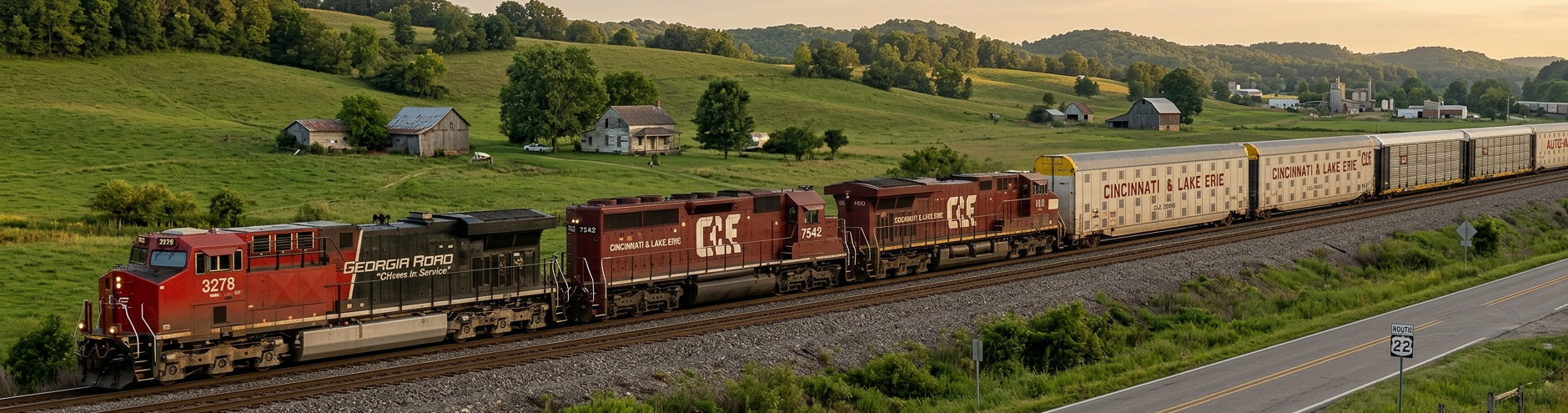
The deferred maintenance from the recession years coupled with the increase in traffic caused concern, with a jump in costly derailments. CLE lacked the capital to fully rebuild its infrastructure to levels needed to handle the spike in heavy unit crude trains. Locomotive road failures were also common as the CLE attempted to operate with a fleet that was aging and tired, most of which dated back to the early 1970s and 1980s. While CLE did manage to add a few newer examples of locomotion from EMD in the 1990s such as EMD SD60s and GE Dash 9s. These purchases were stop-gap measures to finally remove the oldest minority builder ALCOs and oldest EMD Geeps. However, a handful of new units could not offset a roster with the majority pushing 40 years old with only minimal maintenance and no capital rebuilding. (CLE was forced to close its original and only backshop at Dayton, OH in the 1980s to reduce costs). Rolling stock fleets were in even worse shape. CLE relied on a fleet of second-hand ex-Rock Island equipment garnered from the dying railroad in the late 1980s and. By 2000, many of these cars were already approaching service life limits or were in bad need of refurbishment. As with the minimal locomotive purchases of the time, whenever a little cash was on-hand, CLE dabbled in rolling stock upgrades to support its core customers with highly leveraged loans. In short, the CLE was holding its own but by no means making a dazzling show through the 1990s. Talk of merger or buyout keep the rumor mill grinding, but the few offers disappeared when the true shallow financial condition was realized by potential suitors.
CLE managed to stay mostly ahead of an FRA mandated embargo on its crude trains through the early 2000s by minimally maintaining its key crude routes as best it could. This all changed when US-based regional Canadian Atlantic RailRoad (CDAC) regional railroad mis-handled a crude train resulting in the complete destruction of downtown Lac-Magantic, Quebec- CANADA. The impeding investigation found the poorly run CDAC was not properly maintaining its track, equipment or operations to required FRA minimum standards when handling hazardous material and was deemed the blatant instigator of the accident.
The publicity and loss of life caused by the CDAC accident put all facets of crude train operation in the spotlight, especially on smaller regionals. The FRA promised to invoke not only new tank car standards, but guidelines for the track structure and handling of the trains. It was clear to the independent CLE it lacked the resources to cope with the new requirements on its crude and sand traffic. To make matters worse, the CLE stop-gap approach to operating the railroad immediately raised concern as the railroad lacked the physical plant, motive and railcar requirements to support the new standards the FRA planned to implement. Failure to comply would summarily result in the lucrative traffic being banned for failure to maintain these minimum standards. Loss of crude traffic would force the CLE into bankruptcy it managed to tenaciously dodge so many times in its history. Attempts to gain needed additional loans and capital investment proved lackluster due to the already highly leveraged nature of the railroad’s finances.
With no place to turn, CLE threw itself at the mercy of its two primary interchange partners for help. This was the Cumberland, Utica & Toledo RR (CU&T) to the north and the Georgia Road (former IC lines) to the South. The three railroads mulled several potential outcomes, and in 2015 the CLE was purchased as a joint but independent subsidiary of the CU&T and Georgia Road. Georgia Road provided 55 percent of the financing with CU&T picking up the other 45 percent. The plan included significant investment to bring the foundering CLE up to modern 286K standards. The main connecting lines between the Georgia Road in the South to the CU&T in the north were rebuilt with high ballast, new ties, and CWR rail. Key bridges were replaced or reworked, and terminals were streamlined to allow seamless traffic between Louisville and Chicago as wells as Cincinnati to Pittsburg via Detroit. New motive power was transferred by both CU&T and Georgia Road with the roster quickly modernized by replacing or rebuilding now aging EMD and GE second generation power CLE was forced to rely on during its final independent years.

A steady stream of Crude trains could now polish upgraded rails and new automotive trains worked new mixing and distribution yards built to service the changing automotive industry. Existing steel and heavy manufacturing segments were bolstered with new equipment, allowing CLE operations to expand and capture traffic it lost. The CLE was finally realizing its potential as a regional bridge line between its Georgia Road and Cumberland, Utica and Toledo owners. The CLE opened capacity eastward and southward out of Chicago to interchanges at Cincinnati and Pittsburg. Deep South foreign OEM automakers established their own logistics chains into the Midwest, fed through Louisville into the Great Lakes Region. CP Bakken Crude trains regularly used the CLE to relieve its own congested routes into the Northeast. CU&T could reliably move its Marcellus Oil and Gas traffic to CLE connections to the Georgia Road for movement to Gulf States refineries.