
In the modern railroad era, the requirement of spacer cars between locomotive power and hazardous materials railcars in a train consist is absolute. This rule attempts to guarantee minimum crew safety in case of derailment and removes a potential ignition source by separating operating locomotive exhaust from potential combustive materials railcars located directly behind the locomotive. In most cases, sparks and heat from locomotive exhaust reduces exponentially in minimum distances and also lessens ignition of vapors that might be venting on the hazardous cars.
Railroads have always been an economical transportation mode for crude oil and gas in tank cars. In recent years, unit ethanol and LPG trains have joined the mix of petrochemical traffic. Much of this product stream handled by railroads now operates in unit train movements. The result is a need for a fleet of cars to maintain the FRA spacing and buffer requirements for these trains. While the tank cars are usually privately owned, the space buffer cars are generally provided by one or more of the railroads handling the unit trains. The very minimum requirement of a suitable buffer car is a gondola or covered hopper spaced between the locomotives and the tank cars. Where DPU power is required in modern post 2000s era operations, these units also have space away from actual cars by a minimum of one car. Use of empty cars as buffers is allowed, but placing empty cars at the head of extremely heavy unit trains increases the potential of derailment due to strain of the lighter, empty car. As a result, the FRA mandated spacer or buffer cars for unit tank trains must have a non-hazardous load of inert weight to maintain traction to weight integrity. BNSF was an early example of creating use specific buffer cars for is growing unit crude oil train business. It pulled surplus airside covered hoppers built in the 1970s earmark them for “Buffer Service” primarily for its unit tank trains. These cars had their bottom pneumatic discharge outlets sealed and the car was fully loaded with inert sand to increase the weight of the car to reduce loading forces experienced by light empty cars coupled in front of a heavy loaded train. BNSF minimally re-stenciled these cars for their intended service.
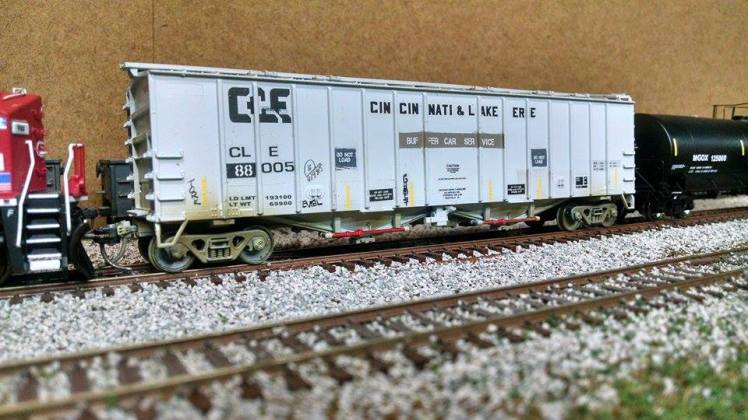
The Cincinnati & Lake Erie Railroad saw the advent of unit crude traffic originating from the Canadian Pacific (CP) at Chicago, IL and the Cumberland, Utica and Toledo Railroad (CU&T) in the early 2000s as a new form of horizontal drilling and shale fracking allowed profitable extraction of oil and natural gas out of the shale oil regions of the Bakken (Dakotas and Canada) and the Utica and Marcellus oil fields in Pennsylvania. Buffer cars moved long distances with their assigned trains, and availability tended to be spotty during surges in business. As a result, CLE mimicked BNSF by pulling surplus and obsolete two bay pneumatic air slide covered hoppers and reworking them for crude oil train buffer service. These cars had their outlets sealed and pneumatics removed. The car was then filled with inert sand to increase weight. Early cars were only minimally re-stenciled much like the BNSF examples.
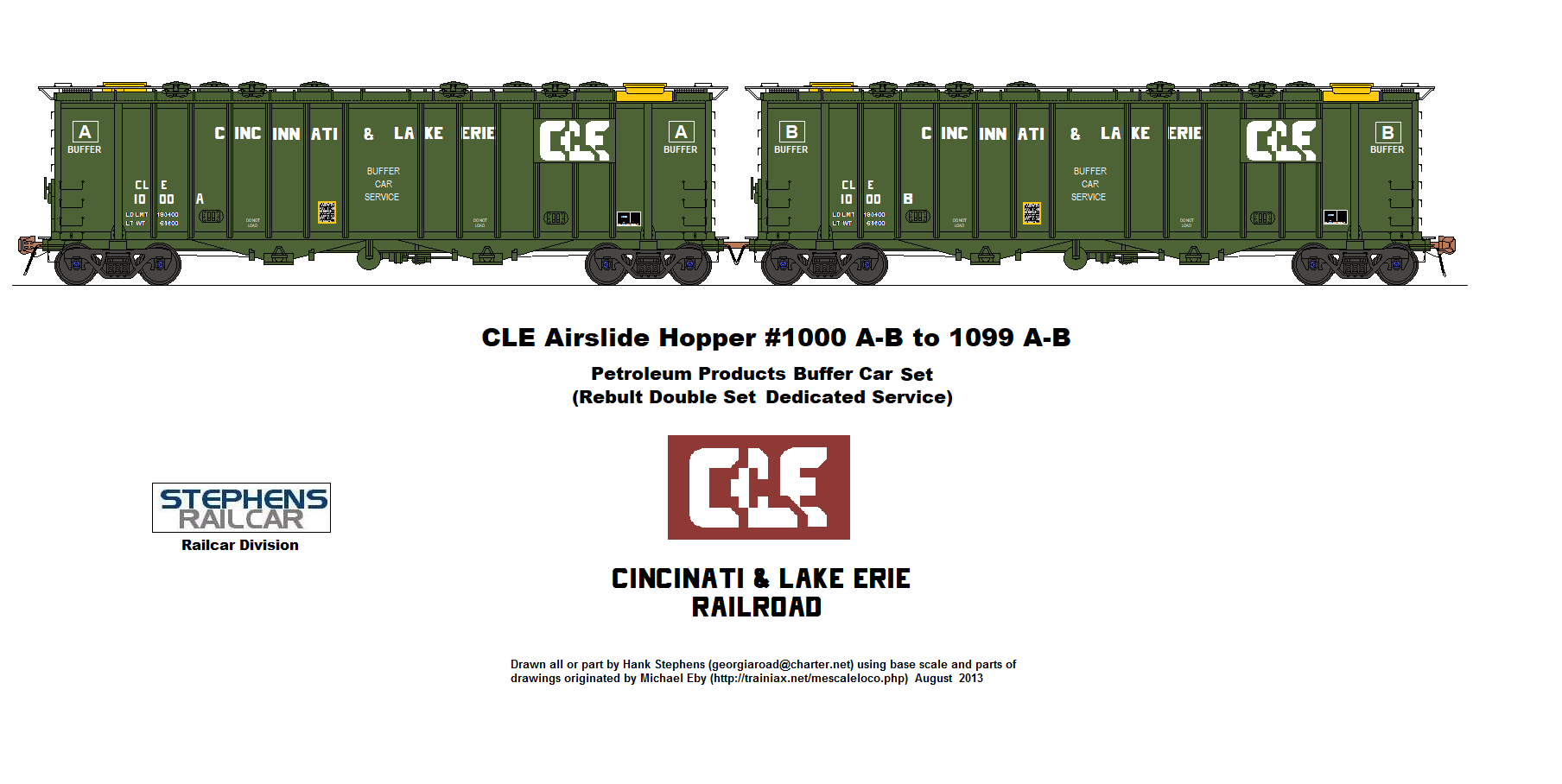
As the late 1990s moved into the 2000s, minimum requirements for single buffer cars were changed to a recommended two car buffer set. This change, along with the upgraded requirements of tank cars in crude and ethanol service, was predicated by a series of nasty derailments in the early 2000s. CLE, ever looking for revenue streams, purchased additional air slide cars with the idea of leasing them in the open market as a standardized FRA compliant buffer car option for railroads and shippers. GATX was at the time replacing its remaining air slide fleet with modern larger capacity pressure differential cars. Many of these cars had been semi-permanently linked with drawbars to create a higher capacity single car to extend their service life in flour and dry powder service. The two car sets were perfect for the new FRA recommended two car buffer configuration specification. CLE converted the cars and went as far as repainting the units in a dark green scheme featuring the service. These units were numbered in the 1000-1099 series and joined the CLE buffer car fleet.
 Georgia Road Transportation